Facebook Instagram Youtube Twitter

What is Lanthanum – Properties of Lanthanum Element – Symbol La

What is Lanthanum

Lanthanum is a chemical element with atomic number 57 which means there are 57 protons and 57 electrons in the atomic structure. The chemical symbol for Lanthanum is La.

Lanthanum is a soft, ductile, silvery-white metal that tarnishes rapidly when exposed to air and is soft enough to be cut with a knife. It is the eponym of the lanthanide series, a group of 15 similar elements between lanthanum and lutetium in the periodic table, of which lanthanum is the first and the prototype. It is also sometimes considered the first element of the 6th-period transition metals and is traditionally counted among the rare earth elements.
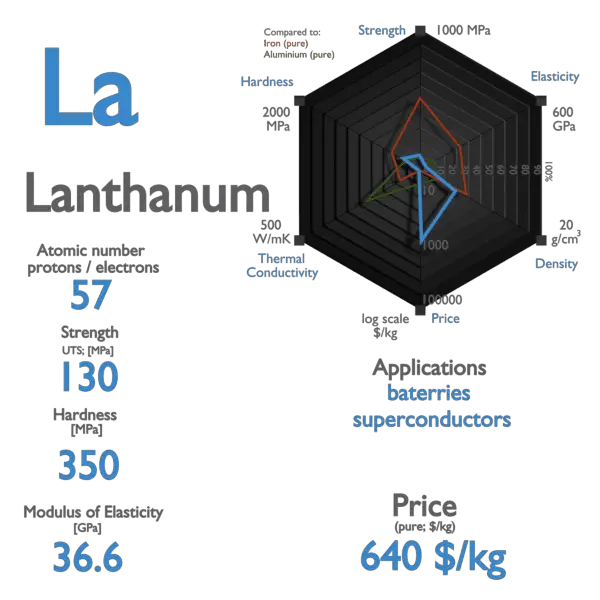
Lanthanum - Properties

Lanthanum – Properties

Element Lanthanum
Atomic Number 57
Symbol La
Element Category Rare Earth Metal
Phase at STP Solid
Atomic Mass [amu] 138.9055
Density at STP [g/cm3] 6.146
Electron Configuration [Xe] 5d1 6s2
Possible Oxidation States +3
Electron Affinity [kJ/mol] 48
Electronegativity [Pauling scale] 1.1
1st Ionization Energy [eV] 5.577
Year of Discovery 1839
Discoverer Mosander, Carl Gustav
Thermal properties
Melting Point [Celsius scale] 920
Boiling Point [Celsius scale] 3454
Thermal Conductivity [W/m K] 13
Specific Heat [J/g K] 0.19
Heat of Fusion [kJ/mol] 6.2
Heat of Vaporization [kJ/mol] 414

See also: Properties of Lanthanum

Atomic Mass of Lanthanum

Atomic mass of Lanthanum is 138.9055 u. 

Note that, each element may contain more isotopes, therefore this resulting atomic mass is calculated from naturally-occuring isotopes and their abundance.

The unit of measure for mass is the atomic mass unit (amu). One atomic mass unit is equal to 1.66 x 10⁻²⁴ grams. One unified atomic mass unit is approximately the mass of one nucleon (either a single proton or neutron) and is numerically equivalent to 1 g/mol.

For 12C, the atomic mass is exactly 12u since the atomic mass unit is defined from it. The isotopic mass usually differs for other isotopes and is usually within 0.1 u of the mass number. For example, 63Cu (29 protons and 34 neutrons) has a mass number of 63, and an isotopic mass in its nuclear ground state is 62.91367 u.

There are two reasons for the difference between mass number and isotopic mass, known as the mass defect:

  1. The neutron is slightly heavier than the proton. This increases the mass of nuclei with more neutrons than protons relative to the atomic mass unit scale based on 12C with equal numbers of protons and neutrons.
  2. The nuclear binding energy varies between nuclei. A nucleus with greater binding energy has lower total energy, and therefore a lower mass according to Einstein’s mass-energy equivalence relation E = mc2. For 63Cu, the atomic mass is less than 63, so this must be the dominant factor.

See also: Mass Number

Density of Lanthanum

Density of Lanthanum is 6.146g/cm3.
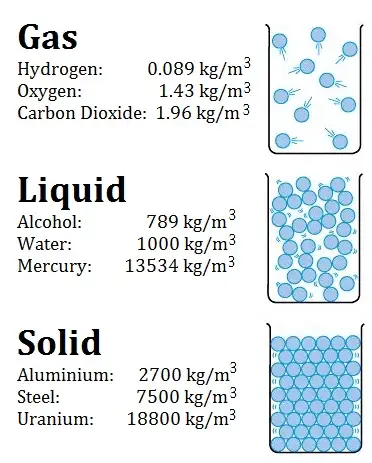
Density - Gas - Liquid - Solid

Typical densities of various substances at atmospheric pressure.

Density is defined as the mass per unit volume. It is an intensive property, which is mathematically defined as mass divided by volume:

ρ = m/V

In other words, the density (ρ) of a substance is the total mass (m) of that substance divided by the total volume (V) occupied by that substance. The standard SI unit is kilograms per cubic meter (kg/m3). The Standard English unit is pounds mass per cubic foot (lbm/ft3).

See also: What is Density

See also: Densest Materials of the Earth
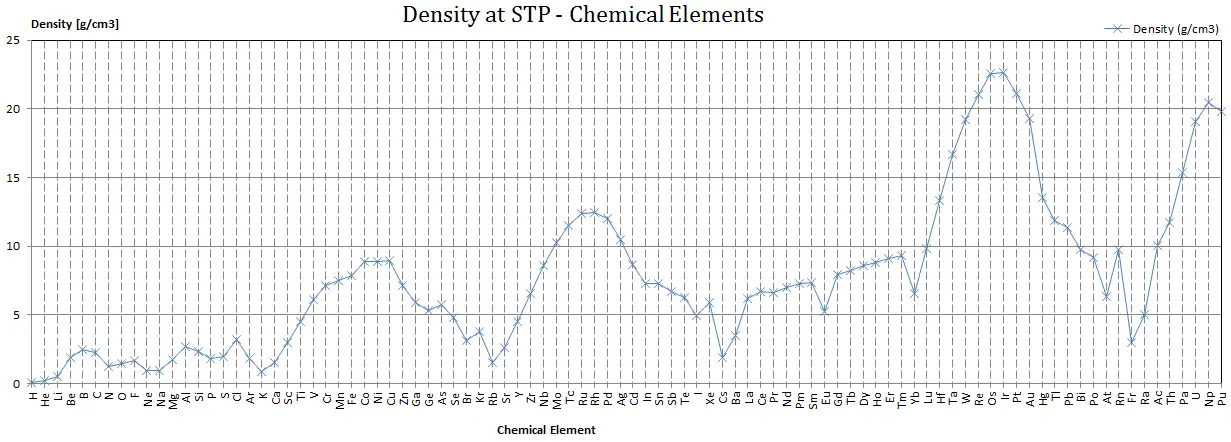
density - chemical elements

Electron Affinity and Electronegativity of Lanthanum

Electron Affinity of Lanthanum is 48 kJ/mol.

Electronegativity of Lanthanum is 1.1.

Electron Affinity

In chemistry and atomic physics, the electron affinity of an atom or molecule is defined as:

the change in energy (in kJ/mole) of a neutral atom or molecule (in the gaseous phase) when an electron is added to the atom to form a negative ion.

X + e– → X– + energy        Affinity = – ∆H

In other words, it can be expressed as the neutral atom’s likelihood of gaining an electron. Note that ionization energies measure the tendency of a neutral atom to resist the loss of electrons. Electron affinities are more difficult to measure than ionization energies.

An atom of Lanthanum in the gas phase, for example, gives off energy when it gains an electron to form an ion of Lanthanum.

La + e– → La–        – ∆H = Affinity = 48 kJ/mol

To use electron affinities properly, it is essential to keep track of signs. When an electron is added to a neutral atom, energy is released. This affinity is known as the first electron affinity, and these energies are negative. By convention, the negative sign shows a release of energy. However, more energy is required to add an electron to a negative ion which overwhelms any release of energy from the electron attachment process. This affinity is known as the second electron affinity, and these energies are positive.

Affinities of Nonmetals vs. Affinities of Metals

  • Metals: Metals like to lose valence electrons to form cations to have a fully stable shell. The electron affinity of metals is lower than that of nonmetals. Mercury most weakly attracts an extra electron.
  • Nonmetals: Generally, nonmetals have more positive electron affinity than metals. Nonmetals like to gain electrons to form anions to have a fully stable electron shell. Chlorine most strongly attracts extra electrons. The electron affinities of the noble gases have not been conclusively measured, so they may or may not have slightly negative values.

Electronegativity

Electronegativity, symbol χ, is a chemical property that describes the tendency of an atom to attract electrons towards this atom. For this purpose, a dimensionless quantity, the Pauling scale, symbol χ, is the most commonly used.

The electronegativity of Lanthanum is:

χ = 1.1

In general, an atom’s electronegativity is affected by both its atomic number and the distance at which its valence electrons reside from the charged nucleus. The higher the associated electronegativity number, the more an element or compound attracts electrons towards it.

The most electronegative atom, fluorine, is assigned a value of 4.0, and values range down to cesium and francium, which are the least electronegative at 0.7.
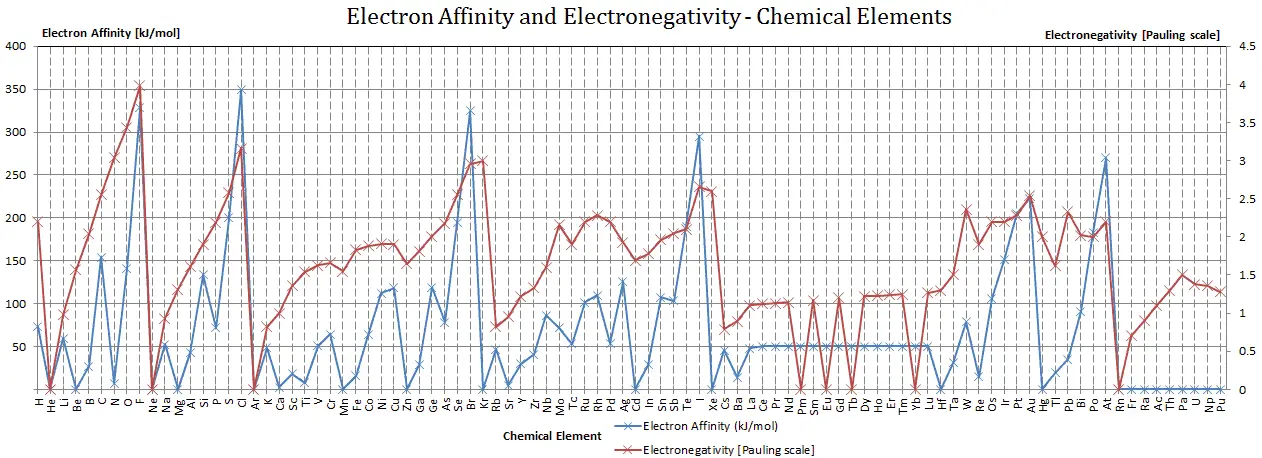
electron affinity and electronegativity

First Ionization Energy of Lanthanum

First Ionization Energy of Lanthanum is 5.577 eV.

Ionization energy, also called ionization potential, is the energy necessary to remove an electron from the neutral atom.

X + energy → X+ + e−

where X is any atom or molecule capable of being ionized, X+ is that atom or molecule with an electron removed (positive ion), and e− is the removed electron.

A Lanthanum atom, for example, requires the following ionization energy to remove the outermost electron.

La + IE → La+ + e−        IE = 5.577 eV

The ionization energy associated with removal of the first electron is most commonly used. The nth ionization energy refers to the amount of energy required to remove an electron from the species with a charge of (n-1).

1st ionization energy

X → X+ + e−

2nd ionization energy

X+ → X2+ + e−

3rd ionization energy

X2+ → X3+ + e−

Ionization Energy for different Elements

There is ionization energy for each successive electron removed. The electrons that circle the nucleus move in fairly well-defined orbits. Some of these electrons are more tightly bound in the atom than others. For example, only 7.38 eV is required to remove the outermost electron from a lead atom, while 88,000 eV is required to remove the innermost electron. Helps to understand the reactivity of elements (especially metals, which lose electrons).

In general, the ionization energy increases moving up a group and moving left to the right across a period. Moreover:

  • Ionization energy is lowest for the alkali metals, which have a single electron outside a closed shell.
  • Ionization energy increases across a row on the periodic maximum for the noble gases which have closed shells.

For example, sodium requires only 496 kJ/mol or 5.14 eV/atom to ionize it. On the other hand, neon, the noble gas, immediately preceding it in the periodic table, requires 2081 kJ/mol or 21.56 eV/atom.
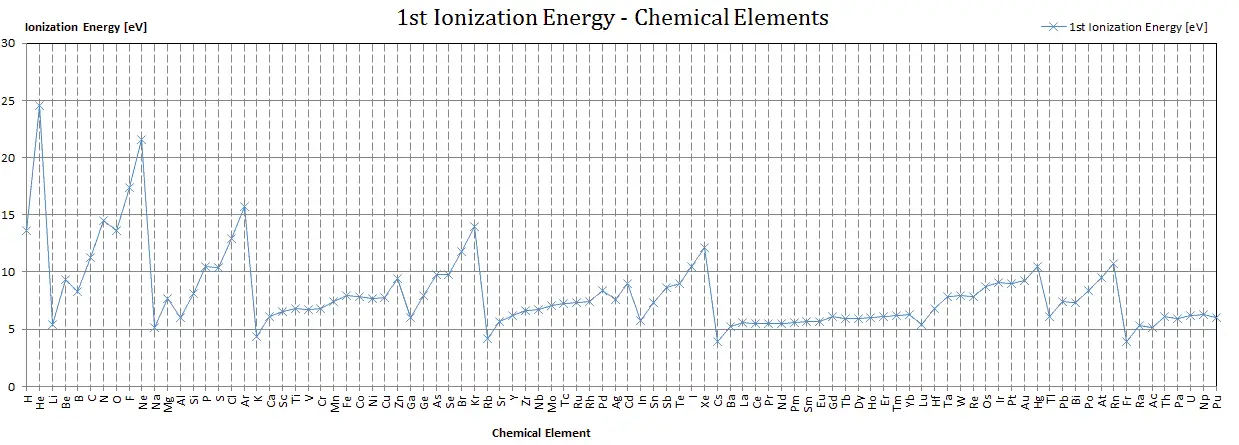
ionization energy


Lanthanum – Melting Point and Boiling Point

Melting point of Lanthanum is 920°C.

Boiling point of Lanthanum is 3454°C.

Note that these points are associated with the standard atmospheric pressure.

Boiling Point – Saturation

In thermodynamics, saturation defines a condition in which a mixture of vapor and liquid can exist together at a given temperature and pressure. The temperature at which vaporization (boiling) starts to occur for a given pressure is called the saturation temperature or boiling point. The pressure at which vaporization (boiling) starts to occur for a given temperature is called the saturation pressure. When considered as the temperature of the reverse change from vapor to liquid, it is referred to as the condensation point.

Melting Point – Saturation

In thermodynamics, the melting point defines a condition in which the solid and liquid can exist in equilibrium. Adding heat will convert the solid into a liquid with no temperature change. The melting point of a substance depends on pressure and is usually specified at standard pressure. When considered as the temperature of the reverse change from liquid to solid, it is referred to as the freezing point or crystallization point.
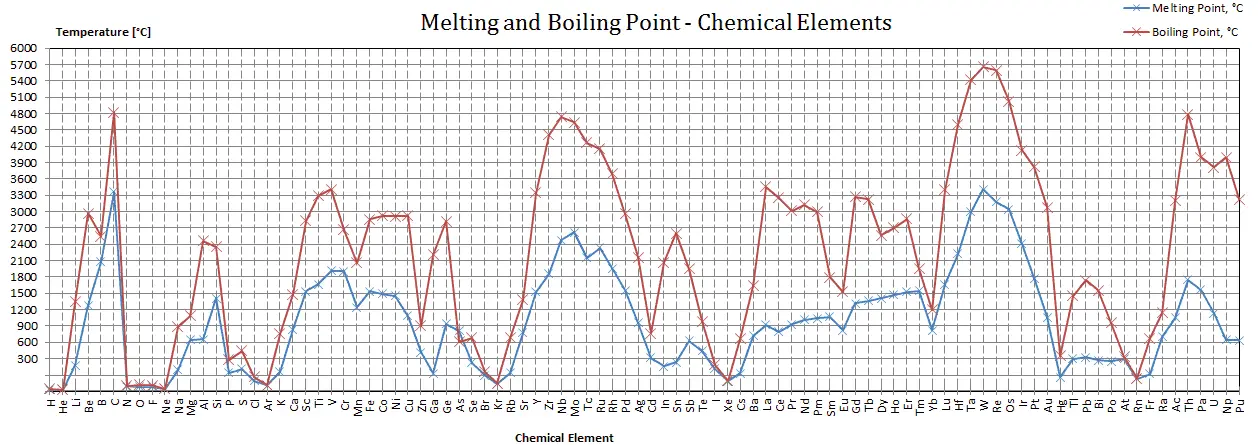
melting and boiling point

Lanthanum – Specific Heat, Latent Heat of Fusion, Latent Heat of Vaporization

Specific heat of Lanthanum is 0.19 J/g K.

Latent Heat of Fusion of Lanthanum is 6.2 kJ/mol.

Latent Heat of Vaporization of Lanthanum is 414 kJ/mol.

Specific Heat

Specific heat, or specific heat capacity, is a property related to internal energy that is very important in thermodynamics. The intensive properties cv and cp are defined for pure, simple compressible substances as partial derivatives of the internal energy u(T, v) and enthalpy h(T, p), respectively:
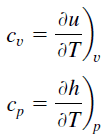
Specific Heat at Constant Volume and Constant Pressure

Table of specific heat capacitieswhere the subscripts v and p denote the variables held fixed during differentiation. The properties cv and cp are referred to as specific heats(or heat capacities) because, under certain special conditions, they relate the temperature change of a system to the amount of energy added by heat transfer. Their SI units are J/kg K or J/mol K.

Different substances are affected to different magnitudes by the addition of heat. When a given amount of heat is added to different substances, their temperatures increase by different amounts.

Heat capacity is an extensive property of matter, meaning it is proportional to the size of the system. Heat capacity C has the unit of energy per degree or energy per kelvin. When expressing the same phenomenon as an intensive property, the heat capacity is divided by the amount of substance, mass, or volume. Thus the quantity is independent of the size or extent of the sample.

specific heat - heat capacity


Latent Heat of Vaporization

Phase changes - enthalpy of vaporization

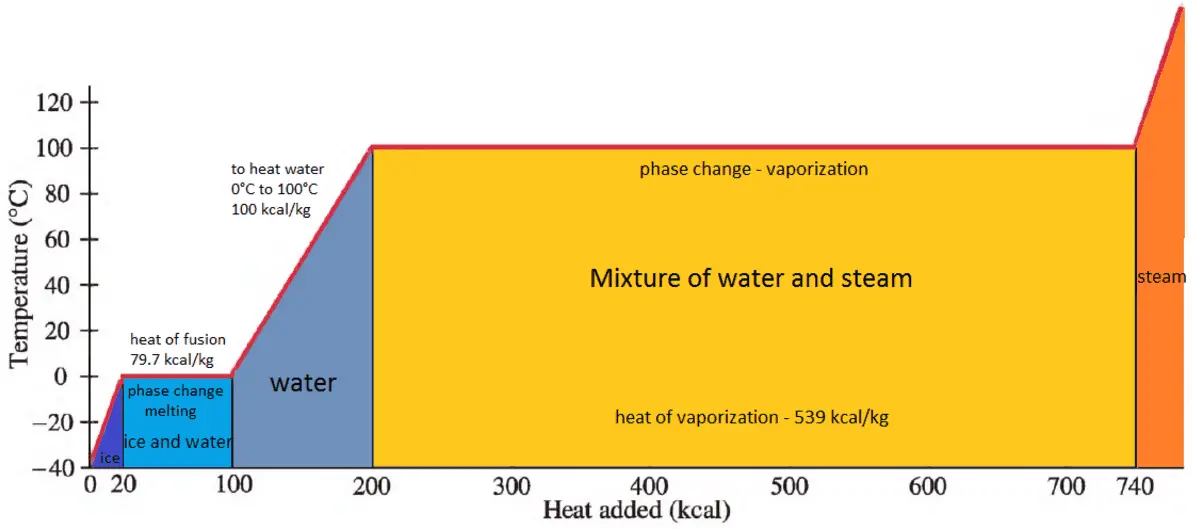
In general, when a material changes phase from solid to liquid or from liquid to gas, a certain amount of energy is involved in this change of phase. In the case of liquid to gas phase change, this amount of energy is known as the enthalpy of vaporization (symbol ∆Hvap; unit: J), also known as the (latent) heat of vaporization or heat of evaporation. As an example, see the figure, which describes the phase transitions of water.

Latent heat is the amount of heat added to or removed from a substance to produce a change in phase. This energy breaks down the attractive intermolecular forces and must provide the energy necessary to expand the gas (the pΔV work). When latent heat is added, no temperature change occurs. The enthalpy of vaporization is a function of the pressure at which that transformation takes place.

Latent Heat of Fusion

In the case of solid to liquid phase change, the change in enthalpy required to change its state is known as the enthalpy of fusion (symbol ∆Hfus; unit: J), also known as the (latent) heat of fusion. Latent heat is the amount of heat added to or removed from a substance to produce a phase change. This energy breaks down the attractive intermolecular forces and also must provide the energy necessary to expand the system (the pΔV work).

The liquid phase has higher internal energy than the solid phase. This means energy must be supplied to a solid in order to melt it, and energy is released from a liquid when it freezes because the molecules in the liquid experience weaker intermolecular forces and so have higher potential energy (a kind of bond-dissociation energy for intermolecular forces).

The temperature at which the phase transition occurs is the melting point.

When latent heat is added, no temperature change occurs. The enthalpy of fusion is a function of the pressure at which that transformation takes place. By convention, the pressure is assumed to be 1 atm (101.325 kPa) unless otherwise specified.

heat of fusion and vaporization

Lanthanum in Periodic Table

Hydro­gen1H He­lium2He
Lith­ium3Li Beryl­lium4Be Boron5B Carbon6C Nitro­gen7N Oxy­gen8O Fluor­ine9F Neon10Ne
So­dium11Na Magne­sium12Mg Alumin­ium13Al Sili­con14Si Phos­phorus15P Sulfur16S Chlor­ine17Cl Argon18Ar
Potas­sium19K Cal­cium20Ca Scan­dium21Sc Tita­nium22Ti Vana­dium23V Chrom­ium24Cr Manga­nese25Mn Iron26Fe Cobalt27Co Nickel28Ni Copper29Cu Zinc30Zn Gallium31Ga Germa­nium32Ge Arsenic33As Sele­nium34Se Bromine35Br Kryp­ton36Kr
Rubid­ium37Rb Stront­ium38Sr Yttrium39Y Zirco­nium40Zr Nio­bium41Nb Molyb­denum42Mo Tech­netium43Tc Ruthe­nium44Ru Rho­dium45Rh Pallad­ium46Pd Silver47Ag Cad­mium48Cd Indium49In Tin50Sn Anti­mony51Sb Tellur­ium52Te Iodine53I Xenon54Xe
Cae­sium55Cs Ba­rium56Ba Lan­thanum57La 1 asterisk Haf­nium72Hf Tanta­lum73Ta Tung­sten74W Rhe­nium75Re Os­mium76Os Iridium77Ir Plat­inum78Pt Gold79Au Mer­cury80Hg Thallium81Tl Lead82Pb Bis­muth83Bi Polo­nium84Po Asta­tine85At Radon86Rn
Fran­cium87Fr Ra­dium88Ra Actin­ium89Ac 1 asterisk Ruther­fordium104Rf Dub­nium105Db Sea­borgium106Sg Bohr­ium107Bh Has­sium108Hs Meit­nerium109Mt Darm­stadtium110Ds Roent­genium111Rg Coper­nicium112Cn Nihon­ium113Nh Flerov­ium114Fl Moscov­ium115Mc Liver­morium116Lv Tenness­ine117Ts Oga­nesson118Og
1 asterisk Cerium58Ce Praseo­dymium59Pr Neo­dymium60Nd Prome­thium61Pm Sama­rium62Sm Europ­ium63Eu Gadolin­ium64Gd Ter­bium65Tb Dyspro­sium66Dy Hol­mium67Ho Erbium68Er Thulium69Tm Ytter­bium70Yb Lute­tium71Lu
1 asterisk Thor­ium90Th Protac­tinium91Pa Ura­nium92U Neptu­nium93Np Pluto­nium94Pu Ameri­cium95Am Curium96Cm Berkel­ium97Bk Califor­nium98Cf Einstei­nium99Es Fer­mium100Fm Mende­levium101Md Nobel­ium102No Lawren­cium103Lr

–
–
–

What is Cerium – Properties of Cerium Element – Symbol Ce

What is Cerium

Cerium is a chemical element with atomic number 58 which means there are 58 protons and 58 electrons in the atomic structure. The chemical symbol for Cerium is Ce.

Cerium is a soft, ductile and silvery-white metal that tarnishes when exposed to air, and it is soft enough to be cut with a knife. Cerium is the second element in the lanthanide series. Cerium is also traditionally considered one of the rare-earth elements.

Cerium - Properties

Cerium – Properties

Element Cerium
Atomic Number 58
Symbol Ce
Element Category Rare Earth Metal
Phase at STP Solid
Atomic Mass [amu] 140.116
Density at STP [g/cm3] 6.689
Electron Configuration [Xe] 4f1 5d1 6s2
Possible Oxidation States +3,4
Electron Affinity [kJ/mol] 50
Electronegativity [Pauling scale] 1.12
1st Ionization Energy [eV] 5.5387
Year of Discovery 1803
Discoverer Hisinger, Wilhelm & Berzelius, Jöns Jacob/Klaproth, Martin Heinrich
Thermal properties
Melting Point [Celsius scale] 798
Boiling Point [Celsius scale] 3257
Thermal Conductivity [W/m K] 11
Specific Heat [J/g K] 0.19
Heat of Fusion [kJ/mol] 5.46
Heat of Vaporization [kJ/mol] 414

See also: Properties of Cerium

Atomic Mass of Cerium

Atomic mass of Cerium is 140.116 u. 

Note that, each element may contain more isotopes, therefore this resulting atomic mass is calculated from naturally-occuring isotopes and their abundance.

The unit of measure for mass is the atomic mass unit (amu). One atomic mass unit is equal to 1.66 x 10⁻²⁴ grams. One unified atomic mass unit is approximately the mass of one nucleon (either a single proton or neutron) and is numerically equivalent to 1 g/mol.

For 12C, the atomic mass is exactly 12u since the atomic mass unit is defined from it. The isotopic mass usually differs for other isotopes and is usually within 0.1 u of the mass number. For example, 63Cu (29 protons and 34 neutrons) has a mass number of 63, and an isotopic mass in its nuclear ground state is 62.91367 u.

There are two reasons for the difference between mass number and isotopic mass, known as the mass defect:

  1. The neutron is slightly heavier than the proton. This increases the mass of nuclei with more neutrons than protons relative to the atomic mass unit scale based on 12C with equal numbers of protons and neutrons.
  2. The nuclear binding energy varies between nuclei. A nucleus with greater binding energy has lower total energy, and therefore a lower mass according to Einstein’s mass-energy equivalence relation E = mc2. For 63Cu, the atomic mass is less than 63, so this must be the dominant factor.

See also: Mass Number

Density of Cerium

Density of Cerium is 6.689g/cm3.
Density - Gas - Liquid - Solid

Typical densities of various substances at atmospheric pressure.

Density is defined as the mass per unit volume. It is an intensive property, which is mathematically defined as mass divided by volume:

ρ = m/V

In other words, the density (ρ) of a substance is the total mass (m) of that substance divided by the total volume (V) occupied by that substance. The standard SI unit is kilograms per cubic meter (kg/m3). The Standard English unit is pounds mass per cubic foot (lbm/ft3).

See also: What is Density

See also: Densest Materials of the Earth

density - chemical elements

Electron Affinity and Electronegativity of Cerium

Electron Affinity of Cerium is 50 kJ/mol.

Electronegativity of Cerium is 1.12.

Electron Affinity

In chemistry and atomic physics, the electron affinity of an atom or molecule is defined as:

the change in energy (in kJ/mole) of a neutral atom or molecule (in the gaseous phase) when an electron is added to the atom to form a negative ion.

X + e– → X– + energy        Affinity = – ∆H

In other words, it can be expressed as the neutral atom’s likelihood of gaining an electron. Note that ionization energies measure the tendency of a neutral atom to resist the loss of electrons. Electron affinities are more difficult to measure than ionization energies.

An atom of Cerium in the gas phase, for example, gives off energy when it gains an electron to form an ion of Cerium.

Ce + e– → Ce–        – ∆H = Affinity = 50 kJ/mol

To use electron affinities properly, it is essential to keep track of signs. When an electron is added to a neutral atom, energy is released. This affinity is known as the first electron affinity, and these energies are negative. By convention, the negative sign shows a release of energy. However, more energy is required to add an electron to a negative ion which overwhelms any release of energy from the electron attachment process. This affinity is known as the second electron affinity, and these energies are positive.

Affinities of Nonmetals vs. Affinities of Metals

  • Metals: Metals like to lose valence electrons to form cations to have a fully stable shell. The electron affinity of metals is lower than that of nonmetals. Mercury most weakly attracts an extra electron.
  • Nonmetals: Generally, nonmetals have more positive electron affinity than metals. Nonmetals like to gain electrons to form anions to have a fully stable electron shell. Chlorine most strongly attracts extra electrons. The electron affinities of the noble gases have not been conclusively measured, so they may or may not have slightly negative values.

Electronegativity

Electronegativity, symbol χ, is a chemical property that describes the tendency of an atom to attract electrons towards this atom. For this purpose, a dimensionless quantity, the Pauling scale, symbol χ, is the most commonly used.

The electronegativity of Cerium is:

χ = 1.12

In general, an atom’s electronegativity is affected by both its atomic number and the distance at which its valence electrons reside from the charged nucleus. The higher the associated electronegativity number, the more an element or compound attracts electrons towards it.

The most electronegative atom, fluorine, is assigned a value of 4.0, and values range down to cesium and francium, which are the least electronegative at 0.7.

electron affinity and electronegativity

First Ionization Energy of Cerium

First Ionization Energy of Cerium is 5.5387 eV.

Ionization energy, also called ionization potential, is the energy necessary to remove an electron from the neutral atom.

X + energy → X+ + e−

where X is any atom or molecule capable of being ionized, X+ is that atom or molecule with an electron removed (positive ion), and e− is the removed electron.

A Cerium atom, for example, requires the following ionization energy to remove the outermost electron.

Ce + IE → Ce+ + e−        IE = 5.5387 eV

The ionization energy associated with removal of the first electron is most commonly used. The nth ionization energy refers to the amount of energy required to remove an electron from the species with a charge of (n-1).

1st ionization energy

X → X+ + e−

2nd ionization energy

X+ → X2+ + e−

3rd ionization energy

X2+ → X3+ + e−

Ionization Energy for different Elements

There is ionization energy for each successive electron removed. The electrons that circle the nucleus move in fairly well-defined orbits. Some of these electrons are more tightly bound in the atom than others. For example, only 7.38 eV is required to remove the outermost electron from a lead atom, while 88,000 eV is required to remove the innermost electron. Helps to understand the reactivity of elements (especially metals, which lose electrons).

In general, the ionization energy increases moving up a group and moving left to the right across a period. Moreover:

  • Ionization energy is lowest for the alkali metals, which have a single electron outside a closed shell.
  • Ionization energy increases across a row on the periodic maximum for the noble gases which have closed shells.

For example, sodium requires only 496 kJ/mol or 5.14 eV/atom to ionize it. On the other hand, neon, the noble gas, immediately preceding it in the periodic table, requires 2081 kJ/mol or 21.56 eV/atom.

ionization energy


Cerium – Melting Point and Boiling Point

Melting point of Cerium is 798°C.

Boiling point of Cerium is 3257°C.

Note that these points are associated with the standard atmospheric pressure.

Boiling Point – Saturation

In thermodynamics, saturation defines a condition in which a mixture of vapor and liquid can exist together at a given temperature and pressure. The temperature at which vaporization (boiling) starts to occur for a given pressure is called the saturation temperature or boiling point. The pressure at which vaporization (boiling) starts to occur for a given temperature is called the saturation pressure. When considered as the temperature of the reverse change from vapor to liquid, it is referred to as the condensation point.

Melting Point – Saturation

In thermodynamics, the melting point defines a condition in which the solid and liquid can exist in equilibrium. Adding heat will convert the solid into a liquid with no temperature change. The melting point of a substance depends on pressure and is usually specified at standard pressure. When considered as the temperature of the reverse change from liquid to solid, it is referred to as the freezing point or crystallization point.

melting and boiling point

Cerium – Specific Heat, Latent Heat of Fusion, Latent Heat of Vaporization

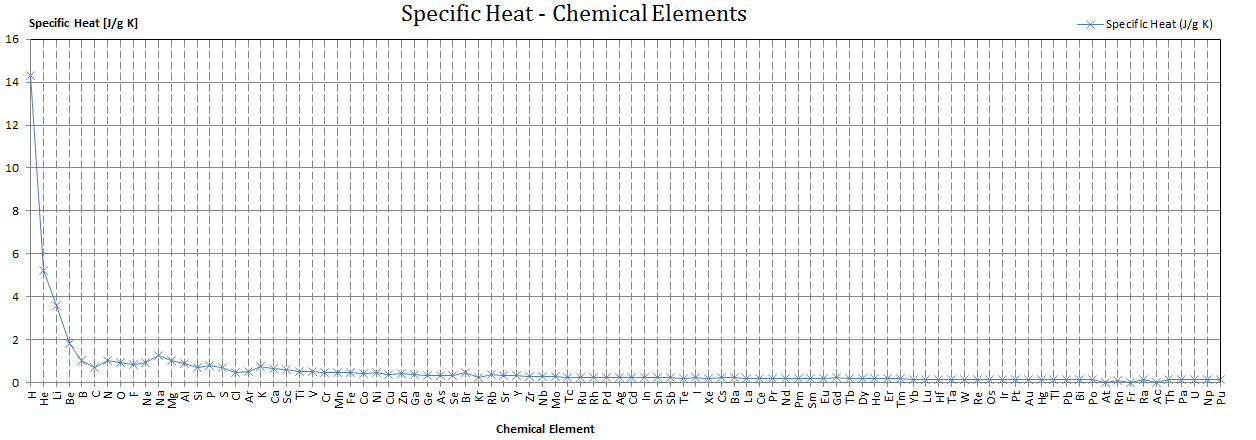
Specific heat of Cerium is 0.19 J/g K.

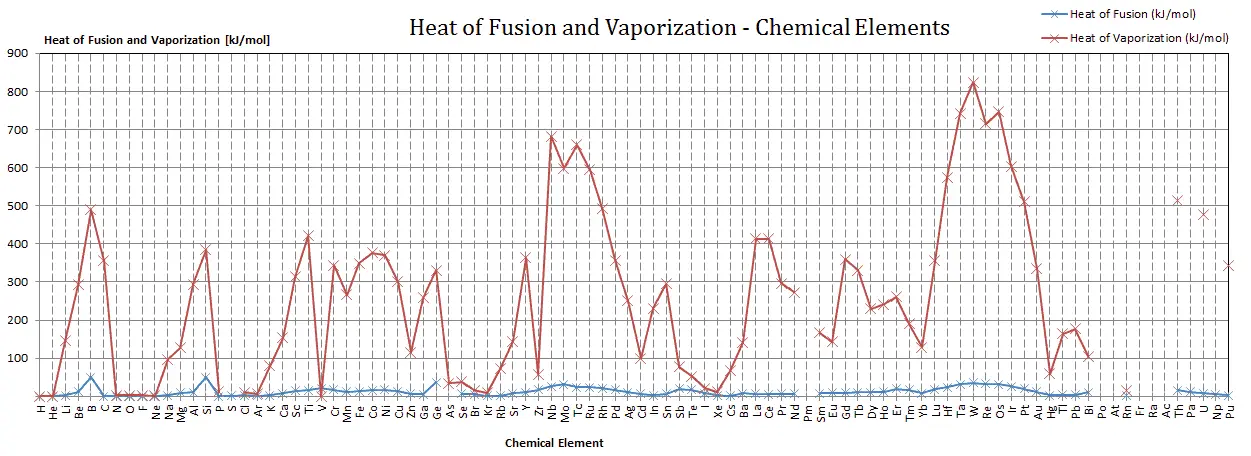
Latent Heat of Fusion of Cerium is 5.46 kJ/mol.

Latent Heat of Vaporization of Cerium is 414 kJ/mol.

Specific Heat

Specific heat, or specific heat capacity, is a property related to internal energy that is very important in thermodynamics. The intensive properties cv and cp are defined for pure, simple compressible substances as partial derivatives of the internal energy u(T, v) and enthalpy h(T, p), respectively:
Specific Heat at Constant Volume and Constant Pressure

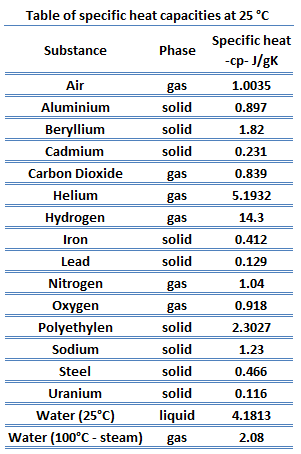
Table of specific heat capacitieswhere the subscripts v and p denote the variables held fixed during differentiation. The properties cv and cp are referred to as specific heats(or heat capacities) because, under certain special conditions, they relate the temperature change of a system to the amount of energy added by heat transfer. Their SI units are J/kg K or J/mol K.

Different substances are affected to different magnitudes by the addition of heat. When a given amount of heat is added to different substances, their temperatures increase by different amounts.

Heat capacity is an extensive property of matter, meaning it is proportional to the size of the system. Heat capacity C has the unit of energy per degree or energy per kelvin. When expressing the same phenomenon as an intensive property, the heat capacity is divided by the amount of substance, mass, or volume. Thus the quantity is independent of the size or extent of the sample.
specific heat - heat capacity


Latent Heat of Vaporization

Phase changes - enthalpy of vaporization

In general, when a material changes phase from solid to liquid or from liquid to gas, a certain amount of energy is involved in this change of phase. In the case of liquid to gas phase change, this amount of energy is known as the enthalpy of vaporization (symbol ∆Hvap; unit: J), also known as the (latent) heat of vaporization or heat of evaporation. As an example, see the figure, which describes the phase transitions of water.

Latent heat is the amount of heat added to or removed from a substance to produce a change in phase. This energy breaks down the attractive intermolecular forces and must provide the energy necessary to expand the gas (the pΔV work). When latent heat is added, no temperature change occurs. The enthalpy of vaporization is a function of the pressure at which that transformation takes place.

Latent Heat of Fusion

In the case of solid to liquid phase change, the change in enthalpy required to change its state is known as the enthalpy of fusion (symbol ∆Hfus; unit: J), also known as the (latent) heat of fusion. Latent heat is the amount of heat added to or removed from a substance to produce a phase change. This energy breaks down the attractive intermolecular forces and also must provide the energy necessary to expand the system (the pΔV work).

The liquid phase has higher internal energy than the solid phase. This means energy must be supplied to a solid in order to melt it, and energy is released from a liquid when it freezes because the molecules in the liquid experience weaker intermolecular forces and so have higher potential energy (a kind of bond-dissociation energy for intermolecular forces).

The temperature at which the phase transition occurs is the melting point.

When latent heat is added, no temperature change occurs. The enthalpy of fusion is a function of the pressure at which that transformation takes place. By convention, the pressure is assumed to be 1 atm (101.325 kPa) unless otherwise specified.
heat of fusion and vaporization

Cerium in Periodic Table

Hydro­gen1H He­lium2He
Lith­ium3Li Beryl­lium4Be Boron5B Carbon6C Nitro­gen7N Oxy­gen8O Fluor­ine9F Neon10Ne
So­dium11Na Magne­sium12Mg Alumin­ium13Al Sili­con14Si Phos­phorus15P Sulfur16S Chlor­ine17Cl Argon18Ar
Potas­sium19K Cal­cium20Ca Scan­dium21Sc Tita­nium22Ti Vana­dium23V Chrom­ium24Cr Manga­nese25Mn Iron26Fe Cobalt27Co Nickel28Ni Copper29Cu Zinc30Zn Gallium31Ga Germa­nium32Ge Arsenic33As Sele­nium34Se Bromine35Br Kryp­ton36Kr
Rubid­ium37Rb Stront­ium38Sr Yttrium39Y Zirco­nium40Zr Nio­bium41Nb Molyb­denum42Mo Tech­netium43Tc Ruthe­nium44Ru Rho­dium45Rh Pallad­ium46Pd Silver47Ag Cad­mium48Cd Indium49In Tin50Sn Anti­mony51Sb Tellur­ium52Te Iodine53I Xenon54Xe
Cae­sium55Cs Ba­rium56Ba Lan­thanum57La 1 asterisk Haf­nium72Hf Tanta­lum73Ta Tung­sten74W Rhe­nium75Re Os­mium76Os Iridium77Ir Plat­inum78Pt Gold79Au Mer­cury80Hg Thallium81Tl Lead82Pb Bis­muth83Bi Polo­nium84Po Asta­tine85At Radon86Rn
Fran­cium87Fr Ra­dium88Ra Actin­ium89Ac 1 asterisk Ruther­fordium104Rf Dub­nium105Db Sea­borgium106Sg Bohr­ium107Bh Has­sium108Hs Meit­nerium109Mt Darm­stadtium110Ds Roent­genium111Rg Coper­nicium112Cn Nihon­ium113Nh Flerov­ium114Fl Moscov­ium115Mc Liver­morium116Lv Tenness­ine117Ts Oga­nesson118Og
1 asterisk Cerium58Ce Praseo­dymium59Pr Neo­dymium60Nd Prome­thium61Pm Sama­rium62Sm Europ­ium63Eu Gadolin­ium64Gd Ter­bium65Tb Dyspro­sium66Dy Hol­mium67Ho Erbium68Er Thulium69Tm Ytter­bium70Yb Lute­tium71Lu
1 asterisk Thor­ium90Th Protac­tinium91Pa Ura­nium92U Neptu­nium93Np Pluto­nium94Pu Ameri­cium95Am Curium96Cm Berkel­ium97Bk Califor­nium98Cf Einstei­nium99Es Fer­mium100Fm Mende­levium101Md Nobel­ium102No Lawren­cium103Lr

–
–
–

What is Caesium – Properties of Caesium Element – Symbol Cs

What is Caesium

Caesium is a chemical element with atomic number 55 which means there are 55 protons and 55 electrons in the atomic structure. The chemical symbol for Caesium is Cs.

Caesium is a soft, silvery-gold alkali metal with a melting point of 28.5 °C, which makes it one of only five elemental metals that are liquid at or near room temperature. Caesium has physical and chemical properties similar to those of rubidium and potassium.

Caesium - Properties

Caesium – Properties

Element Caesium
Atomic Number 55
Symbol Cs
Element Category Alkali Metal
Phase at STP Solid
Atomic Mass [amu] 132.9055
Density at STP [g/cm3] 1.879
Electron Configuration [Xe] 6s1
Possible Oxidation States +1
Electron Affinity [kJ/mol] 45.5
Electronegativity [Pauling scale] 0.79
1st Ionization Energy [eV] 3.8939
Year of Discovery 1860
Discoverer Kirchhoff, Gustav & Bunsen, Robert
Thermal properties
Melting Point [Celsius scale] 28.4
Boiling Point [Celsius scale] 669
Thermal Conductivity [W/m K] 36
Specific Heat [J/g K] 0.24
Heat of Fusion [kJ/mol] 2.092
Heat of Vaporization [kJ/mol] 67.74

See also: Properties of Caesium

Atomic Mass of Caesium

Atomic mass of Caesium is 132.9055 u. 

Note that, each element may contain more isotopes, therefore this resulting atomic mass is calculated from naturally-occuring isotopes and their abundance.

The unit of measure for mass is the atomic mass unit (amu). One atomic mass unit is equal to 1.66 x 10⁻²⁴ grams. One unified atomic mass unit is approximately the mass of one nucleon (either a single proton or neutron) and is numerically equivalent to 1 g/mol.

For 12C, the atomic mass is exactly 12u since the atomic mass unit is defined from it. The isotopic mass usually differs for other isotopes and is usually within 0.1 u of the mass number. For example, 63Cu (29 protons and 34 neutrons) has a mass number of 63, and an isotopic mass in its nuclear ground state is 62.91367 u.

There are two reasons for the difference between mass number and isotopic mass, known as the mass defect:

  1. The neutron is slightly heavier than the proton. This increases the mass of nuclei with more neutrons than protons relative to the atomic mass unit scale based on 12C with equal numbers of protons and neutrons.
  2. The nuclear binding energy varies between nuclei. A nucleus with greater binding energy has lower total energy, and therefore a lower mass according to Einstein’s mass-energy equivalence relation E = mc2. For 63Cu, the atomic mass is less than 63, so this must be the dominant factor.

See also: Mass Number

Density of Caesium

Density of Caesium is 1.879g/cm3.
Density - Gas - Liquid - Solid

Typical densities of various substances at atmospheric pressure.

Density is defined as the mass per unit volume. It is an intensive property, which is mathematically defined as mass divided by volume:

ρ = m/V

In other words, the density (ρ) of a substance is the total mass (m) of that substance divided by the total volume (V) occupied by that substance. The standard SI unit is kilograms per cubic meter (kg/m3). The Standard English unit is pounds mass per cubic foot (lbm/ft3).

See also: What is Density

See also: Densest Materials of the Earth

density - chemical elements

Electron Affinity and Electronegativity of Caesium

Electron Affinity of Caesium is 45.5 kJ/mol.

Electronegativity of Caesium is 0.79.

Electron Affinity

In chemistry and atomic physics, the electron affinity of an atom or molecule is defined as:

the change in energy (in kJ/mole) of a neutral atom or molecule (in the gaseous phase) when an electron is added to the atom to form a negative ion.

X + e– → X– + energy        Affinity = – ∆H

In other words, it can be expressed as the neutral atom’s likelihood of gaining an electron. Note that ionization energies measure the tendency of a neutral atom to resist the loss of electrons. Electron affinities are more difficult to measure than ionization energies.

An atom of Caesium in the gas phase, for example, gives off energy when it gains an electron to form an ion of Caesium.

Cs + e– → Cs–        – ∆H = Affinity = 45.5 kJ/mol

To use electron affinities properly, it is essential to keep track of signs. When an electron is added to a neutral atom, energy is released. This affinity is known as the first electron affinity, and these energies are negative. By convention, the negative sign shows a release of energy. However, more energy is required to add an electron to a negative ion which overwhelms any release of energy from the electron attachment process. This affinity is known as the second electron affinity, and these energies are positive.

Affinities of Nonmetals vs. Affinities of Metals

  • Metals: Metals like to lose valence electrons to form cations to have a fully stable shell. The electron affinity of metals is lower than that of nonmetals. Mercury most weakly attracts an extra electron.
  • Nonmetals: Generally, nonmetals have more positive electron affinity than metals. Nonmetals like to gain electrons to form anions to have a fully stable electron shell. Chlorine most strongly attracts extra electrons. The electron affinities of the noble gases have not been conclusively measured, so they may or may not have slightly negative values.

Electronegativity

Electronegativity, symbol χ, is a chemical property that describes the tendency of an atom to attract electrons towards this atom. For this purpose, a dimensionless quantity, the Pauling scale, symbol χ, is the most commonly used.

The electronegativity of Caesium is:

χ = 0.79

In general, an atom’s electronegativity is affected by both its atomic number and the distance at which its valence electrons reside from the charged nucleus. The higher the associated electronegativity number, the more an element or compound attracts electrons towards it.

The most electronegative atom, fluorine, is assigned a value of 4.0, and values range down to cesium and francium, which are the least electronegative at 0.7.

electron affinity and electronegativity

First Ionization Energy of Caesium

First Ionization Energy of Caesium is 3.8939 eV.

Ionization energy, also called ionization potential, is the energy necessary to remove an electron from the neutral atom.

X + energy → X+ + e−

where X is any atom or molecule capable of being ionized, X+ is that atom or molecule with an electron removed (positive ion), and e− is the removed electron.

A Caesium atom, for example, requires the following ionization energy to remove the outermost electron.

Cs + IE → Cs+ + e−        IE = 3.8939 eV

The ionization energy associated with removal of the first electron is most commonly used. The nth ionization energy refers to the amount of energy required to remove an electron from the species with a charge of (n-1).

1st ionization energy

X → X+ + e−

2nd ionization energy

X+ → X2+ + e−

3rd ionization energy

X2+ → X3+ + e−

Ionization Energy for different Elements

There is ionization energy for each successive electron removed. The electrons that circle the nucleus move in fairly well-defined orbits. Some of these electrons are more tightly bound in the atom than others. For example, only 7.38 eV is required to remove the outermost electron from a lead atom, while 88,000 eV is required to remove the innermost electron. Helps to understand the reactivity of elements (especially metals, which lose electrons).

In general, the ionization energy increases moving up a group and moving left to the right across a period. Moreover:

  • Ionization energy is lowest for the alkali metals, which have a single electron outside a closed shell.
  • Ionization energy increases across a row on the periodic maximum for the noble gases which have closed shells.

For example, sodium requires only 496 kJ/mol or 5.14 eV/atom to ionize it. On the other hand, neon, the noble gas, immediately preceding it in the periodic table, requires 2081 kJ/mol or 21.56 eV/atom.

ionization energy


Caesium – Melting Point and Boiling Point

Melting point of Caesium is 28.4°C.

Boiling point of Caesium is 669°C.

Note that these points are associated with the standard atmospheric pressure.

Boiling Point – Saturation

In thermodynamics, saturation defines a condition in which a mixture of vapor and liquid can exist together at a given temperature and pressure. The temperature at which vaporization (boiling) starts to occur for a given pressure is called the saturation temperature or boiling point. The pressure at which vaporization (boiling) starts to occur for a given temperature is called the saturation pressure. When considered as the temperature of the reverse change from vapor to liquid, it is referred to as the condensation point.

Melting Point – Saturation

In thermodynamics, the melting point defines a condition in which the solid and liquid can exist in equilibrium. Adding heat will convert the solid into a liquid with no temperature change. The melting point of a substance depends on pressure and is usually specified at standard pressure. When considered as the temperature of the reverse change from liquid to solid, it is referred to as the freezing point or crystallization point.

melting and boiling point

Caesium – Specific Heat, Latent Heat of Fusion, Latent Heat of Vaporization

Specific heat of Caesium is 0.24 J/g K.

Latent Heat of Fusion of Caesium is 2.092 kJ/mol.

Latent Heat of Vaporization of Caesium is 67.74 kJ/mol.

Specific Heat

Specific heat, or specific heat capacity, is a property related to internal energy that is very important in thermodynamics. The intensive properties cv and cp are defined for pure, simple compressible substances as partial derivatives of the internal energy u(T, v) and enthalpy h(T, p), respectively:

Specific Heat at Constant Volume and Constant Pressure

Table of specific heat capacitieswhere the subscripts v and p denote the variables held fixed during differentiation. The properties cv and cp are referred to as specific heats(or heat capacities) because, under certain special conditions, they relate the temperature change of a system to the amount of energy added by heat transfer. Their SI units are J/kg K or J/mol K.

Different substances are affected to different magnitudes by the addition of heat. When a given amount of heat is added to different substances, their temperatures increase by different amounts.

Heat capacity is an extensive property of matter, meaning it is proportional to the size of the system. Heat capacity C has the unit of energy per degree or energy per kelvin. When expressing the same phenomenon as an intensive property, the heat capacity is divided by the amount of substance, mass, or volume. Thus the quantity is independent of the size or extent of the sample.

specific heat - heat capacity


Latent Heat of Vaporization

Phase changes - enthalpy of vaporization

In general, when a material changes phase from solid to liquid or from liquid to gas, a certain amount of energy is involved in this change of phase. In the case of liquid to gas phase change, this amount of energy is known as the enthalpy of vaporization (symbol ∆Hvap; unit: J), also known as the (latent) heat of vaporization or heat of evaporation. As an example, see the figure, which describes the phase transitions of water.

Latent heat is the amount of heat added to or removed from a substance to produce a change in phase. This energy breaks down the attractive intermolecular forces and must provide the energy necessary to expand the gas (the pΔV work). When latent heat is added, no temperature change occurs. The enthalpy of vaporization is a function of the pressure at which that transformation takes place.

Latent Heat of Fusion

In the case of solid to liquid phase change, the change in enthalpy required to change its state is known as the enthalpy of fusion (symbol ∆Hfus; unit: J), also known as the (latent) heat of fusion. Latent heat is the amount of heat added to or removed from a substance to produce a phase change. This energy breaks down the attractive intermolecular forces and also must provide the energy necessary to expand the system (the pΔV work).

The liquid phase has higher internal energy than the solid phase. This means energy must be supplied to a solid in order to melt it, and energy is released from a liquid when it freezes because the molecules in the liquid experience weaker intermolecular forces and so have higher potential energy (a kind of bond-dissociation energy for intermolecular forces).

The temperature at which the phase transition occurs is the melting point.

When latent heat is added, no temperature change occurs. The enthalpy of fusion is a function of the pressure at which that transformation takes place. By convention, the pressure is assumed to be 1 atm (101.325 kPa) unless otherwise specified.

heat of fusion and vaporization

Caesium in Periodic Table

Hydro­gen1H He­lium2He
Lith­ium3Li Beryl­lium4Be Boron5B Carbon6C Nitro­gen7N Oxy­gen8O Fluor­ine9F Neon10Ne
So­dium11Na Magne­sium12Mg Alumin­ium13Al Sili­con14Si Phos­phorus15P Sulfur16S Chlor­ine17Cl Argon18Ar
Potas­sium19K Cal­cium20Ca Scan­dium21Sc Tita­nium22Ti Vana­dium23V Chrom­ium24Cr Manga­nese25Mn Iron26Fe Cobalt27Co Nickel28Ni Copper29Cu Zinc30Zn Gallium31Ga Germa­nium32Ge Arsenic33As Sele­nium34Se Bromine35Br Kryp­ton36Kr
Rubid­ium37Rb Stront­ium38Sr Yttrium39Y Zirco­nium40Zr Nio­bium41Nb Molyb­denum42Mo Tech­netium43Tc Ruthe­nium44Ru Rho­dium45Rh Pallad­ium46Pd Silver47Ag Cad­mium48Cd Indium49In Tin50Sn Anti­mony51Sb Tellur­ium52Te Iodine53I Xenon54Xe
Cae­sium55Cs Ba­rium56Ba Lan­thanum57La 1 asterisk Haf­nium72Hf Tanta­lum73Ta Tung­sten74W Rhe­nium75Re Os­mium76Os Iridium77Ir Plat­inum78Pt Gold79Au Mer­cury80Hg Thallium81Tl Lead82Pb Bis­muth83Bi Polo­nium84Po Asta­tine85At Radon86Rn
Fran­cium87Fr Ra­dium88Ra Actin­ium89Ac 1 asterisk Ruther­fordium104Rf Dub­nium105Db Sea­borgium106Sg Bohr­ium107Bh Has­sium108Hs Meit­nerium109Mt Darm­stadtium110Ds Roent­genium111Rg Coper­nicium112Cn Nihon­ium113Nh Flerov­ium114Fl Moscov­ium115Mc Liver­morium116Lv Tenness­ine117Ts Oga­nesson118Og
1 asterisk Cerium58Ce Praseo­dymium59Pr Neo­dymium60Nd Prome­thium61Pm Sama­rium62Sm Europ­ium63Eu Gadolin­ium64Gd Ter­bium65Tb Dyspro­sium66Dy Hol­mium67Ho Erbium68Er Thulium69Tm Ytter­bium70Yb Lute­tium71Lu
1 asterisk Thor­ium90Th Protac­tinium91Pa Ura­nium92U Neptu­nium93Np Pluto­nium94Pu Ameri­cium95Am Curium96Cm Berkel­ium97Bk Califor­nium98Cf Einstei­nium99Es Fer­mium100Fm Mende­levium101Md Nobel­ium102No Lawren­cium103Lr

–
–
–

What is Barium – Properties of Barium Element – Symbol Ba

What is Barium

Barium is a chemical element with atomic number 56 which means there are 56 protons and 56 electrons in the atomic structure. The chemical symbol for Barium is Ba.

Barium is the fifth element in group 2 and is a soft, silvery alkaline earth metal. Because of its high chemical reactivity, barium is never found in nature as a free element. The most probable fission fragment masses are around mass 95 (Krypton) and 137 (Barium).

Barium - Properties

Barium – Properties

Element Barium
Atomic Number 56
Symbol Ba
Element Category Alkaline Earth Metal
Phase at STP Solid
Atomic Mass [amu] 137.327
Density at STP [g/cm3] 3.51
Electron Configuration [Xe] 6s2
Possible Oxidation States +2
Electron Affinity [kJ/mol] 13.95
Electronegativity [Pauling scale] 0.89
1st Ionization Energy [eV] 5.2117
Year of Discovery 1808
Discoverer Davy, Sir Humphry
Thermal properties
Melting Point [Celsius scale] 725
Boiling Point [Celsius scale] 1640
Thermal Conductivity [W/m K] 18
Specific Heat [J/g K] 0.204
Heat of Fusion [kJ/mol] 7.75
Heat of Vaporization [kJ/mol] 142

See also: Properties of Barium

Atomic Mass of Barium

Atomic mass of Barium is 137.327 u. 

Note that, each element may contain more isotopes, therefore this resulting atomic mass is calculated from naturally-occuring isotopes and their abundance.

The unit of measure for mass is the atomic mass unit (amu). One atomic mass unit is equal to 1.66 x 10⁻²⁴ grams. One unified atomic mass unit is approximately the mass of one nucleon (either a single proton or neutron) and is numerically equivalent to 1 g/mol.

For 12C, the atomic mass is exactly 12u since the atomic mass unit is defined from it. The isotopic mass usually differs for other isotopes and is usually within 0.1 u of the mass number. For example, 63Cu (29 protons and 34 neutrons) has a mass number of 63, and an isotopic mass in its nuclear ground state is 62.91367 u.

There are two reasons for the difference between mass number and isotopic mass, known as the mass defect:

  1. The neutron is slightly heavier than the proton. This increases the mass of nuclei with more neutrons than protons relative to the atomic mass unit scale based on 12C with equal numbers of protons and neutrons.
  2. The nuclear binding energy varies between nuclei. A nucleus with greater binding energy has lower total energy, and therefore a lower mass according to Einstein’s mass-energy equivalence relation E = mc2. For 63Cu, the atomic mass is less than 63, so this must be the dominant factor.

See also: Mass Number

Density of Barium

Density of Barium is 3.51g/cm3.
Density - Gas - Liquid - Solid

Typical densities of various substances at atmospheric pressure.

Density is defined as the mass per unit volume. It is an intensive property, which is mathematically defined as mass divided by volume:

ρ = m/V

In other words, the density (ρ) of a substance is the total mass (m) of that substance divided by the total volume (V) occupied by that substance. The standard SI unit is kilograms per cubic meter (kg/m3). The Standard English unit is pounds mass per cubic foot (lbm/ft3).

See also: What is Density

See also: Densest Materials of the Earth

density - chemical elements

Electron Affinity and Electronegativity of Barium

Electron Affinity of Barium is 13.95 kJ/mol.

Electronegativity of Barium is 0.89.

Electron Affinity

In chemistry and atomic physics, the electron affinity of an atom or molecule is defined as:

the change in energy (in kJ/mole) of a neutral atom or molecule (in the gaseous phase) when an electron is added to the atom to form a negative ion.

X + e– → X– + energy        Affinity = – ∆H

In other words, it can be expressed as the neutral atom’s likelihood of gaining an electron. Note that ionization energies measure the tendency of a neutral atom to resist the loss of electrons. Electron affinities are more difficult to measure than ionization energies.

An atom of Barium in the gas phase, for example, gives off energy when it gains an electron to form an ion of Barium.

Ba + e– → Ba–        – ∆H = Affinity = 13.95 kJ/mol

To use electron affinities properly, it is essential to keep track of signs. When an electron is added to a neutral atom, energy is released. This affinity is known as the first electron affinity, and these energies are negative. By convention, the negative sign shows a release of energy. However, more energy is required to add an electron to a negative ion which overwhelms any release of energy from the electron attachment process. This affinity is known as the second electron affinity, and these energies are positive.

Affinities of Nonmetals vs. Affinities of Metals

  • Metals: Metals like to lose valence electrons to form cations to have a fully stable shell. The electron affinity of metals is lower than that of nonmetals. Mercury most weakly attracts an extra electron.
  • Nonmetals: Generally, nonmetals have more positive electron affinity than metals. Nonmetals like to gain electrons to form anions to have a fully stable electron shell. Chlorine most strongly attracts extra electrons. The electron affinities of the noble gases have not been conclusively measured, so they may or may not have slightly negative values.

Electronegativity

Electronegativity, symbol χ, is a chemical property that describes the tendency of an atom to attract electrons towards this atom. For this purpose, a dimensionless quantity, the Pauling scale, symbol χ, is the most commonly used.

The electronegativity of Barium is:

χ = 0.89

In general, an atom’s electronegativity is affected by both its atomic number and the distance at which its valence electrons reside from the charged nucleus. The higher the associated electronegativity number, the more an element or compound attracts electrons towards it.

The most electronegative atom, fluorine, is assigned a value of 4.0, and values range down to cesium and francium, which are the least electronegative at 0.7.

electron affinity and electronegativity

First Ionization Energy of Barium

First Ionization Energy of Barium is 5.2117 eV.

Ionization energy, also called ionization potential, is the energy necessary to remove an electron from the neutral atom.

X + energy → X+ + e−

where X is any atom or molecule capable of being ionized, X+ is that atom or molecule with an electron removed (positive ion), and e− is the removed electron.

A Barium atom, for example, requires the following ionization energy to remove the outermost electron.

Ba + IE → Ba+ + e−        IE = 5.2117 eV

The ionization energy associated with removal of the first electron is most commonly used. The nth ionization energy refers to the amount of energy required to remove an electron from the species with a charge of (n-1).

1st ionization energy

X → X+ + e−

2nd ionization energy

X+ → X2+ + e−

3rd ionization energy

X2+ → X3+ + e−

Ionization Energy for different Elements

There is ionization energy for each successive electron removed. The electrons that circle the nucleus move in fairly well-defined orbits. Some of these electrons are more tightly bound in the atom than others. For example, only 7.38 eV is required to remove the outermost electron from a lead atom, while 88,000 eV is required to remove the innermost electron. Helps to understand the reactivity of elements (especially metals, which lose electrons).

In general, the ionization energy increases moving up a group and moving left to the right across a period. Moreover:

  • Ionization energy is lowest for the alkali metals, which have a single electron outside a closed shell.
  • Ionization energy increases across a row on the periodic maximum for the noble gases which have closed shells.

For example, sodium requires only 496 kJ/mol or 5.14 eV/atom to ionize it. On the other hand, neon, the noble gas, immediately preceding it in the periodic table, requires 2081 kJ/mol or 21.56 eV/atom.

ionization energy


Barium – Melting Point and Boiling Point

Melting point of Barium is 725°C.

Boiling point of Barium is 1640°C.

Note that these points are associated with the standard atmospheric pressure.

Boiling Point – Saturation

In thermodynamics, saturation defines a condition in which a mixture of vapor and liquid can exist together at a given temperature and pressure. The temperature at which vaporization (boiling) starts to occur for a given pressure is called the saturation temperature or boiling point. The pressure at which vaporization (boiling) starts to occur for a given temperature is called the saturation pressure. When considered as the temperature of the reverse change from vapor to liquid, it is referred to as the condensation point.

Melting Point – Saturation

In thermodynamics, the melting point defines a condition in which the solid and liquid can exist in equilibrium. Adding heat will convert the solid into a liquid with no temperature change. The melting point of a substance depends on pressure and is usually specified at standard pressure. When considered as the temperature of the reverse change from liquid to solid, it is referred to as the freezing point or crystallization point.

melting and boiling point

Barium – Specific Heat, Latent Heat of Fusion, Latent Heat of Vaporization

Specific heat of Barium is 0.204 J/g K.

Latent Heat of Fusion of Barium is 7.75 kJ/mol.

Latent Heat of Vaporization of Barium is 142 kJ/mol.

Specific Heat

Specific heat, or specific heat capacity, is a property related to internal energy that is very important in thermodynamics. The intensive properties cv and cp are defined for pure, simple compressible substances as partial derivatives of the internal energy u(T, v) and enthalpy h(T, p), respectively:

Specific Heat at Constant Volume and Constant Pressure

Table of specific heat capacitieswhere the subscripts v and p denote the variables held fixed during differentiation. The properties cv and cp are referred to as specific heats(or heat capacities) because, under certain special conditions, they relate the temperature change of a system to the amount of energy added by heat transfer. Their SI units are J/kg K or J/mol K.

Different substances are affected to different magnitudes by the addition of heat. When a given amount of heat is added to different substances, their temperatures increase by different amounts.

Heat capacity is an extensive property of matter, meaning it is proportional to the size of the system. Heat capacity C has the unit of energy per degree or energy per kelvin. When expressing the same phenomenon as an intensive property, the heat capacity is divided by the amount of substance, mass, or volume. Thus the quantity is independent of the size or extent of the sample.

specific heat - heat capacity


Latent Heat of Vaporization

Phase changes - enthalpy of vaporization

In general, when a material changes phase from solid to liquid or from liquid to gas, a certain amount of energy is involved in this change of phase. In the case of liquid to gas phase change, this amount of energy is known as the enthalpy of vaporization (symbol ∆Hvap; unit: J), also known as the (latent) heat of vaporization or heat of evaporation. As an example, see the figure, which describes the phase transitions of water.

Latent heat is the amount of heat added to or removed from a substance to produce a change in phase. This energy breaks down the attractive intermolecular forces and must provide the energy necessary to expand the gas (the pΔV work). When latent heat is added, no temperature change occurs. The enthalpy of vaporization is a function of the pressure at which that transformation takes place.

Latent Heat of Fusion

In the case of solid to liquid phase change, the change in enthalpy required to change its state is known as the enthalpy of fusion (symbol ∆Hfus; unit: J), also known as the (latent) heat of fusion. Latent heat is the amount of heat added to or removed from a substance to produce a phase change. This energy breaks down the attractive intermolecular forces and also must provide the energy necessary to expand the system (the pΔV work).

The liquid phase has higher internal energy than the solid phase. This means energy must be supplied to a solid in order to melt it, and energy is released from a liquid when it freezes because the molecules in the liquid experience weaker intermolecular forces and so have higher potential energy (a kind of bond-dissociation energy for intermolecular forces).

The temperature at which the phase transition occurs is the melting point.

When latent heat is added, no temperature change occurs. The enthalpy of fusion is a function of the pressure at which that transformation takes place. By convention, the pressure is assumed to be 1 atm (101.325 kPa) unless otherwise specified.

heat of fusion and vaporization

Barium in Periodic Table

Hydro­gen1H He­lium2He
Lith­ium3Li Beryl­lium4Be Boron5B Carbon6C Nitro­gen7N Oxy­gen8O Fluor­ine9F Neon10Ne
So­dium11Na Magne­sium12Mg Alumin­ium13Al Sili­con14Si Phos­phorus15P Sulfur16S Chlor­ine17Cl Argon18Ar
Potas­sium19K Cal­cium20Ca Scan­dium21Sc Tita­nium22Ti Vana­dium23V Chrom­ium24Cr Manga­nese25Mn Iron26Fe Cobalt27Co Nickel28Ni Copper29Cu Zinc30Zn Gallium31Ga Germa­nium32Ge Arsenic33As Sele­nium34Se Bromine35Br Kryp­ton36Kr
Rubid­ium37Rb Stront­ium38Sr Yttrium39Y Zirco­nium40Zr Nio­bium41Nb Molyb­denum42Mo Tech­netium43Tc Ruthe­nium44Ru Rho­dium45Rh Pallad­ium46Pd Silver47Ag Cad­mium48Cd Indium49In Tin50Sn Anti­mony51Sb Tellur­ium52Te Iodine53I Xenon54Xe
Cae­sium55Cs Ba­rium56Ba Lan­thanum57La 1 asterisk Haf­nium72Hf Tanta­lum73Ta Tung­sten74W Rhe­nium75Re Os­mium76Os Iridium77Ir Plat­inum78Pt Gold79Au Mer­cury80Hg Thallium81Tl Lead82Pb Bis­muth83Bi Polo­nium84Po Asta­tine85At Radon86Rn
Fran­cium87Fr Ra­dium88Ra Actin­ium89Ac 1 asterisk Ruther­fordium104Rf Dub­nium105Db Sea­borgium106Sg Bohr­ium107Bh Has­sium108Hs Meit­nerium109Mt Darm­stadtium110Ds Roent­genium111Rg Coper­nicium112Cn Nihon­ium113Nh Flerov­ium114Fl Moscov­ium115Mc Liver­morium116Lv Tenness­ine117Ts Oga­nesson118Og
1 asterisk Cerium58Ce Praseo­dymium59Pr Neo­dymium60Nd Prome­thium61Pm Sama­rium62Sm Europ­ium63Eu Gadolin­ium64Gd Ter­bium65Tb Dyspro­sium66Dy Hol­mium67Ho Erbium68Er Thulium69Tm Ytter­bium70Yb Lute­tium71Lu
1 asterisk Thor­ium90Th Protac­tinium91Pa Ura­nium92U Neptu­nium93Np Pluto­nium94Pu Ameri­cium95Am Curium96Cm Berkel­ium97Bk Califor­nium98Cf Einstei­nium99Es Fer­mium100Fm Mende­levium101Md Nobel­ium102No Lawren­cium103Lr

–
–
–

What is Iodine – Properties of Iodine Element – Symbol I

What is Iodine

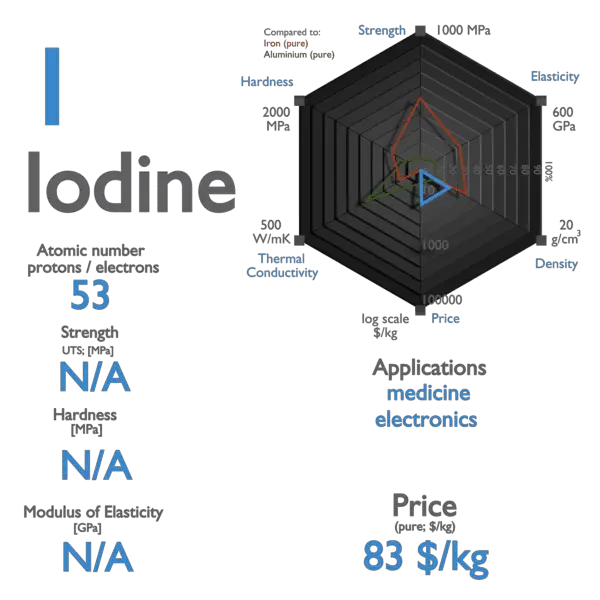
Iodine is a chemical element with atomic number 53 which means there are 53 protons and 53 electrons in the atomic structure. The chemical symbol for Iodine is I.

Iodine is the heaviest of the stable halogens, it exists as a lustrous, purple-black metallic solid at standard conditions that sublimes readily to form a violet gas. Iodine is the least abundant of the stable halogens, being the sixty-first most abundant element. It is even less abundant than the so-called rare earths. It is the heaviest essential mineral nutrient.

Iodine - Properties

Iodine – Properties

Element Iodine
Atomic Number 53
Symbol I
Element Category Halogen
Phase at STP Solid
Atomic Mass [amu] 126.90447
Density at STP [g/cm3] 4.94
Electron Configuration [Kr] 4d10 5s2 5p5
Possible Oxidation States +1,5,7/-1
Electron Affinity [kJ/mol] 295.2
Electronegativity [Pauling scale] 2.66
1st Ionization Energy [eV] 10.4513
Year of Discovery 1811
Discoverer Courtois, Bernard
Thermal properties
Melting Point [Celsius scale] 113.5
Boiling Point [Celsius scale] 184
Thermal Conductivity [W/m K] 0.449
Specific Heat [J/g K] 0.214
Heat of Fusion [kJ/mol] 7.824
Heat of Vaporization [kJ/mol] 20.752

See also: Properties of Iodine

Atomic Mass of Iodine

Atomic mass of Iodine is 126.90447 u. 

Note that, each element may contain more isotopes, therefore this resulting atomic mass is calculated from naturally-occuring isotopes and their abundance.

The unit of measure for mass is the atomic mass unit (amu). One atomic mass unit is equal to 1.66 x 10⁻²⁴ grams. One unified atomic mass unit is approximately the mass of one nucleon (either a single proton or neutron) and is numerically equivalent to 1 g/mol.

For 12C, the atomic mass is exactly 12u since the atomic mass unit is defined from it. The isotopic mass usually differs for other isotopes and is usually within 0.1 u of the mass number. For example, 63Cu (29 protons and 34 neutrons) has a mass number of 63, and an isotopic mass in its nuclear ground state is 62.91367 u.

There are two reasons for the difference between mass number and isotopic mass, known as the mass defect:

  1. The neutron is slightly heavier than the proton. This increases the mass of nuclei with more neutrons than protons relative to the atomic mass unit scale based on 12C with equal numbers of protons and neutrons.
  2. The nuclear binding energy varies between nuclei. A nucleus with greater binding energy has lower total energy, and therefore a lower mass according to Einstein’s mass-energy equivalence relation E = mc2. For 63Cu, the atomic mass is less than 63, so this must be the dominant factor.

See also: Mass Number

Density of Iodine

Density of Iodine is 4.94g/cm3.
Density - Gas - Liquid - Solid

Typical densities of various substances at atmospheric pressure.

Density is defined as the mass per unit volume. It is an intensive property, which is mathematically defined as mass divided by volume:

ρ = m/V

In other words, the density (ρ) of a substance is the total mass (m) of that substance divided by the total volume (V) occupied by that substance. The standard SI unit is kilograms per cubic meter (kg/m3). The Standard English unit is pounds mass per cubic foot (lbm/ft3).

See also: What is Density

See also: Densest Materials of the Earth

density - chemical elements

Electron Affinity and Electronegativity of Iodine

Electron Affinity of Iodine is 295.2 kJ/mol.

Electronegativity of Iodine is 2.66.

Electron Affinity

In chemistry and atomic physics, the electron affinity of an atom or molecule is defined as:

the change in energy (in kJ/mole) of a neutral atom or molecule (in the gaseous phase) when an electron is added to the atom to form a negative ion.

X + e– → X– + energy        Affinity = – ∆H

In other words, it can be expressed as the neutral atom’s likelihood of gaining an electron. Note that ionization energies measure the tendency of a neutral atom to resist the loss of electrons. Electron affinities are more difficult to measure than ionization energies.

An atom of Iodine in the gas phase, for example, gives off energy when it gains an electron to form an ion of Iodine.

I + e– → I–        – ∆H = Affinity = 295.2 kJ/mol

To use electron affinities properly, it is essential to keep track of signs. When an electron is added to a neutral atom, energy is released. This affinity is known as the first electron affinity, and these energies are negative. By convention, the negative sign shows a release of energy. However, more energy is required to add an electron to a negative ion which overwhelms any release of energy from the electron attachment process. This affinity is known as the second electron affinity, and these energies are positive.

Affinities of Nonmetals vs. Affinities of Metals

  • Metals: Metals like to lose valence electrons to form cations to have a fully stable shell. The electron affinity of metals is lower than that of nonmetals. Mercury most weakly attracts an extra electron.
  • Nonmetals: Generally, nonmetals have more positive electron affinity than metals. Nonmetals like to gain electrons to form anions to have a fully stable electron shell. Chlorine most strongly attracts extra electrons. The electron affinities of the noble gases have not been conclusively measured, so they may or may not have slightly negative values.

Electronegativity

Electronegativity, symbol χ, is a chemical property that describes the tendency of an atom to attract electrons towards this atom. For this purpose, a dimensionless quantity, the Pauling scale, symbol χ, is the most commonly used.

The electronegativity of Iodine is:

χ = 2.66

In general, an atom’s electronegativity is affected by both its atomic number and the distance at which its valence electrons reside from the charged nucleus. The higher the associated electronegativity number, the more an element or compound attracts electrons towards it.

The most electronegative atom, fluorine, is assigned a value of 4.0, and values range down to cesium and francium, which are the least electronegative at 0.7.

electron affinity and electronegativity

First Ionization Energy of Iodine

First Ionization Energy of Iodine is 10.4513 eV.

Ionization energy, also called ionization potential, is the energy necessary to remove an electron from the neutral atom.

X + energy → X+ + e−

where X is any atom or molecule capable of being ionized, X+ is that atom or molecule with an electron removed (positive ion), and e− is the removed electron.

A Iodine atom, for example, requires the following ionization energy to remove the outermost electron.

I + IE → I+ + e−        IE = 10.4513 eV

The ionization energy associated with removal of the first electron is most commonly used. The nth ionization energy refers to the amount of energy required to remove an electron from the species with a charge of (n-1).

1st ionization energy

X → X+ + e−

2nd ionization energy

X+ → X2+ + e−

3rd ionization energy

X2+ → X3+ + e−

Ionization Energy for different Elements

There is ionization energy for each successive electron removed. The electrons that circle the nucleus move in fairly well-defined orbits. Some of these electrons are more tightly bound in the atom than others. For example, only 7.38 eV is required to remove the outermost electron from a lead atom, while 88,000 eV is required to remove the innermost electron. Helps to understand the reactivity of elements (especially metals, which lose electrons).

In general, the ionization energy increases moving up a group and moving left to the right across a period. Moreover:

  • Ionization energy is lowest for the alkali metals, which have a single electron outside a closed shell.
  • Ionization energy increases across a row on the periodic maximum for the noble gases which have closed shells.

For example, sodium requires only 496 kJ/mol or 5.14 eV/atom to ionize it. On the other hand, neon, the noble gas, immediately preceding it in the periodic table, requires 2081 kJ/mol or 21.56 eV/atom.

ionization energy


Iodine – Melting Point and Boiling Point

Melting point of Iodine is 113.5°C.

Boiling point of Iodine is 184°C.

Note that these points are associated with the standard atmospheric pressure.

Boiling Point – Saturation

In thermodynamics, saturation defines a condition in which a mixture of vapor and liquid can exist together at a given temperature and pressure. The temperature at which vaporization (boiling) starts to occur for a given pressure is called the saturation temperature or boiling point. The pressure at which vaporization (boiling) starts to occur for a given temperature is called the saturation pressure. When considered as the temperature of the reverse change from vapor to liquid, it is referred to as the condensation point.

Melting Point – Saturation

In thermodynamics, the melting point defines a condition in which the solid and liquid can exist in equilibrium. Adding heat will convert the solid into a liquid with no temperature change. The melting point of a substance depends on pressure and is usually specified at standard pressure. When considered as the temperature of the reverse change from liquid to solid, it is referred to as the freezing point or crystallization point.

melting and boiling point

Iodine – Specific Heat, Latent Heat of Fusion, Latent Heat of Vaporization

Specific heat of Iodine is 0.214 J/g K.

Latent Heat of Fusion of Iodine is 7.824 kJ/mol.

Latent Heat of Vaporization of Iodine is 20.752 kJ/mol.

Specific Heat

Specific heat, or specific heat capacity, is a property related to internal energy that is very important in thermodynamics. The intensive properties cv and cp are defined for pure, simple compressible substances as partial derivatives of the internal energy u(T, v) and enthalpy h(T, p), respectively:

Specific Heat at Constant Volume and Constant Pressure

Table of specific heat capacitieswhere the subscripts v and p denote the variables held fixed during differentiation. The properties cv and cp are referred to as specific heats(or heat capacities) because, under certain special conditions, they relate the temperature change of a system to the amount of energy added by heat transfer. Their SI units are J/kg K or J/mol K.

Different substances are affected to different magnitudes by the addition of heat. When a given amount of heat is added to different substances, their temperatures increase by different amounts.

Heat capacity is an extensive property of matter, meaning it is proportional to the size of the system. Heat capacity C has the unit of energy per degree or energy per kelvin. When expressing the same phenomenon as an intensive property, the heat capacity is divided by the amount of substance, mass, or volume. Thus the quantity is independent of the size or extent of the sample.

specific heat - heat capacity


Latent Heat of Vaporization

Phase changes - enthalpy of vaporization

In general, when a material changes phase from solid to liquid or from liquid to gas, a certain amount of energy is involved in this change of phase. In the case of liquid to gas phase change, this amount of energy is known as the enthalpy of vaporization (symbol ∆Hvap; unit: J), also known as the (latent) heat of vaporization or heat of evaporation. As an example, see the figure, which describes the phase transitions of water.

Latent heat is the amount of heat added to or removed from a substance to produce a change in phase. This energy breaks down the attractive intermolecular forces and must provide the energy necessary to expand the gas (the pΔV work). When latent heat is added, no temperature change occurs. The enthalpy of vaporization is a function of the pressure at which that transformation takes place.

Latent Heat of Fusion

In the case of solid to liquid phase change, the change in enthalpy required to change its state is known as the enthalpy of fusion (symbol ∆Hfus; unit: J), also known as the (latent) heat of fusion. Latent heat is the amount of heat added to or removed from a substance to produce a phase change. This energy breaks down the attractive intermolecular forces and also must provide the energy necessary to expand the system (the pΔV work).

The liquid phase has higher internal energy than the solid phase. This means energy must be supplied to a solid in order to melt it, and energy is released from a liquid when it freezes because the molecules in the liquid experience weaker intermolecular forces and so have higher potential energy (a kind of bond-dissociation energy for intermolecular forces).

The temperature at which the phase transition occurs is the melting point.

When latent heat is added, no temperature change occurs. The enthalpy of fusion is a function of the pressure at which that transformation takes place. By convention, the pressure is assumed to be 1 atm (101.325 kPa) unless otherwise specified.

heat of fusion and vaporization

Iodine in Periodic Table

Hydro­gen1H He­lium2He
Lith­ium3Li Beryl­lium4Be Boron5B Carbon6C Nitro­gen7N Oxy­gen8O Fluor­ine9F Neon10Ne
So­dium11Na Magne­sium12Mg Alumin­ium13Al Sili­con14Si Phos­phorus15P Sulfur16S Chlor­ine17Cl Argon18Ar
Potas­sium19K Cal­cium20Ca Scan­dium21Sc Tita­nium22Ti Vana­dium23V Chrom­ium24Cr Manga­nese25Mn Iron26Fe Cobalt27Co Nickel28Ni Copper29Cu Zinc30Zn Gallium31Ga Germa­nium32Ge Arsenic33As Sele­nium34Se Bromine35Br Kryp­ton36Kr
Rubid­ium37Rb Stront­ium38Sr Yttrium39Y Zirco­nium40Zr Nio­bium41Nb Molyb­denum42Mo Tech­netium43Tc Ruthe­nium44Ru Rho­dium45Rh Pallad­ium46Pd Silver47Ag Cad­mium48Cd Indium49In Tin50Sn Anti­mony51Sb Tellur­ium52Te Iodine53I Xenon54Xe
Cae­sium55Cs Ba­rium56Ba Lan­thanum57La 1 asterisk Haf­nium72Hf Tanta­lum73Ta Tung­sten74W Rhe­nium75Re Os­mium76Os Iridium77Ir Plat­inum78Pt Gold79Au Mer­cury80Hg Thallium81Tl Lead82Pb Bis­muth83Bi Polo­nium84Po Asta­tine85At Radon86Rn
Fran­cium87Fr Ra­dium88Ra Actin­ium89Ac 1 asterisk Ruther­fordium104Rf Dub­nium105Db Sea­borgium106Sg Bohr­ium107Bh Has­sium108Hs Meit­nerium109Mt Darm­stadtium110Ds Roent­genium111Rg Coper­nicium112Cn Nihon­ium113Nh Flerov­ium114Fl Moscov­ium115Mc Liver­morium116Lv Tenness­ine117Ts Oga­nesson118Og
1 asterisk Cerium58Ce Praseo­dymium59Pr Neo­dymium60Nd Prome­thium61Pm Sama­rium62Sm Europ­ium63Eu Gadolin­ium64Gd Ter­bium65Tb Dyspro­sium66Dy Hol­mium67Ho Erbium68Er Thulium69Tm Ytter­bium70Yb Lute­tium71Lu
1 asterisk Thor­ium90Th Protac­tinium91Pa Ura­nium92U Neptu­nium93Np Pluto­nium94Pu Ameri­cium95Am Curium96Cm Berkel­ium97Bk Califor­nium98Cf Einstei­nium99Es Fer­mium100Fm Mende­levium101Md Nobel­ium102No Lawren­cium103Lr

–
–
–

What is Xenon – Properties of Xenon Element – Symbol Xe

What is Xenon

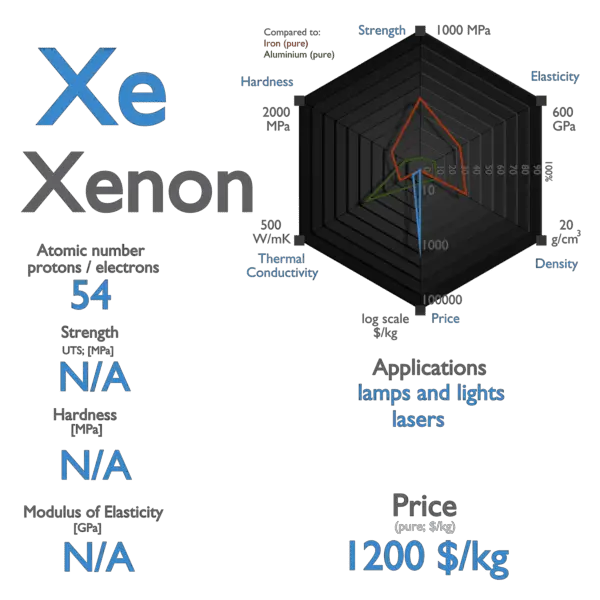
Xenon is a chemical element with atomic number 54 which means there are 54 protons and 54 electrons in the atomic structure. The chemical symbol for Xenon is Xe.

Xenon is a colorless, dense, odorless noble gas found in the Earth’s atmosphere in trace amounts.[10] Although generally unreactive, xenon can undergo a few chemical reactions. Xenon was first discovered in 1898 by the Scottish chemist William Ramsay and English chemist Morris Travers. The name xenon for this gas comes from the Greek word ξένον [xenon], neuter singular form of ξένος [xenos], meaning ‘foreign(er)’, ‘strange(r)’, or ‘guest’. In nuclear industry, especially artificial xenon 135 has a tremendous impact on the operation of a nuclear reactor. For physicists and for reactor operators, it is important to understand the mechanisms that produce and remove xenon from the reactor to predict how the reactor will respond following changes in power level.

Xenon - Properties

Xenon – Properties

Element Xenon
Atomic Number 54
Symbol Xe
Element Category Noble Gas
Phase at STP Gas
Atomic Mass [amu] 131.293
Density at STP [g/cm3] 5.9
Electron Configuration [Kr] 4d10 5s2 5p6
Possible Oxidation States 0
Electron Affinity [kJ/mol] —
Electronegativity [Pauling scale] 2.6
1st Ionization Energy [eV] 12.1299
Year of Discovery 1898
Discoverer Ramsay, William & Travers, Morris William
Thermal properties
Melting Point [Celsius scale] -111.8
Boiling Point [Celsius scale] -107.1
Thermal Conductivity [W/m K] 0.00565
Specific Heat [J/g K] 0.158
Heat of Fusion [kJ/mol] 2.297
Heat of Vaporization [kJ/mol] 12.636

See also: Properties of Xenon

Atomic Mass of Xenon

Atomic mass of Xenon is 131.293 u. 

Note that, each element may contain more isotopes, therefore this resulting atomic mass is calculated from naturally-occuring isotopes and their abundance.

The unit of measure for mass is the atomic mass unit (amu). One atomic mass unit is equal to 1.66 x 10⁻²⁴ grams. One unified atomic mass unit is approximately the mass of one nucleon (either a single proton or neutron) and is numerically equivalent to 1 g/mol.

For 12C, the atomic mass is exactly 12u since the atomic mass unit is defined from it. The isotopic mass usually differs for other isotopes and is usually within 0.1 u of the mass number. For example, 63Cu (29 protons and 34 neutrons) has a mass number of 63, and an isotopic mass in its nuclear ground state is 62.91367 u.

There are two reasons for the difference between mass number and isotopic mass, known as the mass defect:

  1. The neutron is slightly heavier than the proton. This increases the mass of nuclei with more neutrons than protons relative to the atomic mass unit scale based on 12C with equal numbers of protons and neutrons.
  2. The nuclear binding energy varies between nuclei. A nucleus with greater binding energy has lower total energy, and therefore a lower mass according to Einstein’s mass-energy equivalence relation E = mc2. For 63Cu, the atomic mass is less than 63, so this must be the dominant factor.

See also: Mass Number

Density of Xenon

Density of Xenon is 5.9g/cm3.
Density - Gas - Liquid - Solid

Typical densities of various substances at atmospheric pressure.

Density is defined as the mass per unit volume. It is an intensive property, which is mathematically defined as mass divided by volume:

ρ = m/V

In other words, the density (ρ) of a substance is the total mass (m) of that substance divided by the total volume (V) occupied by that substance. The standard SI unit is kilograms per cubic meter (kg/m3). The Standard English unit is pounds mass per cubic foot (lbm/ft3).

See also: What is Density

See also: Densest Materials of the Earth

density - chemical elements

Electron Affinity and Electronegativity of Xenon

Electron Affinity of Xenon is — kJ/mol.

Electronegativity of Xenon is 2.6.

Electron Affinity

In chemistry and atomic physics, the electron affinity of an atom or molecule is defined as:

the change in energy (in kJ/mole) of a neutral atom or molecule (in the gaseous phase) when an electron is added to the atom to form a negative ion.

X + e– → X– + energy        Affinity = – ∆H

In other words, it can be expressed as the neutral atom’s likelihood of gaining an electron. Note that ionization energies measure the tendency of a neutral atom to resist the loss of electrons. Electron affinities are more difficult to measure than ionization energies.

An atom of Xenon in the gas phase, for example, gives off energy when it gains an electron to form an ion of Xenon.

Xe + e– → Xe–        – ∆H = Affinity = — kJ/mol

To use electron affinities properly, it is essential to keep track of signs. When an electron is added to a neutral atom, energy is released. This affinity is known as the first electron affinity, and these energies are negative. By convention, the negative sign shows a release of energy. However, more energy is required to add an electron to a negative ion which overwhelms any release of energy from the electron attachment process. This affinity is known as the second electron affinity, and these energies are positive.

Affinities of Nonmetals vs. Affinities of Metals

  • Metals: Metals like to lose valence electrons to form cations to have a fully stable shell. The electron affinity of metals is lower than that of nonmetals. Mercury most weakly attracts an extra electron.
  • Nonmetals: Generally, nonmetals have more positive electron affinity than metals. Nonmetals like to gain electrons to form anions to have a fully stable electron shell. Chlorine most strongly attracts extra electrons. The electron affinities of the noble gases have not been conclusively measured, so they may or may not have slightly negative values.

Electronegativity

Electronegativity, symbol χ, is a chemical property that describes the tendency of an atom to attract electrons towards this atom. For this purpose, a dimensionless quantity, the Pauling scale, symbol χ, is the most commonly used.

The electronegativity of Xenon is:

χ = 2.6

In general, an atom’s electronegativity is affected by both its atomic number and the distance at which its valence electrons reside from the charged nucleus. The higher the associated electronegativity number, the more an element or compound attracts electrons towards it.

The most electronegative atom, fluorine, is assigned a value of 4.0, and values range down to cesium and francium, which are the least electronegative at 0.7.

electron affinity and electronegativity

First Ionization Energy of Xenon

First Ionization Energy of Xenon is 12.1299 eV.

Ionization energy, also called ionization potential, is the energy necessary to remove an electron from the neutral atom.

X + energy → X+ + e−

where X is any atom or molecule capable of being ionized, X+ is that atom or molecule with an electron removed (positive ion), and e− is the removed electron.

A Xenon atom, for example, requires the following ionization energy to remove the outermost electron.

Xe + IE → Xe+ + e−        IE = 12.1299 eV

The ionization energy associated with removal of the first electron is most commonly used. The nth ionization energy refers to the amount of energy required to remove an electron from the species with a charge of (n-1).

1st ionization energy

X → X+ + e−

2nd ionization energy

X+ → X2+ + e−

3rd ionization energy

X2+ → X3+ + e−

Ionization Energy for different Elements

There is ionization energy for each successive electron removed. The electrons that circle the nucleus move in fairly well-defined orbits. Some of these electrons are more tightly bound in the atom than others. For example, only 7.38 eV is required to remove the outermost electron from a lead atom, while 88,000 eV is required to remove the innermost electron. Helps to understand the reactivity of elements (especially metals, which lose electrons).

In general, the ionization energy increases moving up a group and moving left to the right across a period. Moreover:

  • Ionization energy is lowest for the alkali metals, which have a single electron outside a closed shell.
  • Ionization energy increases across a row on the periodic maximum for the noble gases which have closed shells.

For example, sodium requires only 496 kJ/mol or 5.14 eV/atom to ionize it. On the other hand, neon, the noble gas, immediately preceding it in the periodic table, requires 2081 kJ/mol or 21.56 eV/atom.

ionization energy


Xenon – Melting Point and Boiling Point

Melting point of Xenon is -111.8°C.

Boiling point of Xenon is -107.1°C.

Note that these points are associated with the standard atmospheric pressure.

Boiling Point – Saturation

In thermodynamics, saturation defines a condition in which a mixture of vapor and liquid can exist together at a given temperature and pressure. The temperature at which vaporization (boiling) starts to occur for a given pressure is called the saturation temperature or boiling point. The pressure at which vaporization (boiling) starts to occur for a given temperature is called the saturation pressure. When considered as the temperature of the reverse change from vapor to liquid, it is referred to as the condensation point.

Melting Point – Saturation

In thermodynamics, the melting point defines a condition in which the solid and liquid can exist in equilibrium. Adding heat will convert the solid into a liquid with no temperature change. The melting point of a substance depends on pressure and is usually specified at standard pressure. When considered as the temperature of the reverse change from liquid to solid, it is referred to as the freezing point or crystallization point.

melting and boiling point

Xenon – Specific Heat, Latent Heat of Fusion, Latent Heat of Vaporization

Specific heat of Xenon is 0.158 J/g K.

Latent Heat of Fusion of Xenon is 2.297 kJ/mol.

Latent Heat of Vaporization of Xenon is 12.636 kJ/mol.

Specific Heat

Specific heat, or specific heat capacity, is a property related to internal energy that is very important in thermodynamics. The intensive properties cv and cp are defined for pure, simple compressible substances as partial derivatives of the internal energy u(T, v) and enthalpy h(T, p), respectively:

Specific Heat at Constant Volume and Constant Pressure

Table of specific heat capacitieswhere the subscripts v and p denote the variables held fixed during differentiation. The properties cv and cp are referred to as specific heats(or heat capacities) because, under certain special conditions, they relate the temperature change of a system to the amount of energy added by heat transfer. Their SI units are J/kg K or J/mol K.

Different substances are affected to different magnitudes by the addition of heat. When a given amount of heat is added to different substances, their temperatures increase by different amounts.

Heat capacity is an extensive property of matter, meaning it is proportional to the size of the system. Heat capacity C has the unit of energy per degree or energy per kelvin. When expressing the same phenomenon as an intensive property, the heat capacity is divided by the amount of substance, mass, or volume. Thus the quantity is independent of the size or extent of the sample.

specific heat - heat capacity


Latent Heat of Vaporization

Phase changes - enthalpy of vaporization

In general, when a material changes phase from solid to liquid or from liquid to gas, a certain amount of energy is involved in this change of phase. In the case of liquid to gas phase change, this amount of energy is known as the enthalpy of vaporization (symbol ∆Hvap; unit: J), also known as the (latent) heat of vaporization or heat of evaporation. As an example, see the figure, which describes the phase transitions of water.

Latent heat is the amount of heat added to or removed from a substance to produce a change in phase. This energy breaks down the attractive intermolecular forces and must provide the energy necessary to expand the gas (the pΔV work). When latent heat is added, no temperature change occurs. The enthalpy of vaporization is a function of the pressure at which that transformation takes place.

Latent Heat of Fusion

In the case of solid to liquid phase change, the change in enthalpy required to change its state is known as the enthalpy of fusion (symbol ∆Hfus; unit: J), also known as the (latent) heat of fusion. Latent heat is the amount of heat added to or removed from a substance to produce a phase change. This energy breaks down the attractive intermolecular forces and also must provide the energy necessary to expand the system (the pΔV work).

The liquid phase has higher internal energy than the solid phase. This means energy must be supplied to a solid in order to melt it, and energy is released from a liquid when it freezes because the molecules in the liquid experience weaker intermolecular forces and so have higher potential energy (a kind of bond-dissociation energy for intermolecular forces).

The temperature at which the phase transition occurs is the melting point.

When latent heat is added, no temperature change occurs. The enthalpy of fusion is a function of the pressure at which that transformation takes place. By convention, the pressure is assumed to be 1 atm (101.325 kPa) unless otherwise specified.

heat of fusion and vaporization

Xenon in Periodic Table

Hydro­gen1H He­lium2He
Lith­ium3Li Beryl­lium4Be Boron5B Carbon6C Nitro­gen7N Oxy­gen8O Fluor­ine9F Neon10Ne
So­dium11Na Magne­sium12Mg Alumin­ium13Al Sili­con14Si Phos­phorus15P Sulfur16S Chlor­ine17Cl Argon18Ar
Potas­sium19K Cal­cium20Ca Scan­dium21Sc Tita­nium22Ti Vana­dium23V Chrom­ium24Cr Manga­nese25Mn Iron26Fe Cobalt27Co Nickel28Ni Copper29Cu Zinc30Zn Gallium31Ga Germa­nium32Ge Arsenic33As Sele­nium34Se Bromine35Br Kryp­ton36Kr
Rubid­ium37Rb Stront­ium38Sr Yttrium39Y Zirco­nium40Zr Nio­bium41Nb Molyb­denum42Mo Tech­netium43Tc Ruthe­nium44Ru Rho­dium45Rh Pallad­ium46Pd Silver47Ag Cad­mium48Cd Indium49In Tin50Sn Anti­mony51Sb Tellur­ium52Te Iodine53I Xenon54Xe
Cae­sium55Cs Ba­rium56Ba Lan­thanum57La 1 asterisk Haf­nium72Hf Tanta­lum73Ta Tung­sten74W Rhe­nium75Re Os­mium76Os Iridium77Ir Plat­inum78Pt Gold79Au Mer­cury80Hg Thallium81Tl Lead82Pb Bis­muth83Bi Polo­nium84Po Asta­tine85At Radon86Rn
Fran­cium87Fr Ra­dium88Ra Actin­ium89Ac 1 asterisk Ruther­fordium104Rf Dub­nium105Db Sea­borgium106Sg Bohr­ium107Bh Has­sium108Hs Meit­nerium109Mt Darm­stadtium110Ds Roent­genium111Rg Coper­nicium112Cn Nihon­ium113Nh Flerov­ium114Fl Moscov­ium115Mc Liver­morium116Lv Tenness­ine117Ts Oga­nesson118Og
1 asterisk Cerium58Ce Praseo­dymium59Pr Neo­dymium60Nd Prome­thium61Pm Sama­rium62Sm Europ­ium63Eu Gadolin­ium64Gd Ter­bium65Tb Dyspro­sium66Dy Hol­mium67Ho Erbium68Er Thulium69Tm Ytter­bium70Yb Lute­tium71Lu
1 asterisk Thor­ium90Th Protac­tinium91Pa Ura­nium92U Neptu­nium93Np Pluto­nium94Pu Ameri­cium95Am Curium96Cm Berkel­ium97Bk Califor­nium98Cf Einstei­nium99Es Fer­mium100Fm Mende­levium101Md Nobel­ium102No Lawren­cium103Lr

–
–
–

What is Antimony – Properties of Antimony Element – Symbol Sb

What is Antimony

Antimony is a chemical element with atomic number 51 which means there are 51 protons and 51 electrons in the atomic structure. The chemical symbol for Antimony is Sb.

Antimony is a lustrous gray metalloid, it is found in nature mainly as the sulfide mineral stibnite. Antimony compounds have been known since ancient times and were powdered for use as medicine and cosmetics, often known by the Arabic name, kohl.

Antimony - Properties

Antimony – Properties

Element Antimony
Atomic Number 51
Symbol Sb
Element Category Metalloids
Phase at STP Solid
Atomic Mass [amu] 121.76
Density at STP [g/cm3] 6.697
Electron Configuration [Kr] 4d10 5s2 5p3
Possible Oxidation States +3,5/-3
Electron Affinity [kJ/mol] 103.2
Electronegativity [Pauling scale] 2.05
1st Ionization Energy [eV] 8.64
Year of Discovery unknown
Discoverer unknown
Thermal properties
Melting Point [Celsius scale] 631
Boiling Point [Celsius scale] 1950
Thermal Conductivity [W/m K] 24
Specific Heat [J/g K] 0.21
Heat of Fusion [kJ/mol] 19.87
Heat of Vaporization [kJ/mol] 77.14

See also: Properties of Antimony

Atomic Mass of Antimony

Atomic mass of Antimony is 121.76 u. 

Note that, each element may contain more isotopes, therefore this resulting atomic mass is calculated from naturally-occuring isotopes and their abundance.

The unit of measure for mass is the atomic mass unit (amu). One atomic mass unit is equal to 1.66 x 10⁻²⁴ grams. One unified atomic mass unit is approximately the mass of one nucleon (either a single proton or neutron) and is numerically equivalent to 1 g/mol.

For 12C, the atomic mass is exactly 12u since the atomic mass unit is defined from it. The isotopic mass usually differs for other isotopes and is usually within 0.1 u of the mass number. For example, 63Cu (29 protons and 34 neutrons) has a mass number of 63, and an isotopic mass in its nuclear ground state is 62.91367 u.

There are two reasons for the difference between mass number and isotopic mass, known as the mass defect:

  1. The neutron is slightly heavier than the proton. This increases the mass of nuclei with more neutrons than protons relative to the atomic mass unit scale based on 12C with equal numbers of protons and neutrons.
  2. The nuclear binding energy varies between nuclei. A nucleus with greater binding energy has lower total energy, and therefore a lower mass according to Einstein’s mass-energy equivalence relation E = mc2. For 63Cu, the atomic mass is less than 63, so this must be the dominant factor.

See also: Mass Number

Density of Antimony

Density of Antimony is 6.697g/cm3.
Density - Gas - Liquid - Solid

Typical densities of various substances at atmospheric pressure.

Density is defined as the mass per unit volume. It is an intensive property, which is mathematically defined as mass divided by volume:

ρ = m/V

In other words, the density (ρ) of a substance is the total mass (m) of that substance divided by the total volume (V) occupied by that substance. The standard SI unit is kilograms per cubic meter (kg/m3). The Standard English unit is pounds mass per cubic foot (lbm/ft3).

See also: What is Density

See also: Densest Materials of the Earth

density - chemical elements

Electron Affinity and Electronegativity of Antimony

Electron Affinity of Antimony is 103.2 kJ/mol.

Electronegativity of Antimony is 2.05.

Electron Affinity

In chemistry and atomic physics, the electron affinity of an atom or molecule is defined as:

the change in energy (in kJ/mole) of a neutral atom or molecule (in the gaseous phase) when an electron is added to the atom to form a negative ion.

X + e– → X– + energy        Affinity = – ∆H

In other words, it can be expressed as the neutral atom’s likelihood of gaining an electron. Note that ionization energies measure the tendency of a neutral atom to resist the loss of electrons. Electron affinities are more difficult to measure than ionization energies.

An atom of Antimony in the gas phase, for example, gives off energy when it gains an electron to form an ion of Antimony.

Sb + e– → Sb–        – ∆H = Affinity = 103.2 kJ/mol

To use electron affinities properly, it is essential to keep track of signs. When an electron is added to a neutral atom, energy is released. This affinity is known as the first electron affinity, and these energies are negative. By convention, the negative sign shows a release of energy. However, more energy is required to add an electron to a negative ion which overwhelms any release of energy from the electron attachment process. This affinity is known as the second electron affinity, and these energies are positive.

Affinities of Nonmetals vs. Affinities of Metals

  • Metals: Metals like to lose valence electrons to form cations to have a fully stable shell. The electron affinity of metals is lower than that of nonmetals. Mercury most weakly attracts an extra electron.
  • Nonmetals: Generally, nonmetals have more positive electron affinity than metals. Nonmetals like to gain electrons to form anions to have a fully stable electron shell. Chlorine most strongly attracts extra electrons. The electron affinities of the noble gases have not been conclusively measured, so they may or may not have slightly negative values.

Electronegativity

Electronegativity, symbol χ, is a chemical property that describes the tendency of an atom to attract electrons towards this atom. For this purpose, a dimensionless quantity, the Pauling scale, symbol χ, is the most commonly used.

The electronegativity of Antimony is:

χ = 2.05

In general, an atom’s electronegativity is affected by both its atomic number and the distance at which its valence electrons reside from the charged nucleus. The higher the associated electronegativity number, the more an element or compound attracts electrons towards it.

The most electronegative atom, fluorine, is assigned a value of 4.0, and values range down to cesium and francium, which are the least electronegative at 0.7.

electron affinity and electronegativity

First Ionization Energy of Antimony

First Ionization Energy of Antimony is 8.64 eV.

Ionization energy, also called ionization potential, is the energy necessary to remove an electron from the neutral atom.

X + energy → X+ + e−

where X is any atom or molecule capable of being ionized, X+ is that atom or molecule with an electron removed (positive ion), and e− is the removed electron.

A Antimony atom, for example, requires the following ionization energy to remove the outermost electron.

Sb + IE → Sb+ + e−        IE = 8.64 eV

The ionization energy associated with removal of the first electron is most commonly used. The nth ionization energy refers to the amount of energy required to remove an electron from the species with a charge of (n-1).

1st ionization energy

X → X+ + e−

2nd ionization energy

X+ → X2+ + e−

3rd ionization energy

X2+ → X3+ + e−

Ionization Energy for different Elements

There is ionization energy for each successive electron removed. The electrons that circle the nucleus move in fairly well-defined orbits. Some of these electrons are more tightly bound in the atom than others. For example, only 7.38 eV is required to remove the outermost electron from a lead atom, while 88,000 eV is required to remove the innermost electron. Helps to understand the reactivity of elements (especially metals, which lose electrons).

In general, the ionization energy increases moving up a group and moving left to the right across a period. Moreover:

  • Ionization energy is lowest for the alkali metals, which have a single electron outside a closed shell.
  • Ionization energy increases across a row on the periodic maximum for the noble gases which have closed shells.

For example, sodium requires only 496 kJ/mol or 5.14 eV/atom to ionize it. On the other hand, neon, the noble gas, immediately preceding it in the periodic table, requires 2081 kJ/mol or 21.56 eV/atom.

ionization energy


Antimony – Melting Point and Boiling Point

Melting point of Antimony is 631°C.

Boiling point of Antimony is 1950°C.

Note that these points are associated with the standard atmospheric pressure.

Boiling Point – Saturation

In thermodynamics, saturation defines a condition in which a mixture of vapor and liquid can exist together at a given temperature and pressure. The temperature at which vaporization (boiling) starts to occur for a given pressure is called the saturation temperature or boiling point. The pressure at which vaporization (boiling) starts to occur for a given temperature is called the saturation pressure. When considered as the temperature of the reverse change from vapor to liquid, it is referred to as the condensation point.

Melting Point – Saturation

In thermodynamics, the melting point defines a condition in which the solid and liquid can exist in equilibrium. Adding heat will convert the solid into a liquid with no temperature change. The melting point of a substance depends on pressure and is usually specified at standard pressure. When considered as the temperature of the reverse change from liquid to solid, it is referred to as the freezing point or crystallization point.

melting and boiling point

Antimony – Specific Heat, Latent Heat of Fusion, Latent Heat of Vaporization

Specific heat of Antimony is 0.21 J/g K.

Latent Heat of Fusion of Antimony is 19.87 kJ/mol.

Latent Heat of Vaporization of Antimony is 77.14 kJ/mol.

Specific Heat

Specific heat, or specific heat capacity, is a property related to internal energy that is very important in thermodynamics. The intensive properties cv and cp are defined for pure, simple compressible substances as partial derivatives of the internal energy u(T, v) and enthalpy h(T, p), respectively:

Specific Heat at Constant Volume and Constant Pressure

Table of specific heat capacitieswhere the subscripts v and p denote the variables held fixed during differentiation. The properties cv and cp are referred to as specific heats(or heat capacities) because, under certain special conditions, they relate the temperature change of a system to the amount of energy added by heat transfer. Their SI units are J/kg K or J/mol K.

Different substances are affected to different magnitudes by the addition of heat. When a given amount of heat is added to different substances, their temperatures increase by different amounts.

Heat capacity is an extensive property of matter, meaning it is proportional to the size of the system. Heat capacity C has the unit of energy per degree or energy per kelvin. When expressing the same phenomenon as an intensive property, the heat capacity is divided by the amount of substance, mass, or volume. Thus the quantity is independent of the size or extent of the sample.

specific heat - heat capacity


Latent Heat of Vaporization

Phase changes - enthalpy of vaporization

In general, when a material changes phase from solid to liquid or from liquid to gas, a certain amount of energy is involved in this change of phase. In the case of liquid to gas phase change, this amount of energy is known as the enthalpy of vaporization (symbol ∆Hvap; unit: J), also known as the (latent) heat of vaporization or heat of evaporation. As an example, see the figure, which describes the phase transitions of water.

Latent heat is the amount of heat added to or removed from a substance to produce a change in phase. This energy breaks down the attractive intermolecular forces and must provide the energy necessary to expand the gas (the pΔV work). When latent heat is added, no temperature change occurs. The enthalpy of vaporization is a function of the pressure at which that transformation takes place.

Latent Heat of Fusion

In the case of solid to liquid phase change, the change in enthalpy required to change its state is known as the enthalpy of fusion (symbol ∆Hfus; unit: J), also known as the (latent) heat of fusion. Latent heat is the amount of heat added to or removed from a substance to produce a phase change. This energy breaks down the attractive intermolecular forces and also must provide the energy necessary to expand the system (the pΔV work).

The liquid phase has higher internal energy than the solid phase. This means energy must be supplied to a solid in order to melt it, and energy is released from a liquid when it freezes because the molecules in the liquid experience weaker intermolecular forces and so have higher potential energy (a kind of bond-dissociation energy for intermolecular forces).

The temperature at which the phase transition occurs is the melting point.

When latent heat is added, no temperature change occurs. The enthalpy of fusion is a function of the pressure at which that transformation takes place. By convention, the pressure is assumed to be 1 atm (101.325 kPa) unless otherwise specified.

heat of fusion and vaporization

Antimony in Periodic Table

Hydro­gen1H He­lium2He
Lith­ium3Li Beryl­lium4Be Boron5B Carbon6C Nitro­gen7N Oxy­gen8O Fluor­ine9F Neon10Ne
So­dium11Na Magne­sium12Mg Alumin­ium13Al Sili­con14Si Phos­phorus15P Sulfur16S Chlor­ine17Cl Argon18Ar
Potas­sium19K Cal­cium20Ca Scan­dium21Sc Tita­nium22Ti Vana­dium23V Chrom­ium24Cr Manga­nese25Mn Iron26Fe Cobalt27Co Nickel28Ni Copper29Cu Zinc30Zn Gallium31Ga Germa­nium32Ge Arsenic33As Sele­nium34Se Bromine35Br Kryp­ton36Kr
Rubid­ium37Rb Stront­ium38Sr Yttrium39Y Zirco­nium40Zr Nio­bium41Nb Molyb­denum42Mo Tech­netium43Tc Ruthe­nium44Ru Rho­dium45Rh Pallad­ium46Pd Silver47Ag Cad­mium48Cd Indium49In Tin50Sn Anti­mony51Sb Tellur­ium52Te Iodine53I Xenon54Xe
Cae­sium55Cs Ba­rium56Ba Lan­thanum57La 1 asterisk Haf­nium72Hf Tanta­lum73Ta Tung­sten74W Rhe­nium75Re Os­mium76Os Iridium77Ir Plat­inum78Pt Gold79Au Mer­cury80Hg Thallium81Tl Lead82Pb Bis­muth83Bi Polo­nium84Po Asta­tine85At Radon86Rn
Fran­cium87Fr Ra­dium88Ra Actin­ium89Ac 1 asterisk Ruther­fordium104Rf Dub­nium105Db Sea­borgium106Sg Bohr­ium107Bh Has­sium108Hs Meit­nerium109Mt Darm­stadtium110Ds Roent­genium111Rg Coper­nicium112Cn Nihon­ium113Nh Flerov­ium114Fl Moscov­ium115Mc Liver­morium116Lv Tenness­ine117Ts Oga­nesson118Og
1 asterisk Cerium58Ce Praseo­dymium59Pr Neo­dymium60Nd Prome­thium61Pm Sama­rium62Sm Europ­ium63Eu Gadolin­ium64Gd Ter­bium65Tb Dyspro­sium66Dy Hol­mium67Ho Erbium68Er Thulium69Tm Ytter­bium70Yb Lute­tium71Lu
1 asterisk Thor­ium90Th Protac­tinium91Pa Ura­nium92U Neptu­nium93Np Pluto­nium94Pu Ameri­cium95Am Curium96Cm Berkel­ium97Bk Califor­nium98Cf Einstei­nium99Es Fer­mium100Fm Mende­levium101Md Nobel­ium102No Lawren­cium103Lr

–
–
–

What is Tellurium – Properties of Tellurium Element – Symbol Te

What is Tellurium

Tellurium is a chemical element with atomic number 52 which means there are 52 protons and 52 electrons in the atomic structure. The chemical symbol for Tellurium is Te.

Tellurium is a brittle, mildly toxic, rare, silver-white metalloid. Tellurium is chemically related to selenium and sulfur. It is occasionally found in native form as elemental crystals. Tellurium is far more common in the universe as a whole than on Earth. Its extreme rarity in the Earth’s crust, comparable to that of platinum.

Tellurium - Properties

Tellurium – Properties

Element Tellurium
Atomic Number 52
Symbol Te
Element Category Metalloids
Phase at STP Solid
Atomic Mass [amu] 127.6
Density at STP [g/cm3] 6.24
Electron Configuration [Kr] 4d10 5s2 5p4
Possible Oxidation States +4,6/-2
Electron Affinity [kJ/mol] 190.2
Electronegativity [Pauling scale] 2.1
1st Ionization Energy [eV] 9.0096
Year of Discovery 1782
Discoverer Müller von Reichenstein, Franz Joseph
Thermal properties
Melting Point [Celsius scale] 449.5
Boiling Point [Celsius scale] 989.8
Thermal Conductivity [W/m K] 3
Specific Heat [J/g K] 0.2
Heat of Fusion [kJ/mol] 17.49
Heat of Vaporization [kJ/mol] 52.55

See also: Properties of Tellurium

Atomic Mass of Tellurium

Atomic mass of Tellurium is 127.6 u. 

Note that, each element may contain more isotopes, therefore this resulting atomic mass is calculated from naturally-occuring isotopes and their abundance.

The unit of measure for mass is the atomic mass unit (amu). One atomic mass unit is equal to 1.66 x 10⁻²⁴ grams. One unified atomic mass unit is approximately the mass of one nucleon (either a single proton or neutron) and is numerically equivalent to 1 g/mol.

For 12C, the atomic mass is exactly 12u since the atomic mass unit is defined from it. The isotopic mass usually differs for other isotopes and is usually within 0.1 u of the mass number. For example, 63Cu (29 protons and 34 neutrons) has a mass number of 63, and an isotopic mass in its nuclear ground state is 62.91367 u.

There are two reasons for the difference between mass number and isotopic mass, known as the mass defect:

  1. The neutron is slightly heavier than the proton. This increases the mass of nuclei with more neutrons than protons relative to the atomic mass unit scale based on 12C with equal numbers of protons and neutrons.
  2. The nuclear binding energy varies between nuclei. A nucleus with greater binding energy has lower total energy, and therefore a lower mass according to Einstein’s mass-energy equivalence relation E = mc2. For 63Cu, the atomic mass is less than 63, so this must be the dominant factor.

See also: Mass Number

Density of Tellurium

Density of Tellurium is 6.24g/cm3.
Density - Gas - Liquid - Solid

Typical densities of various substances at atmospheric pressure.

Density is defined as the mass per unit volume. It is an intensive property, which is mathematically defined as mass divided by volume:

ρ = m/V

In other words, the density (ρ) of a substance is the total mass (m) of that substance divided by the total volume (V) occupied by that substance. The standard SI unit is kilograms per cubic meter (kg/m3). The Standard English unit is pounds mass per cubic foot (lbm/ft3).

See also: What is Density

See also: Densest Materials of the Earth

density - chemical elements

Electron Affinity and Electronegativity of Tellurium

Electron Affinity of Tellurium is 190.2 kJ/mol.

Electronegativity of Tellurium is 2.1.

Electron Affinity

In chemistry and atomic physics, the electron affinity of an atom or molecule is defined as:

the change in energy (in kJ/mole) of a neutral atom or molecule (in the gaseous phase) when an electron is added to the atom to form a negative ion.

X + e– → X– + energy        Affinity = – ∆H

In other words, it can be expressed as the neutral atom’s likelihood of gaining an electron. Note that ionization energies measure the tendency of a neutral atom to resist the loss of electrons. Electron affinities are more difficult to measure than ionization energies.

An atom of Tellurium in the gas phase, for example, gives off energy when it gains an electron to form an ion of Tellurium.

Te + e– → Te–        – ∆H = Affinity = 190.2 kJ/mol

To use electron affinities properly, it is essential to keep track of signs. When an electron is added to a neutral atom, energy is released. This affinity is known as the first electron affinity, and these energies are negative. By convention, the negative sign shows a release of energy. However, more energy is required to add an electron to a negative ion which overwhelms any release of energy from the electron attachment process. This affinity is known as the second electron affinity, and these energies are positive.

Affinities of Nonmetals vs. Affinities of Metals

  • Metals: Metals like to lose valence electrons to form cations to have a fully stable shell. The electron affinity of metals is lower than that of nonmetals. Mercury most weakly attracts an extra electron.
  • Nonmetals: Generally, nonmetals have more positive electron affinity than metals. Nonmetals like to gain electrons to form anions to have a fully stable electron shell. Chlorine most strongly attracts extra electrons. The electron affinities of the noble gases have not been conclusively measured, so they may or may not have slightly negative values.

Electronegativity

Electronegativity, symbol χ, is a chemical property that describes the tendency of an atom to attract electrons towards this atom. For this purpose, a dimensionless quantity, the Pauling scale, symbol χ, is the most commonly used.

The electronegativity of Tellurium is:

χ = 2.1

In general, an atom’s electronegativity is affected by both its atomic number and the distance at which its valence electrons reside from the charged nucleus. The higher the associated electronegativity number, the more an element or compound attracts electrons towards it.

The most electronegative atom, fluorine, is assigned a value of 4.0, and values range down to cesium and francium, which are the least electronegative at 0.7.

electron affinity and electronegativity

First Ionization Energy of Tellurium

First Ionization Energy of Tellurium is 9.0096 eV.

Ionization energy, also called ionization potential, is the energy necessary to remove an electron from the neutral atom.

X + energy → X+ + e−

where X is any atom or molecule capable of being ionized, X+ is that atom or molecule with an electron removed (positive ion), and e− is the removed electron.

A Tellurium atom, for example, requires the following ionization energy to remove the outermost electron.

Te + IE → Te+ + e−        IE = 9.0096 eV

The ionization energy associated with removal of the first electron is most commonly used. The nth ionization energy refers to the amount of energy required to remove an electron from the species with a charge of (n-1).

1st ionization energy

X → X+ + e−

2nd ionization energy

X+ → X2+ + e−

3rd ionization energy

X2+ → X3+ + e−

Ionization Energy for different Elements

There is ionization energy for each successive electron removed. The electrons that circle the nucleus move in fairly well-defined orbits. Some of these electrons are more tightly bound in the atom than others. For example, only 7.38 eV is required to remove the outermost electron from a lead atom, while 88,000 eV is required to remove the innermost electron. Helps to understand the reactivity of elements (especially metals, which lose electrons).

In general, the ionization energy increases moving up a group and moving left to the right across a period. Moreover:

  • Ionization energy is lowest for the alkali metals, which have a single electron outside a closed shell.
  • Ionization energy increases across a row on the periodic maximum for the noble gases which have closed shells.

For example, sodium requires only 496 kJ/mol or 5.14 eV/atom to ionize it. On the other hand, neon, the noble gas, immediately preceding it in the periodic table, requires 2081 kJ/mol or 21.56 eV/atom.

ionization energy


Tellurium – Melting Point and Boiling Point

Melting point of Tellurium is 449.5°C.

Boiling point of Tellurium is 989.8°C.

Note that these points are associated with the standard atmospheric pressure.

Boiling Point – Saturation

In thermodynamics, saturation defines a condition in which a mixture of vapor and liquid can exist together at a given temperature and pressure. The temperature at which vaporization (boiling) starts to occur for a given pressure is called the saturation temperature or boiling point. The pressure at which vaporization (boiling) starts to occur for a given temperature is called the saturation pressure. When considered as the temperature of the reverse change from vapor to liquid, it is referred to as the condensation point.

Melting Point – Saturation

In thermodynamics, the melting point defines a condition in which the solid and liquid can exist in equilibrium. Adding heat will convert the solid into a liquid with no temperature change. The melting point of a substance depends on pressure and is usually specified at standard pressure. When considered as the temperature of the reverse change from liquid to solid, it is referred to as the freezing point or crystallization point.

melting and boiling point

Tellurium – Specific Heat, Latent Heat of Fusion, Latent Heat of Vaporization

Specific heat of Tellurium is 0.2 J/g K.

Latent Heat of Fusion of Tellurium is 17.49 kJ/mol.

Latent Heat of Vaporization of Tellurium is 52.55 kJ/mol.

Specific Heat

Specific heat, or specific heat capacity, is a property related to internal energy that is very important in thermodynamics. The intensive properties cv and cp are defined for pure, simple compressible substances as partial derivatives of the internal energy u(T, v) and enthalpy h(T, p), respectively:

Specific Heat at Constant Volume and Constant Pressure

Table of specific heat capacitieswhere the subscripts v and p denote the variables held fixed during differentiation. The properties cv and cp are referred to as specific heats(or heat capacities) because, under certain special conditions, they relate the temperature change of a system to the amount of energy added by heat transfer. Their SI units are J/kg K or J/mol K.

Different substances are affected to different magnitudes by the addition of heat. When a given amount of heat is added to different substances, their temperatures increase by different amounts.

Heat capacity is an extensive property of matter, meaning it is proportional to the size of the system. Heat capacity C has the unit of energy per degree or energy per kelvin. When expressing the same phenomenon as an intensive property, the heat capacity is divided by the amount of substance, mass, or volume. Thus the quantity is independent of the size or extent of the sample.

specific heat - heat capacity


Latent Heat of Vaporization

Phase changes - enthalpy of vaporization

In general, when a material changes phase from solid to liquid or from liquid to gas, a certain amount of energy is involved in this change of phase. In the case of liquid to gas phase change, this amount of energy is known as the enthalpy of vaporization (symbol ∆Hvap; unit: J), also known as the (latent) heat of vaporization or heat of evaporation. As an example, see the figure, which describes the phase transitions of water.

Latent heat is the amount of heat added to or removed from a substance to produce a change in phase. This energy breaks down the attractive intermolecular forces and must provide the energy necessary to expand the gas (the pΔV work). When latent heat is added, no temperature change occurs. The enthalpy of vaporization is a function of the pressure at which that transformation takes place.

Latent Heat of Fusion

In the case of solid to liquid phase change, the change in enthalpy required to change its state is known as the enthalpy of fusion (symbol ∆Hfus; unit: J), also known as the (latent) heat of fusion. Latent heat is the amount of heat added to or removed from a substance to produce a phase change. This energy breaks down the attractive intermolecular forces and also must provide the energy necessary to expand the system (the pΔV work).

The liquid phase has higher internal energy than the solid phase. This means energy must be supplied to a solid in order to melt it, and energy is released from a liquid when it freezes because the molecules in the liquid experience weaker intermolecular forces and so have higher potential energy (a kind of bond-dissociation energy for intermolecular forces).

The temperature at which the phase transition occurs is the melting point.

When latent heat is added, no temperature change occurs. The enthalpy of fusion is a function of the pressure at which that transformation takes place. By convention, the pressure is assumed to be 1 atm (101.325 kPa) unless otherwise specified.

heat of fusion and vaporization

Tellurium in Periodic Table

Hydro­gen1H He­lium2He
Lith­ium3Li Beryl­lium4Be Boron5B Carbon6C Nitro­gen7N Oxy­gen8O Fluor­ine9F Neon10Ne
So­dium11Na Magne­sium12Mg Alumin­ium13Al Sili­con14Si Phos­phorus15P Sulfur16S Chlor­ine17Cl Argon18Ar
Potas­sium19K Cal­cium20Ca Scan­dium21Sc Tita­nium22Ti Vana­dium23V Chrom­ium24Cr Manga­nese25Mn Iron26Fe Cobalt27Co Nickel28Ni Copper29Cu Zinc30Zn Gallium31Ga Germa­nium32Ge Arsenic33As Sele­nium34Se Bromine35Br Kryp­ton36Kr
Rubid­ium37Rb Stront­ium38Sr Yttrium39Y Zirco­nium40Zr Nio­bium41Nb Molyb­denum42Mo Tech­netium43Tc Ruthe­nium44Ru Rho­dium45Rh Pallad­ium46Pd Silver47Ag Cad­mium48Cd Indium49In Tin50Sn Anti­mony51Sb Tellur­ium52Te Iodine53I Xenon54Xe
Cae­sium55Cs Ba­rium56Ba Lan­thanum57La 1 asterisk Haf­nium72Hf Tanta­lum73Ta Tung­sten74W Rhe­nium75Re Os­mium76Os Iridium77Ir Plat­inum78Pt Gold79Au Mer­cury80Hg Thallium81Tl Lead82Pb Bis­muth83Bi Polo­nium84Po Asta­tine85At Radon86Rn
Fran­cium87Fr Ra­dium88Ra Actin­ium89Ac 1 asterisk Ruther­fordium104Rf Dub­nium105Db Sea­borgium106Sg Bohr­ium107Bh Has­sium108Hs Meit­nerium109Mt Darm­stadtium110Ds Roent­genium111Rg Coper­nicium112Cn Nihon­ium113Nh Flerov­ium114Fl Moscov­ium115Mc Liver­morium116Lv Tenness­ine117Ts Oga­nesson118Og
1 asterisk Cerium58Ce Praseo­dymium59Pr Neo­dymium60Nd Prome­thium61Pm Sama­rium62Sm Europ­ium63Eu Gadolin­ium64Gd Ter­bium65Tb Dyspro­sium66Dy Hol­mium67Ho Erbium68Er Thulium69Tm Ytter­bium70Yb Lute­tium71Lu
1 asterisk Thor­ium90Th Protac­tinium91Pa Ura­nium92U Neptu­nium93Np Pluto­nium94Pu Ameri­cium95Am Curium96Cm Berkel­ium97Bk Califor­nium98Cf Einstei­nium99Es Fer­mium100Fm Mende­levium101Md Nobel­ium102No Lawren­cium103Lr

–
–
–

What is Indium – Properties of Indium Element – Symbol In

What is Indium

Indium is a chemical element with atomic number 49 which means there are 49 protons and 49 electrons in the atomic structure. The chemical symbol for Indium is In.

Indium is a post-transition metal that makes up 0.21 parts per million of the Earth’s crust. Very soft and malleable, indium has a melting point higher than sodium and gallium, but lower than lithium and tin. Chemically, indium is similar to gallium and thallium.

Indium - Properties

Indium – Properties

Element Indium
Atomic Number 49
Symbol In
Element Category Poor Metal
Phase at STP Solid
Atomic Mass [amu] 114.818
Density at STP [g/cm3] 7.31
Electron Configuration [Kr] 4d10 5s2 5p1
Possible Oxidation States +3
Electron Affinity [kJ/mol] 28.9
Electronegativity [Pauling scale] 1.78
1st Ionization Energy [eV] 5.7864
Year of Discovery 1863
Discoverer Reich, Ferdinand & Richter, Hieronymus
Thermal properties
Melting Point [Celsius scale] 156.6
Boiling Point [Celsius scale] 2072
Thermal Conductivity [W/m K] 82
Specific Heat [J/g K] 0.23
Heat of Fusion [kJ/mol] 3.263
Heat of Vaporization [kJ/mol] 231.5

See also: Properties of Indium

Atomic Mass of Indium

Atomic mass of Indium is 114.818 u. 

Note that, each element may contain more isotopes, therefore this resulting atomic mass is calculated from naturally-occuring isotopes and their abundance.

The unit of measure for mass is the atomic mass unit (amu). One atomic mass unit is equal to 1.66 x 10⁻²⁴ grams. One unified atomic mass unit is approximately the mass of one nucleon (either a single proton or neutron) and is numerically equivalent to 1 g/mol.

For 12C, the atomic mass is exactly 12u since the atomic mass unit is defined from it. The isotopic mass usually differs for other isotopes and is usually within 0.1 u of the mass number. For example, 63Cu (29 protons and 34 neutrons) has a mass number of 63, and an isotopic mass in its nuclear ground state is 62.91367 u.

There are two reasons for the difference between mass number and isotopic mass, known as the mass defect:

  1. The neutron is slightly heavier than the proton. This increases the mass of nuclei with more neutrons than protons relative to the atomic mass unit scale based on 12C with equal numbers of protons and neutrons.
  2. The nuclear binding energy varies between nuclei. A nucleus with greater binding energy has lower total energy, and therefore a lower mass according to Einstein’s mass-energy equivalence relation E = mc2. For 63Cu, the atomic mass is less than 63, so this must be the dominant factor.

See also: Mass Number

Density of Indium

Density of Indium is 7.31g/cm3.
Density - Gas - Liquid - Solid

Typical densities of various substances at atmospheric pressure.

Density is defined as the mass per unit volume. It is an intensive property, which is mathematically defined as mass divided by volume:

ρ = m/V

In other words, the density (ρ) of a substance is the total mass (m) of that substance divided by the total volume (V) occupied by that substance. The standard SI unit is kilograms per cubic meter (kg/m3). The Standard English unit is pounds mass per cubic foot (lbm/ft3).

See also: What is Density

See also: Densest Materials of the Earth

density - chemical elements

Electron Affinity and Electronegativity of Indium

Electron Affinity of Indium is 28.9 kJ/mol.

Electronegativity of Indium is 1.78.

Electron Affinity

In chemistry and atomic physics, the electron affinity of an atom or molecule is defined as:

the change in energy (in kJ/mole) of a neutral atom or molecule (in the gaseous phase) when an electron is added to the atom to form a negative ion.

X + e– → X– + energy        Affinity = – ∆H

In other words, it can be expressed as the neutral atom’s likelihood of gaining an electron. Note that ionization energies measure the tendency of a neutral atom to resist the loss of electrons. Electron affinities are more difficult to measure than ionization energies.

An atom of Indium in the gas phase, for example, gives off energy when it gains an electron to form an ion of Indium.

In + e– → In–        – ∆H = Affinity = 28.9 kJ/mol

To use electron affinities properly, it is essential to keep track of signs. When an electron is added to a neutral atom, energy is released. This affinity is known as the first electron affinity, and these energies are negative. By convention, the negative sign shows a release of energy. However, more energy is required to add an electron to a negative ion which overwhelms any release of energy from the electron attachment process. This affinity is known as the second electron affinity, and these energies are positive.

Affinities of Nonmetals vs. Affinities of Metals

  • Metals: Metals like to lose valence electrons to form cations to have a fully stable shell. The electron affinity of metals is lower than that of nonmetals. Mercury most weakly attracts an extra electron.
  • Nonmetals: Generally, nonmetals have more positive electron affinity than metals. Nonmetals like to gain electrons to form anions to have a fully stable electron shell. Chlorine most strongly attracts extra electrons. The electron affinities of the noble gases have not been conclusively measured, so they may or may not have slightly negative values.

Electronegativity

Electronegativity, symbol χ, is a chemical property that describes the tendency of an atom to attract electrons towards this atom. For this purpose, a dimensionless quantity, the Pauling scale, symbol χ, is the most commonly used.

The electronegativity of Indium is:

χ = 1.78

In general, an atom’s electronegativity is affected by both its atomic number and the distance at which its valence electrons reside from the charged nucleus. The higher the associated electronegativity number, the more an element or compound attracts electrons towards it.

The most electronegative atom, fluorine, is assigned a value of 4.0, and values range down to cesium and francium, which are the least electronegative at 0.7.

electron affinity and electronegativity

First Ionization Energy of Indium

First Ionization Energy of Indium is 5.7864 eV.

Ionization energy, also called ionization potential, is the energy necessary to remove an electron from the neutral atom.

X + energy → X+ + e−

where X is any atom or molecule capable of being ionized, X+ is that atom or molecule with an electron removed (positive ion), and e− is the removed electron.

A Indium atom, for example, requires the following ionization energy to remove the outermost electron.

In + IE → In+ + e−        IE = 5.7864 eV

The ionization energy associated with removal of the first electron is most commonly used. The nth ionization energy refers to the amount of energy required to remove an electron from the species with a charge of (n-1).

1st ionization energy

X → X+ + e−

2nd ionization energy

X+ → X2+ + e−

3rd ionization energy

X2+ → X3+ + e−

Ionization Energy for different Elements

There is ionization energy for each successive electron removed. The electrons that circle the nucleus move in fairly well-defined orbits. Some of these electrons are more tightly bound in the atom than others. For example, only 7.38 eV is required to remove the outermost electron from a lead atom, while 88,000 eV is required to remove the innermost electron. Helps to understand the reactivity of elements (especially metals, which lose electrons).

In general, the ionization energy increases moving up a group and moving left to the right across a period. Moreover:

  • Ionization energy is lowest for the alkali metals, which have a single electron outside a closed shell.
  • Ionization energy increases across a row on the periodic maximum for the noble gases which have closed shells.

For example, sodium requires only 496 kJ/mol or 5.14 eV/atom to ionize it. On the other hand, neon, the noble gas, immediately preceding it in the periodic table, requires 2081 kJ/mol or 21.56 eV/atom.

ionization energy


Indium – Melting Point and Boiling Point

Melting point of Indium is 156.6°C.

Boiling point of Indium is 2072°C.

Note that these points are associated with the standard atmospheric pressure.

Boiling Point – Saturation

In thermodynamics, saturation defines a condition in which a mixture of vapor and liquid can exist together at a given temperature and pressure. The temperature at which vaporization (boiling) starts to occur for a given pressure is called the saturation temperature or boiling point. The pressure at which vaporization (boiling) starts to occur for a given temperature is called the saturation pressure. When considered as the temperature of the reverse change from vapor to liquid, it is referred to as the condensation point.

Melting Point – Saturation

In thermodynamics, the melting point defines a condition in which the solid and liquid can exist in equilibrium. Adding heat will convert the solid into a liquid with no temperature change. The melting point of a substance depends on pressure and is usually specified at standard pressure. When considered as the temperature of the reverse change from liquid to solid, it is referred to as the freezing point or crystallization point.

melting and boiling point

Indium – Specific Heat, Latent Heat of Fusion, Latent Heat of Vaporization

Specific heat of Indium is 0.23 J/g K.

Latent Heat of Fusion of Indium is 3.263 kJ/mol.

Latent Heat of Vaporization of Indium is 231.5 kJ/mol.

Specific Heat

Specific heat, or specific heat capacity, is a property related to internal energy that is very important in thermodynamics. The intensive properties cv and cp are defined for pure, simple compressible substances as partial derivatives of the internal energy u(T, v) and enthalpy h(T, p), respectively:

Specific Heat at Constant Volume and Constant Pressure

Table of specific heat capacitieswhere the subscripts v and p denote the variables held fixed during differentiation. The properties cv and cp are referred to as specific heats(or heat capacities) because, under certain special conditions, they relate the temperature change of a system to the amount of energy added by heat transfer. Their SI units are J/kg K or J/mol K.

Different substances are affected to different magnitudes by the addition of heat. When a given amount of heat is added to different substances, their temperatures increase by different amounts.

Heat capacity is an extensive property of matter, meaning it is proportional to the size of the system. Heat capacity C has the unit of energy per degree or energy per kelvin. When expressing the same phenomenon as an intensive property, the heat capacity is divided by the amount of substance, mass, or volume. Thus the quantity is independent of the size or extent of the sample.

specific heat - heat capacity


Latent Heat of Vaporization

Phase changes - enthalpy of vaporization

In general, when a material changes phase from solid to liquid or from liquid to gas, a certain amount of energy is involved in this change of phase. In the case of liquid to gas phase change, this amount of energy is known as the enthalpy of vaporization (symbol ∆Hvap; unit: J), also known as the (latent) heat of vaporization or heat of evaporation. As an example, see the figure, which describes the phase transitions of water.

Latent heat is the amount of heat added to or removed from a substance to produce a change in phase. This energy breaks down the attractive intermolecular forces and must provide the energy necessary to expand the gas (the pΔV work). When latent heat is added, no temperature change occurs. The enthalpy of vaporization is a function of the pressure at which that transformation takes place.

Latent Heat of Fusion

In the case of solid to liquid phase change, the change in enthalpy required to change its state is known as the enthalpy of fusion (symbol ∆Hfus; unit: J), also known as the (latent) heat of fusion. Latent heat is the amount of heat added to or removed from a substance to produce a phase change. This energy breaks down the attractive intermolecular forces and also must provide the energy necessary to expand the system (the pΔV work).

The liquid phase has higher internal energy than the solid phase. This means energy must be supplied to a solid in order to melt it, and energy is released from a liquid when it freezes because the molecules in the liquid experience weaker intermolecular forces and so have higher potential energy (a kind of bond-dissociation energy for intermolecular forces).

The temperature at which the phase transition occurs is the melting point.

When latent heat is added, no temperature change occurs. The enthalpy of fusion is a function of the pressure at which that transformation takes place. By convention, the pressure is assumed to be 1 atm (101.325 kPa) unless otherwise specified.

heat of fusion and vaporization

Indium in Periodic Table

Hydro­gen1H He­lium2He
Lith­ium3Li Beryl­lium4Be Boron5B Carbon6C Nitro­gen7N Oxy­gen8O Fluor­ine9F Neon10Ne
So­dium11Na Magne­sium12Mg Alumin­ium13Al Sili­con14Si Phos­phorus15P Sulfur16S Chlor­ine17Cl Argon18Ar
Potas­sium19K Cal­cium20Ca Scan­dium21Sc Tita­nium22Ti Vana­dium23V Chrom­ium24Cr Manga­nese25Mn Iron26Fe Cobalt27Co Nickel28Ni Copper29Cu Zinc30Zn Gallium31Ga Germa­nium32Ge Arsenic33As Sele­nium34Se Bromine35Br Kryp­ton36Kr
Rubid­ium37Rb Stront­ium38Sr Yttrium39Y Zirco­nium40Zr Nio­bium41Nb Molyb­denum42Mo Tech­netium43Tc Ruthe­nium44Ru Rho­dium45Rh Pallad­ium46Pd Silver47Ag Cad­mium48Cd Indium49In Tin50Sn Anti­mony51Sb Tellur­ium52Te Iodine53I Xenon54Xe
Cae­sium55Cs Ba­rium56Ba Lan­thanum57La 1 asterisk Haf­nium72Hf Tanta­lum73Ta Tung­sten74W Rhe­nium75Re Os­mium76Os Iridium77Ir Plat­inum78Pt Gold79Au Mer­cury80Hg Thallium81Tl Lead82Pb Bis­muth83Bi Polo­nium84Po Asta­tine85At Radon86Rn
Fran­cium87Fr Ra­dium88Ra Actin­ium89Ac 1 asterisk Ruther­fordium104Rf Dub­nium105Db Sea­borgium106Sg Bohr­ium107Bh Has­sium108Hs Meit­nerium109Mt Darm­stadtium110Ds Roent­genium111Rg Coper­nicium112Cn Nihon­ium113Nh Flerov­ium114Fl Moscov­ium115Mc Liver­morium116Lv Tenness­ine117Ts Oga­nesson118Og
1 asterisk Cerium58Ce Praseo­dymium59Pr Neo­dymium60Nd Prome­thium61Pm Sama­rium62Sm Europ­ium63Eu Gadolin­ium64Gd Ter­bium65Tb Dyspro­sium66Dy Hol­mium67Ho Erbium68Er Thulium69Tm Ytter­bium70Yb Lute­tium71Lu
1 asterisk Thor­ium90Th Protac­tinium91Pa Ura­nium92U Neptu­nium93Np Pluto­nium94Pu Ameri­cium95Am Curium96Cm Berkel­ium97Bk Califor­nium98Cf Einstei­nium99Es Fer­mium100Fm Mende­levium101Md Nobel­ium102No Lawren­cium103Lr

–
–
–

What is Tin – Properties of Tin Element – Symbol Sn

What is Tin

Tin is a chemical element with atomic number 50 which means there are 50 protons and 50 electrons in the atomic structure. The chemical symbol for Tin is Sn.

Tin is a post-transition metal in group 14 of the periodic table. It is obtained chiefly from the mineral cassiterite, which contains tin dioxide. The first alloy used on a large scale was bronze, made of tin and copper, from as early as 3000 BC.

Tin - Properties

Tin – Properties

Element Tin
Atomic Number 50
Symbol Sn
Element Category Poor Metal
Phase at STP Solid
Atomic Mass [amu] 118.71
Density at STP [g/cm3] 7.31
Electron Configuration [Kr] 4d10 5s2 5p2
Possible Oxidation States +2,4
Electron Affinity [kJ/mol] 107.3
Electronegativity [Pauling scale] 1.96
1st Ionization Energy [eV] 7.3438
Year of Discovery unknown
Discoverer unknown
Thermal properties
Melting Point [Celsius scale] 231.93
Boiling Point [Celsius scale] 2602
Thermal Conductivity [W/m K] 67
Specific Heat [J/g K] 0.227
Heat of Fusion [kJ/mol] 7.029
Heat of Vaporization [kJ/mol] 295.8

See also: Properties of Tin

Atomic Mass of Tin

Atomic mass of Tin is 118.71 u. 

Note that, each element may contain more isotopes, therefore this resulting atomic mass is calculated from naturally-occuring isotopes and their abundance.

The unit of measure for mass is the atomic mass unit (amu). One atomic mass unit is equal to 1.66 x 10⁻²⁴ grams. One unified atomic mass unit is approximately the mass of one nucleon (either a single proton or neutron) and is numerically equivalent to 1 g/mol.

For 12C, the atomic mass is exactly 12u since the atomic mass unit is defined from it. The isotopic mass usually differs for other isotopes and is usually within 0.1 u of the mass number. For example, 63Cu (29 protons and 34 neutrons) has a mass number of 63, and an isotopic mass in its nuclear ground state is 62.91367 u.

There are two reasons for the difference between mass number and isotopic mass, known as the mass defect:

  1. The neutron is slightly heavier than the proton. This increases the mass of nuclei with more neutrons than protons relative to the atomic mass unit scale based on 12C with equal numbers of protons and neutrons.
  2. The nuclear binding energy varies between nuclei. A nucleus with greater binding energy has lower total energy, and therefore a lower mass according to Einstein’s mass-energy equivalence relation E = mc2. For 63Cu, the atomic mass is less than 63, so this must be the dominant factor.

See also: Mass Number

Density of Tin

Density of Tin is 7.31g/cm3.
Density - Gas - Liquid - Solid

Typical densities of various substances at atmospheric pressure.

Density is defined as the mass per unit volume. It is an intensive property, which is mathematically defined as mass divided by volume:

ρ = m/V

In other words, the density (ρ) of a substance is the total mass (m) of that substance divided by the total volume (V) occupied by that substance. The standard SI unit is kilograms per cubic meter (kg/m3). The Standard English unit is pounds mass per cubic foot (lbm/ft3).

See also: What is Density

See also: Densest Materials of the Earth

density - chemical elements

Electron Affinity and Electronegativity of Tin

Electron Affinity of Tin is 107.3 kJ/mol.

Electronegativity of Tin is 1.96.

Electron Affinity

In chemistry and atomic physics, the electron affinity of an atom or molecule is defined as:

the change in energy (in kJ/mole) of a neutral atom or molecule (in the gaseous phase) when an electron is added to the atom to form a negative ion.

X + e– → X– + energy        Affinity = – ∆H

In other words, it can be expressed as the neutral atom’s likelihood of gaining an electron. Note that ionization energies measure the tendency of a neutral atom to resist the loss of electrons. Electron affinities are more difficult to measure than ionization energies.

An atom of Tin in the gas phase, for example, gives off energy when it gains an electron to form an ion of Tin.

Sn + e– → Sn–        – ∆H = Affinity = 107.3 kJ/mol

To use electron affinities properly, it is essential to keep track of signs. When an electron is added to a neutral atom, energy is released. This affinity is known as the first electron affinity, and these energies are negative. By convention, the negative sign shows a release of energy. However, more energy is required to add an electron to a negative ion which overwhelms any release of energy from the electron attachment process. This affinity is known as the second electron affinity, and these energies are positive.

Affinities of Nonmetals vs. Affinities of Metals

  • Metals: Metals like to lose valence electrons to form cations to have a fully stable shell. The electron affinity of metals is lower than that of nonmetals. Mercury most weakly attracts an extra electron.
  • Nonmetals: Generally, nonmetals have more positive electron affinity than metals. Nonmetals like to gain electrons to form anions to have a fully stable electron shell. Chlorine most strongly attracts extra electrons. The electron affinities of the noble gases have not been conclusively measured, so they may or may not have slightly negative values.

Electronegativity

Electronegativity, symbol χ, is a chemical property that describes the tendency of an atom to attract electrons towards this atom. For this purpose, a dimensionless quantity, the Pauling scale, symbol χ, is the most commonly used.

The electronegativity of Tin is:

χ = 1.96

In general, an atom’s electronegativity is affected by both its atomic number and the distance at which its valence electrons reside from the charged nucleus. The higher the associated electronegativity number, the more an element or compound attracts electrons towards it.

The most electronegative atom, fluorine, is assigned a value of 4.0, and values range down to cesium and francium, which are the least electronegative at 0.7.

electron affinity and electronegativity

First Ionization Energy of Tin

First Ionization Energy of Tin is 7.3438 eV.

Ionization energy, also called ionization potential, is the energy necessary to remove an electron from the neutral atom.

X + energy → X+ + e−

where X is any atom or molecule capable of being ionized, X+ is that atom or molecule with an electron removed (positive ion), and e− is the removed electron.

A Tin atom, for example, requires the following ionization energy to remove the outermost electron.

Sn + IE → Sn+ + e−        IE = 7.3438 eV

The ionization energy associated with removal of the first electron is most commonly used. The nth ionization energy refers to the amount of energy required to remove an electron from the species with a charge of (n-1).

1st ionization energy

X → X+ + e−

2nd ionization energy

X+ → X2+ + e−

3rd ionization energy

X2+ → X3+ + e−

Ionization Energy for different Elements

There is ionization energy for each successive electron removed. The electrons that circle the nucleus move in fairly well-defined orbits. Some of these electrons are more tightly bound in the atom than others. For example, only 7.38 eV is required to remove the outermost electron from a lead atom, while 88,000 eV is required to remove the innermost electron. Helps to understand the reactivity of elements (especially metals, which lose electrons).

In general, the ionization energy increases moving up a group and moving left to the right across a period. Moreover:

  • Ionization energy is lowest for the alkali metals, which have a single electron outside a closed shell.
  • Ionization energy increases across a row on the periodic maximum for the noble gases which have closed shells.

For example, sodium requires only 496 kJ/mol or 5.14 eV/atom to ionize it. On the other hand, neon, the noble gas, immediately preceding it in the periodic table, requires 2081 kJ/mol or 21.56 eV/atom.

ionization energy


Tin – Melting Point and Boiling Point

Melting point of Tin is 231.93°C.

Boiling point of Tin is 2602°C.

Note that these points are associated with the standard atmospheric pressure.

Boiling Point – Saturation

In thermodynamics, saturation defines a condition in which a mixture of vapor and liquid can exist together at a given temperature and pressure. The temperature at which vaporization (boiling) starts to occur for a given pressure is called the saturation temperature or boiling point. The pressure at which vaporization (boiling) starts to occur for a given temperature is called the saturation pressure. When considered as the temperature of the reverse change from vapor to liquid, it is referred to as the condensation point.

Melting Point – Saturation

In thermodynamics, the melting point defines a condition in which the solid and liquid can exist in equilibrium. Adding heat will convert the solid into a liquid with no temperature change. The melting point of a substance depends on pressure and is usually specified at standard pressure. When considered as the temperature of the reverse change from liquid to solid, it is referred to as the freezing point or crystallization point.

melting and boiling point

Tin – Specific Heat, Latent Heat of Fusion, Latent Heat of Vaporization

Specific heat of Tin is 0.227 J/g K.

Latent Heat of Fusion of Tin is 7.029 kJ/mol.

Latent Heat of Vaporization of Tin is 295.8 kJ/mol.

Specific Heat

Specific heat, or specific heat capacity, is a property related to internal energy that is very important in thermodynamics. The intensive properties cv and cp are defined for pure, simple compressible substances as partial derivatives of the internal energy u(T, v) and enthalpy h(T, p), respectively:

Specific Heat at Constant Volume and Constant Pressure

Table of specific heat capacitieswhere the subscripts v and p denote the variables held fixed during differentiation. The properties cv and cp are referred to as specific heats(or heat capacities) because, under certain special conditions, they relate the temperature change of a system to the amount of energy added by heat transfer. Their SI units are J/kg K or J/mol K.

Different substances are affected to different magnitudes by the addition of heat. When a given amount of heat is added to different substances, their temperatures increase by different amounts.

Heat capacity is an extensive property of matter, meaning it is proportional to the size of the system. Heat capacity C has the unit of energy per degree or energy per kelvin. When expressing the same phenomenon as an intensive property, the heat capacity is divided by the amount of substance, mass, or volume. Thus the quantity is independent of the size or extent of the sample.

specific heat - heat capacity


Latent Heat of Vaporization

Phase changes - enthalpy of vaporization

In general, when a material changes phase from solid to liquid or from liquid to gas, a certain amount of energy is involved in this change of phase. In the case of liquid to gas phase change, this amount of energy is known as the enthalpy of vaporization (symbol ∆Hvap; unit: J), also known as the (latent) heat of vaporization or heat of evaporation. As an example, see the figure, which describes the phase transitions of water.

Latent heat is the amount of heat added to or removed from a substance to produce a change in phase. This energy breaks down the attractive intermolecular forces and must provide the energy necessary to expand the gas (the pΔV work). When latent heat is added, no temperature change occurs. The enthalpy of vaporization is a function of the pressure at which that transformation takes place.

Latent Heat of Fusion

In the case of solid to liquid phase change, the change in enthalpy required to change its state is known as the enthalpy of fusion (symbol ∆Hfus; unit: J), also known as the (latent) heat of fusion. Latent heat is the amount of heat added to or removed from a substance to produce a phase change. This energy breaks down the attractive intermolecular forces and also must provide the energy necessary to expand the system (the pΔV work).

The liquid phase has higher internal energy than the solid phase. This means energy must be supplied to a solid in order to melt it, and energy is released from a liquid when it freezes because the molecules in the liquid experience weaker intermolecular forces and so have higher potential energy (a kind of bond-dissociation energy for intermolecular forces).

The temperature at which the phase transition occurs is the melting point.

When latent heat is added, no temperature change occurs. The enthalpy of fusion is a function of the pressure at which that transformation takes place. By convention, the pressure is assumed to be 1 atm (101.325 kPa) unless otherwise specified.

heat of fusion and vaporization

Tin in Periodic Table

Hydro­gen1H He­lium2He
Lith­ium3Li Beryl­lium4Be Boron5B Carbon6C Nitro­gen7N Oxy­gen8O Fluor­ine9F Neon10Ne
So­dium11Na Magne­sium12Mg Alumin­ium13Al Sili­con14Si Phos­phorus15P Sulfur16S Chlor­ine17Cl Argon18Ar
Potas­sium19K Cal­cium20Ca Scan­dium21Sc Tita­nium22Ti Vana­dium23V Chrom­ium24Cr Manga­nese25Mn Iron26Fe Cobalt27Co Nickel28Ni Copper29Cu Zinc30Zn Gallium31Ga Germa­nium32Ge Arsenic33As Sele­nium34Se Bromine35Br Kryp­ton36Kr
Rubid­ium37Rb Stront­ium38Sr Yttrium39Y Zirco­nium40Zr Nio­bium41Nb Molyb­denum42Mo Tech­netium43Tc Ruthe­nium44Ru Rho­dium45Rh Pallad­ium46Pd Silver47Ag Cad­mium48Cd Indium49In Tin50Sn Anti­mony51Sb Tellur­ium52Te Iodine53I Xenon54Xe
Cae­sium55Cs Ba­rium56Ba Lan­thanum57La 1 asterisk Haf­nium72Hf Tanta­lum73Ta Tung­sten74W Rhe­nium75Re Os­mium76Os Iridium77Ir Plat­inum78Pt Gold79Au Mer­cury80Hg Thallium81Tl Lead82Pb Bis­muth83Bi Polo­nium84Po Asta­tine85At Radon86Rn
Fran­cium87Fr Ra­dium88Ra Actin­ium89Ac 1 asterisk Ruther­fordium104Rf Dub­nium105Db Sea­borgium106Sg Bohr­ium107Bh Has­sium108Hs Meit­nerium109Mt Darm­stadtium110Ds Roent­genium111Rg Coper­nicium112Cn Nihon­ium113Nh Flerov­ium114Fl Moscov­ium115Mc Liver­morium116Lv Tenness­ine117Ts Oga­nesson118Og
1 asterisk Cerium58Ce Praseo­dymium59Pr Neo­dymium60Nd Prome­thium61Pm Sama­rium62Sm Europ­ium63Eu Gadolin­ium64Gd Ter­bium65Tb Dyspro­sium66Dy Hol­mium67Ho Erbium68Er Thulium69Tm Ytter­bium70Yb Lute­tium71Lu
1 asterisk Thor­ium90Th Protac­tinium91Pa Ura­nium92U Neptu­nium93Np Pluto­nium94Pu Ameri­cium95Am Curium96Cm Berkel­ium97Bk Califor­nium98Cf Einstei­nium99Es Fer­mium100Fm Mende­levium101Md Nobel­ium102No Lawren­cium103Lr

–
–
–