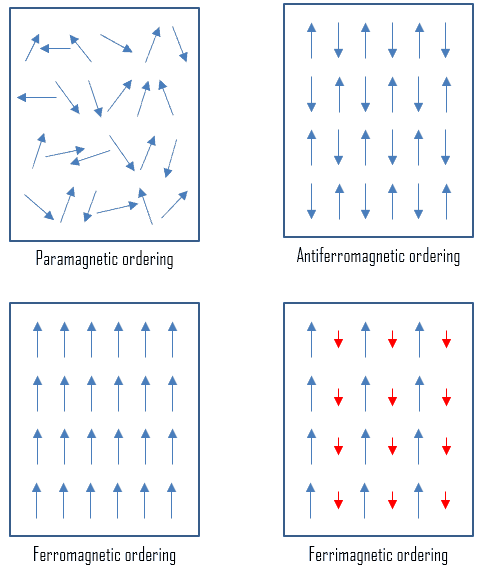
 Five basic types of magnetism have been observed and classified based on the magnetic behavior of materials in response to magnetic fields at different temperatures. From this point of view, these types of materials are:
- Diamagnetic Material. Diamagnetic materials are those that some people generally think of as non-magnetic. A magnetic field repels diamagnetic materials; an applied magnetic field creates an induced magnetic field in the opposite direction, causing a repulsive force. Diamagnetism results from changes in electron orbital motion induced by an external field. Diamagnetic materials include water, wood, most organic compounds such as petroleum and some plastics, and many metals, including copper, particularly the heavy ones with many core electrons, such as mercury, gold, and bismuth. The effect is extremely small (with susceptibilities on the order of -10-5) and in opposition to the applied field. Diamagnetic materials, like water, or water-based materials, have a relative magnetic permeability that is less than or equal to 1 and, therefore, a magnetic susceptibility less than or equal to 0 since susceptibility is defined as χv = μv − 1. Diamagnetic and paramagnetic materials are considered non-magnetic because the magnetizations are relatively small and persist only while an applied field is present. If χ (magnetic susceptibility) is negative, the material is diamagnetic. In this case, the magnetic field in the material is weakened by the induced magnetization. Magnetic fields repel diamagnetic materials. For example, the magnetic susceptibility of diamagnets such as water is χv = −9.05×10⁻⁶. The most strongly diamagnetic material is bismuth, χv = −1.66×10⁻⁴. Generally, non-magnetic materials are said to be para- or diamagnetic because they do not possess permanent magnetization without an external magnetic field.
- Paramagnetic Materials. Paramagnetic materials have permanent atomic dipoles, which are acted on individually and aligned in the direction of an external field. Diamagnetic and paramagnetic materials are considered non-magnetic because the magnetizations are relatively small and persist only while an applied field is present. If χ (magnetic susceptibility) is positive, a material can be paramagnetic. In this case, the magnetic field in the material is strengthened by induced magnetization. Paramagnetic materials include most chemical elements and some compounds. They have a relative magnetic permeability slightly greater than 1 (i.e., a small positive magnetic susceptibility) and hence are attracted to magnetic fields. Generally, non-magnetic materials are said to be para- or diamagnetic because they do not possess permanent magnetization without an external magnetic field.
- Ferromagnetic Materials. Ferromagnetism is the basic mechanism by which material forms a permanent magnet (i.e., materials that can be magnetized by an external magnetic field and remain magnetized after the external field is removed). Ferromagnetism is the strongest type and is responsible for this common phenomenon. Ferromagnetic, ferrimagnetic, or antiferromagnetic materials possess permanent magnetization without an external magnetic field and do not have a well-defined zero-field susceptibility. Permanent magnetic moments in ferromagnetic materials result from atomic magnetic moments due to unpaired electron spins due to the electron structure. There is also a small orbital magnetic moment contribution compared to the spin moment. Thus, even in the absence of an applied field, the magnetic moments of the electrons in the material spontaneously line up parallel to one another. Every ferromagnetic material has its own individual temperature, called the Curie temperature, or Curie point, above which it loses its ferromagnetic properties. This is because the thermal tendency to disorder overwhelms the energy-lowering due to ferromagnetic order. Only a few substances are ferromagnetic. The common ones are iron, cobalt, nickel, most of their alloys, and some compounds of rare earth metals. Ferromagnetism is very important in industry and modern technology. Ferromagnetic materials can be divided into magnetically “soft” materials like annealed iron, which can be magnetized but does not tend to stay magnetized, and magnetically “hard” materials, which do. Permanent magnets are made from “hard” ferromagnetic materials such as alnico and ferrite that are subjected to special processing in a strong magnetic field during manufacture to align their internal microcrystalline structure, making them very hard to demagnetize.
- Antiferromagnetic Materials. In an antiferromagnet, unlike a ferromagnet, there is a tendency for the intrinsic magnetic moments of neighboring valence electrons to point in opposite directions. The substance is antiferromagnetic when all atoms are arranged in a substance so that each neighbor is anti-parallel. Antiferromagnets have a zero net magnetic moment, producing no field. Manganese oxide (MnO) is one material that displays this behavior. Generally, antiferromagnetic order may exist at sufficiently low temperatures but vanishes at and above the Néel temperature. Above the Néel temperature, the material is typically paramagnetic. That is, the thermal energy becomes large enough to destroy the microscopic magnetic ordering within the material. The Néel temperature of MnO is about 116K.
- Ferrimagnetic Materials. The macroscopic magnetic characteristics of ferromagnets and ferrimagnets are similar, and the distinction lies in the source of the net magnetic moments. A ferrimagnetic material has populations of atoms with opposing magnetic moments, as in antiferromagnetism; however, in ferrimagnetic materials, the opposing moments are unequal, and spontaneous magnetization remains. Ferromagnetic, ferrimagnetic, or antiferromagnetic materials possess permanent magnetization without an external magnetic field and do not have a well-defined zero-field susceptibility. Ferrites (widely used in household products such as refrigerator magnets) are usually ferrimagnetic ceramic compounds derived from iron oxides, and Magnetite (Fe3O4) is a famous example.
Generally, proper choice of materials is crucial in the main generator, where strong magnetic fields are present in nuclear power plants and power plants. In general, the main generator consists of a rotating part and a stationary part:
- Stator. The stator is the stationary part of an electric generator, which surrounds the rotor. The stator has a wire winding in which the changing field induces an electric current
- Rotor. The rotor is the rotating part of an electric generator and generates a magnetic field.