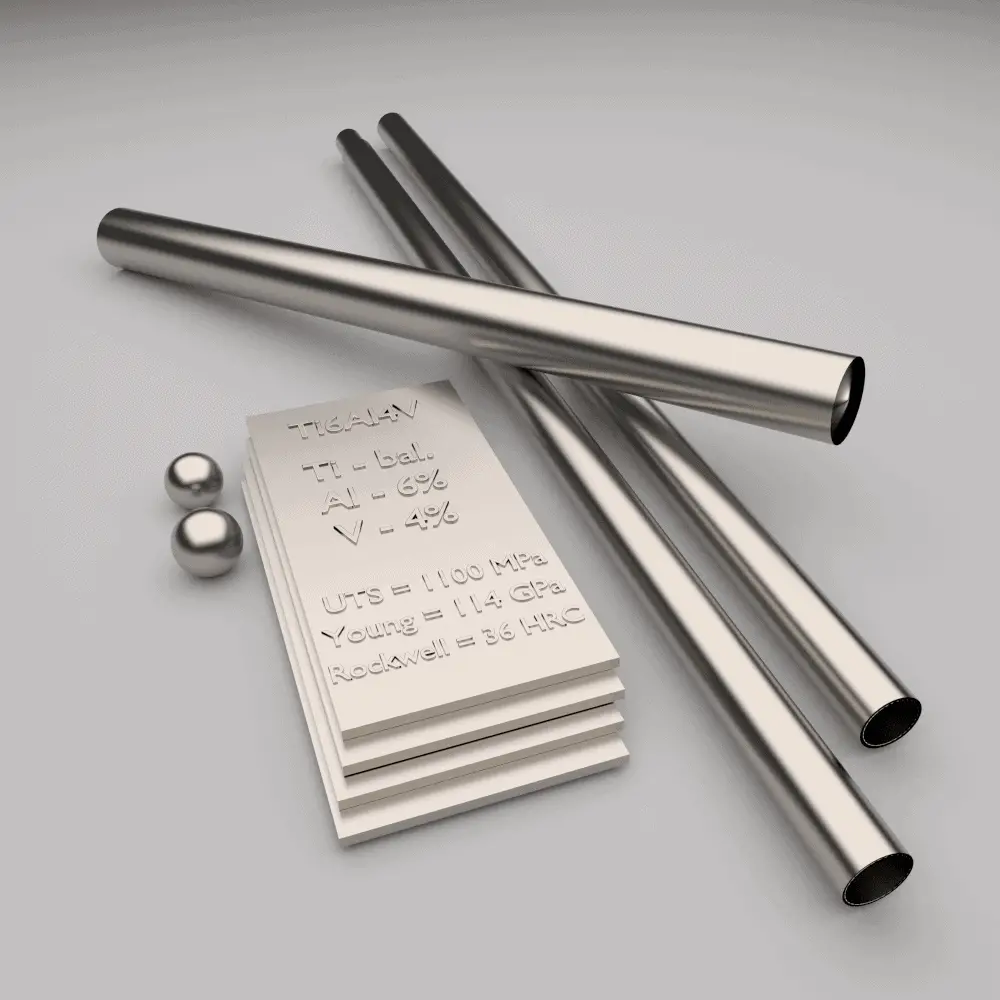
 Titanium is a lustrous transition metal with a silver color, low density, and high strength. Titanium is resistant to corrosion in seawater, aqua regia, and chlorine. In power plants, titanium can be used in surface condensers. Pure titanium is stronger than common, low-carbon steels but 45% lighter. It is also twice as strong as weak aluminium alloys but only 60% heavier. The two most useful properties of the metal are corrosion resistance and strength-to-density ratio, the highest of any metallic element. The corrosion resistance of titanium alloys at normal temperatures is unusually high. Titanium’s corrosion resistance is based on forming a stable, protective oxide layer. Although “commercially pure” titanium has acceptable mechanical properties and has been used for orthopedic and dental implants, titanium is alloyed with small amounts of aluminium and vanadium, typically 6% and 4%, respectively, for most applications by weight. This mixture has a solid solubility that varies dramatically with temperature, allowing it to undergo precipitation strengthening.
Titanium alloys are metals that contain a mixture of titanium and other chemical elements. Such alloys have high tensile strength and toughness (even at extreme temperatures). They are light in weight, have extraordinary corrosion resistance, and can withstand extreme temperatures.
Commercially Pure Titanium – Grade 1 in Steam Condensers
In nuclear power plants, the main steam condenser (MC) system is designed to condense and deaerate the exhaust steam from the main turbine and provide a heat sink for the turbine bypass system. The exhaust steam from the LP turbines is condensed by passing over tubes containing water from the cooling system. These tubes are usually made of stainless steel, copper alloys, or titanium, depending on several selection criteria (such as thermal conductivity or corrosion resistance). Titanium condenser tubes are usually the best technical choice. However, titanium is a very expensive material, and titanium condenser tubes are associated with very high initial costs. Titanium, in particular, can bring major improvements, such as higher water velocities promoting better heat coefficients and excellent resistance to abrasion, erosion, and corrosion, thereby improving resistance to fouling. Tubes are mostly welded tubes from ASTM SB 338 grade 1 made on a continuous manufacturing line. This commercially pure titanium is the softest titanium and has the highest ductility. It has a good cold forming characteristics and provides excellent corrosion resistance. It also has excellent welding properties and high impact toughness. All manufacturing operations (welding, annealing, non-destructive testing) are fully automated to produce high-quality tubes in large quantities.
Thermal Properties of Titanium Alloys
Thermal properties of materials refer to the response of materials to changes in their temperature and the application of heat. As a solid absorbs energy in the form of heat, its temperature rises, and its dimensions increase. But different materials react to the application of heat differently.
Heat capacity, thermal expansion, and thermal conductivity are often critical in solids’ practical use.
Melting Point of Titanium Alloys
The melting point of commercially pure titanium – Grade 2 is around 1660°C.
The melting point of Ti-6Al-4V – Grade 5 titanium alloy is around 1660°C.
In general, melting is a phase change of a substance from the solid to the liquid phase. The melting point of a substance is the temperature at which this phase change occurs. The melting point also defines a condition where the solid and liquid can exist in equilibrium.
Thermal Conductivity of Titanium Alloys
The thermal conductivity of commercially pure titanium – Grade 2 is 16 W/(m. K).
The thermal conductivity of Ti-6Al-4V – Grade 5 titanium alloy is 6.7 W/(m. K).
The heat transfer characteristics of solid material are measured by a property called the thermal conductivity, k (or λ), measured in W/m.K. It measures a substance’s ability to transfer heat through a material by conduction. Note that Fourier’s law applies to all matter, regardless of its state (solid, liquid, or gas). Therefore, it is also defined as liquids and gases.
The thermal conductivity of most liquids and solids varies with temperature, and for vapors, it also depends upon pressure. In general:
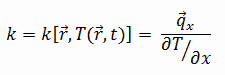
Most materials are nearly homogeneous. Therefore we can usually write k = k (T). Similar definitions are associated with thermal conductivities in the y- and z-directions (ky, kz). However, for an isotropic material, the thermal conductivity is independent of the transfer direction, kx = ky = kz = k.