Corrosion is the deterioration of a material due to chemical interaction with its environment. It is a natural process in which metals convert their structure into a more chemically-stable form, such as oxides, hydroxides, or sulfides. The consequences of corrosion are all too common. Familiar examples include the rusting of automotive body panels and pipings and many tools. Corrosion is usually a negative phenomenon since it is associated with the mechanical failure of an object. Metal atoms are removed from a structural element until it fails, or oxides build up inside a pipe until it is plugged. All metals and alloys are subject to corros, and evenven noble metals, such as gold, are subject to corrosive attack in some environments.
Selective Leaching – Selective Corrosion
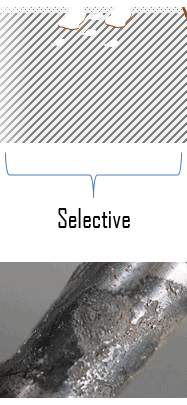 Selective leaching or selective corrosioremovesof one element from a solid alloy by the corrosion process. The most common example is the dezincification of brass, in which zinc is selectively leached from a copper-zinc brass alloy, producing a weakened porous copper structure. The selective removal of zinc can be in a uniform manner or localized scale.
However, many alloys are subject to selective leaching under certain conditions. A similar process occurs in other alloy systems where aluminum, iron, cobalt, chromium, and other elements are removed. Elements in an alloy that are more resistant to the environment remain behind. Two mechanisms are involved:
- Two metals in an alloy are dissolved; one metal redeposits on the surface of the surviving elements.
- One metal is selectively dissolved, leaving the other metals behind.
The first systeinvolvesin the dezincification of brasses, and the second system is involved when molybdenum is removed from nickel alloys in molten sodium hydroxide.