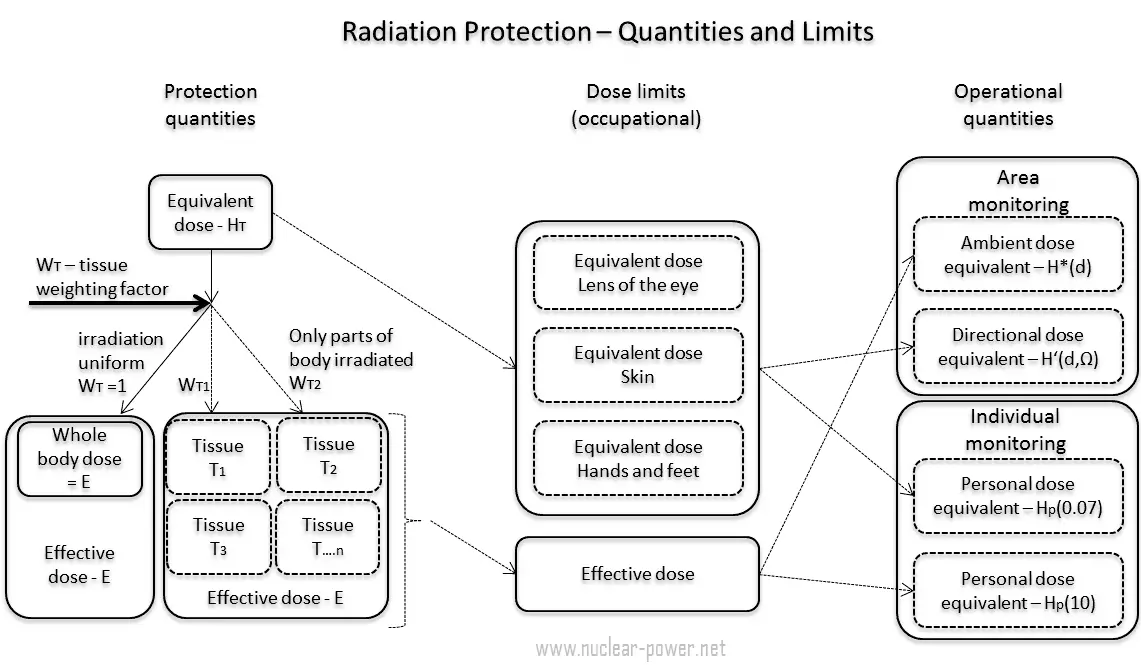
In general, the ICRP defines operational quantities for the area and individual monitoring of external exposures. The operational quantities for area monitoring are:
- Ambient dose equivalent, H*(10). The ambient dose equivalent is an operational quantity for area monitoring of strongly penetrating radiation.
- Directional dose equivalent, H’ (d, Ω). The directional dose equivalent is an operational quantity for area monitoring weakly penetrating radiation.
The operational quantities for individual monitoring are:
- Personal dose equivalent, Hp(0.07). The Hp(0.07) dose equivalent is an operational quantity for individual monitoring to assess the dose to the skin, hands, and feet.
- Personal dose equivalent, Hp(10). The Hp(10) dose equivalent is an operational quantity for individual monitoring to assess the effective dose.
Special Reference: ICRP, 2007. The 2007 Recommendations of the International Commission on Radiological Protection. ICRP Publication 103. Ann. ICRP 37 (2-4).
Deep Dose Equivalent and Shallow Dose Equivalent
Personal Dose Equivalent – Hp(10) – Hp(0.07)
Generally, the personal dose equivalent, Hp(d), is an operational quantity for individual monitoring. According to the ICRP, the personal dose equivalent is defined as:
ICRP Publication 103:
“The dose equivalent in soft tissue (commonly interpreted as the ‘ICRU sphere’) at an appropriate depth, d, below a specified point on the human body.”
The personal dose equivalent is given the symbol Hp(d). Two common operational quantities for individual monitoring defined by the ICRP are:
- Personal dose equivalent, Hp(0.07). The Hp(0.07) dose equivalent is an operational quantity for individual monitoring to assess the dose to the skin, hands, and feet.
- Personal dose equivalent, Hp(10). The Hp(10) dose equivalent is an operational quantity for individual monitoring to assess the effective dose.
As can be seen, various depths can be used. The personal dose equivalent, Hp(d), can be assessed indirectly with a thin, tissue-equivalent detector (radiation dosimeter) worn at the body’s surface and covered with an appropriate thickness of tissue-equivalent material. The specified point, d, is normally taken where the radiation dosimeter is worn.
For assessment of superficial organs and the control of equivalent dose, depths of 0.07 mm for skin and 3 mm for the eye lens are employed, and the personal dose equivalents for those depths are denoted by Hp(0.07) and Hp(3), respectively. Hp(0.07) is also called the shallow dose equivalent.
Hp(10) with a depth d = 10 mm is chosen to assess deep organs and control of effective dose. Hp(10) is also called the deep dose equivalent. If the personal dosimeter is worn on a position of the body representative of its exposure, at low doses, and under the assumption of a uniform whole-body exposure, the Hp(10) provides an effective dose value sufficiently precise for radiological protection purposes. Neutron and gamma radiations contribute to both deep and shallow doses, but beta radiation is completely absorbed in the skin and contributes to shallow doses only.