We must note that radiation is all around us. In, around, and above the world we live in. It is a natural energy force that surrounds us, and it is a part of our natural world that has been here since the birth of our planet. Whether the source of radiation is natural or man-made, whether it is a large dose of radiation or a small dose, there will be some biological effects. In general, ionizing radiation is harmful and potentially lethal to living beings. Still, it can have health benefits in medicine, for example, in radiation therapy to treat cancer and thyrotoxicosis. This chapter briefly summarizes the short and long-term consequences of radiation exposure. But first, we need to define the differences in the types of radiation and the differences in the affected tissues.
High-LET and Low-LET Radiation
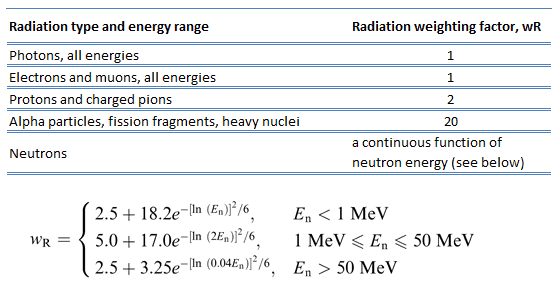
As was written, each type of radiation interacts with matter in a different way. For example, charged particles with high energies can directly ionize atoms. Alpha particles are fairly massive and carry a double positive charge, so they tend to travel only a short distance and do not penetrate very far into a tissue, if at all. However, alpha particles will deposit their energy over a smaller volume (possibly only a few cells if they enter a body) and cause more damage to those few cells.
Beta particles (electrons) are much smaller than alpha particles and carry a single negative charge. They are more penetrating than alpha particles and can travel several meters but deposit less energy at any point along their paths than alpha particles. This means beta particles tend to damage more cells but with lesser damage. On the other hand, electrically neutral particles interact indirectly but can also transfer some or all of their energies to the matter.
It would certainly simplify matters if the biological effects of radiation were directly proportional to the absorbed dose. Unfortunately, biological effects also depend on how the absorbed dose is distributed along the radiation path. Studies have shown that alpha and neutron radiation cause greater biological damage for a given energy deposition per kg of tissue than gamma radiation does. The biological effects of any radiation increase with the linear energy transfer (LET). In short, the biological damage from high-LET radiation (alpha particles, protons, or neutrons) is much greater than that from low-LET radiation (gamma rays). This is because the living tissue can more easily repair damage from radiation spread over a large area than concentrated in a small area. Of course, at very high levels of exposure, gamma rays can still cause a great deal of damage to tissues.
Because more biological damage is caused for the same physical dose (i.e., the same energy deposited per unit mass of tissue), one gray of alpha or neutron radiation is more harmful than one gray of gamma radiation. The fact that radiations of different types (and energies) give different biological effects for the same absorbed dose is described in terms of factors known as the relative biological effectiveness (RBE) and the radiation weighting factor (wR).
Cellular Damage – Radiation
All biological damage effects begin with the consequence of radiation interactions with the atoms forming the cells. All living things are composed of one or more cells, and every part of your body consists of cells or was built by them. Although we tend to think of biological effects in terms of the effect of radiation on living cells, in actuality, ionizing radiation, by definition, interacts only with atoms by a process called ionization. The kinetic energy of particles (photons, electrons, etc.) of ionizing radiation is sufficient for ionizing radiation. The particle can ionize (to form ions by losing electrons) target atoms to form ions, and ionizing radiation can knock electrons from an atom.
There are two mechanisms by which radiation ultimately affects cells. These two mechanisms are commonly called:
- Direct effects. Direct effects are caused by radiation when radiation interacts directly with the atoms of the DNA molecule or some other cellular component critical to the cell’s survival. The probability of the radiation interacting with the DNA molecule is very small since these critical components make up such a small part of the cell.
- Indirect effects. Indirect effects are caused by the interaction of radiation, usually with water molecules. Each cell, just as is the case for the human body, is mostly water. Ionizing radiation may break the bonds that hold the water molecule together, producing radicals such as hydroxyl OH, superoxide anion O2– and others. These radicals can contribute to the destruction of the cell.
A large number of cells of any particular type is called a tissue. If this tissue forms a specialized functional unit, it is called an organ. The type and number of cells affected is also important factor. Some cells and organs in the body are more sensitive to ionizing radiation than others.
The sensitivity of various types of cells to ionizing radiation is very high for tissues consisting of cells that divide rapidly like those found in bone marrow, stomach, intestines, male and female reproductive organs, and developing fetuses. This is because dividing cells require correct DNA information for the cell’s offspring to survive. Direct interaction of radiation with an active cell could result in the death or mutation of the cell, whereas a direct interaction with the DNA of a dormant cell would have less of an effect.
As a result, living cells can be classified according to their reproduction rate, indicating their relative sensitivity to radiation. As a result, actively reproducing cells are more sensitive to ionizing radiation than cells that make up skin, kidney, or liver tissue. The nerve and muscle cells are the slowest to regenerate and are the least sensitive cells.
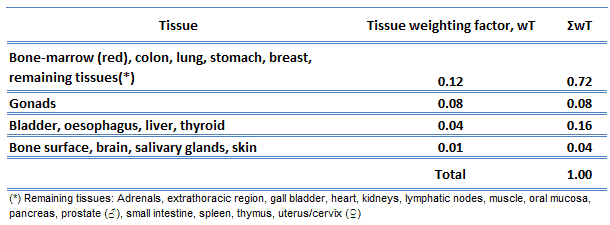 The sensitivity of the various organs of the human body correlates with the relative sensitivity of the cells from which they are composed. In practice, this sensitivity is represented by the tissue weighting factor, wT, which is the factor by which the equivalent dose in a tissue or organ T is weighted to represent the relative contribution of that tissue or organ to the total health detriment resulting from uniform irradiation of the body (ICRP 1991b).
If a person is irradiated only partially, the dose will depend strongly on the irradiated tissue. For example, a 10 mSv gamma dose to the whole body and a 50 mSv dose to the thyroid is the same, in terms of risk, as a whole-body dose of 10 + 0.04 x 50 = 12 mSv.
Acute Dose and Chronic Dose
The biological effects of radiation and their consequences depend strongly on the level of dose rate obtained. Dose rate is a measure of radiation dose intensity (or strength). Low-level doses are common in everyday life. In the following points, a few examples of radiation exposure can be obtained from various sources.
- 05 µSv – Sleeping next to someone
- 09 µSv – Living within 30 miles of a nuclear power plant for a year
- 1 µSv – Eating one banana
- 3 µSv – Living within 50 miles of a coal power plant for a year
- 10 µSv – Average daily dose received from natural background
- 20 µSv – Chest X-ray
From biological consequences point of view, it is very important to distinguish between doses received over short and extended periods. Therefore, the biological effects of radiation are typically divided into two categories.
- Acute Doses. An “acute dose” (short-term high-level dose) occurs over a short and finite period, i.e., within a day.
- Chronic Doses. A “chronic dose” (long-term low-level dose) is a dose that continues for an extended period, i.e., weeks and months, so that a dose rate better describes it.
High doses tend to kill cells, while low doses tend to damage or change them. High doses can cause visually dramatic radiation burns and/or rapid fatality through acute radiation syndrome. Acute doses below 250 mGy are unlikely to have any observable effects. Acute doses of about 3 to 5 Gy have a 50% chance of killing a person some weeks after the exposure if a person receives no medical treatment.
Low doses spread out over long periods don’t cause an immediate problem to any body organ. The effects of low radiation doses occur at the cell level, and the results may not be observed for many years. Moreover, some studies demonstrate that most human tissues exhibit a more pronounced tolerance to the effects of low-LET radiation in case of a prolonged exposure compared to a one-time exposure to a similar dose.