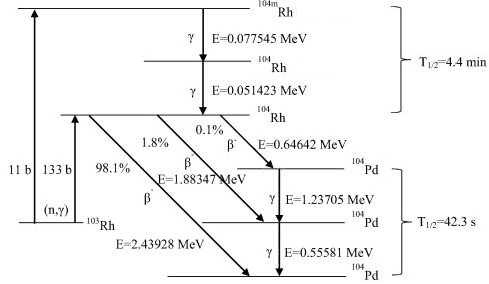
 One possible material is rhodium as the emitter. An SPND with a rhodium emitter has a relatively high sensitivity, a high burn-up rate that perturbs the local power density, and a (two-fold) delayed signal. A rhodium-based detector is the beta-current type of self-powered detector, which uses the following activation reaction to produce a current that can be measured.
1n + 103Rh → 104Rh → 104Pd + β
As can be seen, a neutron captured by rhodium-103 causes a rhodium-103 atom to become a radioactive rhodium-104 atom. The rhodium-104 then decays into palladium-104 plus a beta particle (electron). The beta particle has enough energy to pass through the insulator and reach the collector. The half-life of activated rhodium-104 is 42.3 seconds, which delays the emission of the charged particle. The rhodium-based detector uses this production of beta particles (electrons) to create a current proportional to the number of neutrons captured by the emitter and local reactor power density. A portion of the detector’s current flow is due to gamma rays. A background correction is performed via a background detector consisting of the same components as the detector to compensate for this erroneous signal, except the rhodium is removed.
Rhodium-103 has a capture cross-section of 133 barns for thermal neutrons and a resonance at 1.25 eV. This reaction leads to the production of 104Rh with T1/2 = 42 sec, which is beta radioactive. It must be noted about 11 barns belong to a reaction in which an isomer 104mRh is produced (with T1/2 = 4.4 min).
The following characteristics are typical when used in thermal power reactors (e.g., PWR).
- The rhodium burn-up rate is 0.39% per month in a thermal neutron flux of 1013n/cm2/sec.
- 92% of the signal has a half-life of 42 seconds.
- 8% of the signal has a half-life of 4.4 minutes.
- The beta emission has an energy of 2.44 MeV.