The Sun is a hot star. Really hot star. But all of the heat and light coming from the Sun comes from the fusion reactions happening inside the core of the Sun. Inside the Sun, the pressure is millions of times more than the surface of the Earth, and the temperature reaches more than 15 million Kelvin. Massive gravitational forces create these conditions for nuclear fusion. On Earth, it is impossible to achieve such conditions.
The Sun burns hydrogen atoms, which fuse to form helium nuclei, and a small amount of matter is converted into energy. At its core, the Sun consumes approximately 620 million metric tons of hydrogen each second. Hydrogen, heated to very high temperatures, changes from a gaseous state to a plasma state. Normally, fusion is not possible because the strongly repulsive electrostatic forces between the positively charged nuclei prevent them from getting close enough together to collide and for fusion to occur. The mechanism how to overcome the coulomb barrier is by the temperature and by the pressure. At close distances, the attractive nuclear force allows the nuclei to fuse.
Proton-proton Fusion
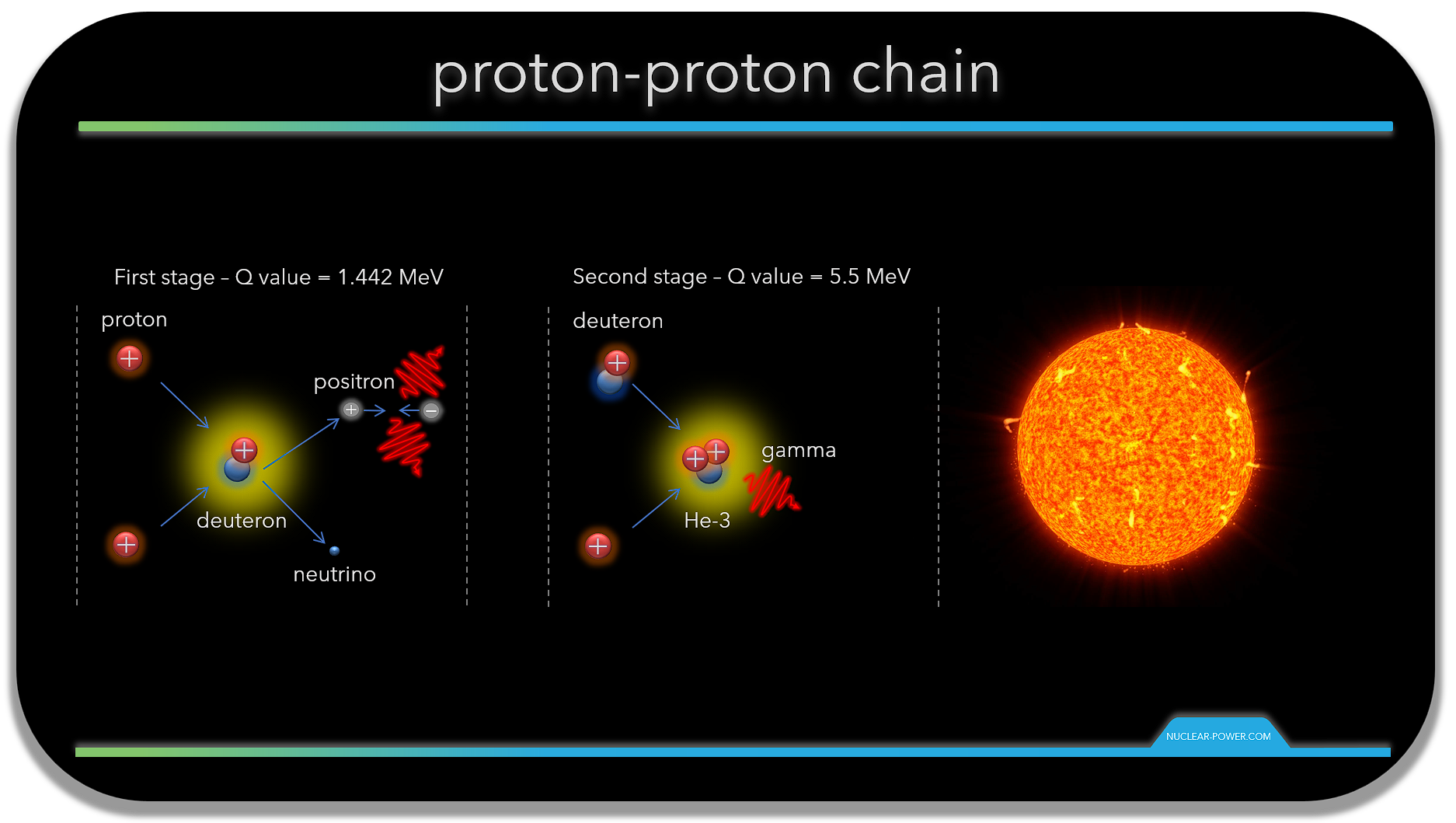
During most of the Sun’s life, energy has been produced by nuclear fusion in the core region through the proton-proton chain. This process converts hydrogen into helium.
In general, proton-proton fusion can occur only if the kinetic energy of the protons is high enough to overcome their mutual electrostatic repulsion. The first step in all the branches is the fusion of two protons into a deuteron. As the protons fuse, one of them undergoes beta plus decay, converting into a neutron by emitting a positron and an electron neutrino.
It must be noted a deuteron-producing event is very rare due to it being initiated by a weak nuclear force. Diprotons are the much more common result of proton-proton reactions, but diprotons almost immediately decay back into two protons. The cross-section of the deuteron-producing reaction is so small that it has not been possible to measure it experimentally. This is very important because it significantly limits the reaction rate. The average proton in the core of the Sun waits 9 billion years before it successfully fuses with another proton. The Q value for the deuteron-producing reaction is plus 1.442 megaelectron volts.
The deuteron produced in the first stage can then fuse with another proton to produce the isotope of helium 3. The Q value is 5.5 megaelectron volts. This second process is mediated by the strong nuclear force rather than the weak force. Therefore, it is extremely fast in comparison to the first step. It is estimated that each newly created deuterium nucleus exists for only about one second before it is converted into helium-3. Helium-3 is then in various branches converted into helium-4.
And why is the first stage so important?
This energy supports almost all life on Earth by photosynthesis, and drives Earth’s climate and weather.