Weak Interaction – Weak Force
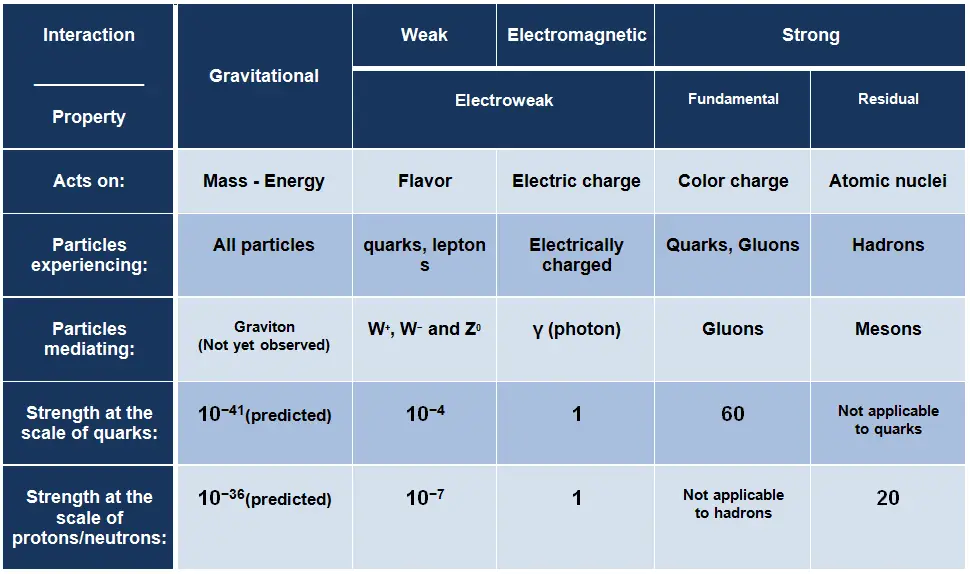
The weak interaction or weak force is one of the four fundamental forces and involves the exchange of the intermediate vector bosons, the W and the Z. Since these bosons are very massive (on the order of 80 GeV, the uncertainty principle dictates a range of about 10-18meters which is less than the diameter of a proton. As a result, the weak interaction takes place only at very small, sub-atomic distances.
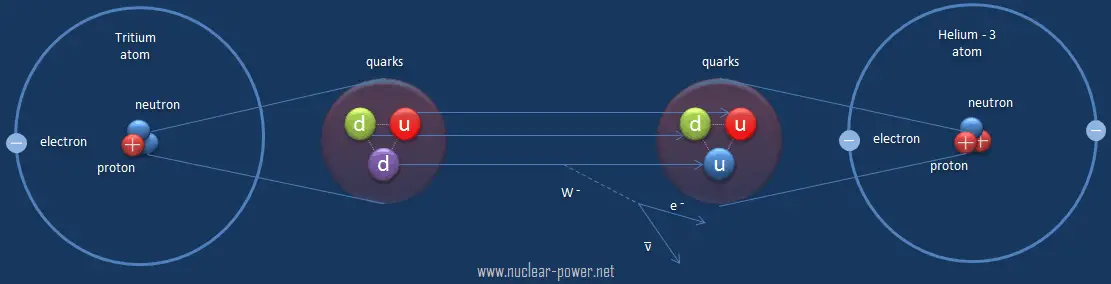
The weak interaction is responsible for some nuclear phenomena, such as beta decay, which can be understood as the weak force operating on the quarks within the neutron. One of two down quarks changes into an up quark by emitting a W– boson (carries away a negative charge). The W– boson then decays into a beta particle and an antineutrino. This process is equivalent to how a neutrino interacts with a neutron.
Electromagnetic Interaction – Electromagnetic Force
The electromagnetic force is the force responsible for all electromagnetic processes. It acts between electrically charged particles. It is an infinite-ranged force, much stronger than the gravitational force, and obeys the inverse square law. Still, neither electricity nor magnetism adds up in the way that gravitational force does. Since there are positive and negative charges (poles), these charges tend to cancel each other out. Electromagnetism includes the electrostatic force acting between charged particles at rest and the combined effect of electric and magnetic forces acting between charged particles moving relative to each other.
The photon, the quantum of electromagnetic radiation, is an elementary particle that is the electromagnetic force carrier. Photons are gauge bosons with no electric charge or rest mass and one spin unit. Common to all photons is the speed of light, the universal constant of physics. In empty space, the photon moves at c (the speed of light – 299 792 458 meters per second).
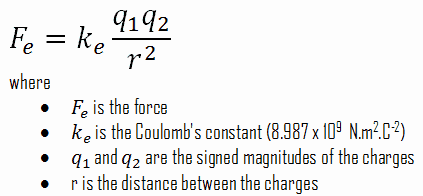
Forces between static electrically charged particles are governed by Coulomb’s law. Coulomb’s law can be used to calculate the force between charged particles (e.g., two protons). The electrostatic force is directly proportional to the electrical charges of the two particles and inversely proportional to the square of the distance between the particles. Coulomb’s law is stated as the following equation.
Coulomb’s law and magnetic force are summarized in the Lorentz force law. Fundamentally, both magnetic and electric forces are manifestations of an exchange force involving the exchange of photons.
The electromagnetic force plays a major role in determining the internal properties of most objects encountered in daily life. The chemical properties of atoms and molecules are determined by the number of protons and by the number and arrangement of electrons.
Weak Force vs Electromagnetic Force