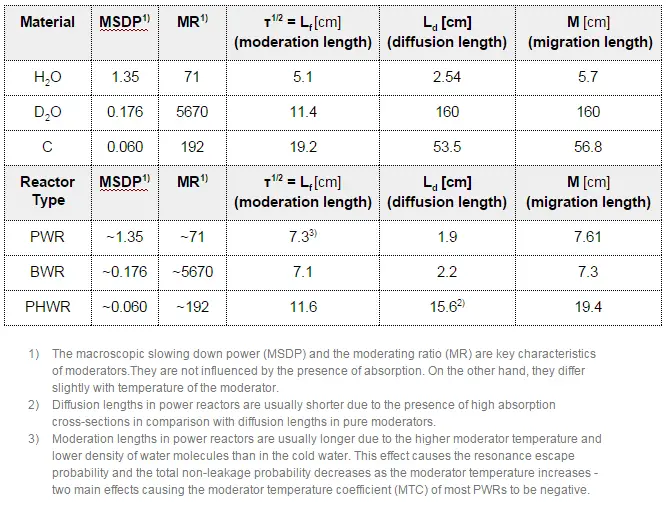
Logically, the reflector coefficient (albedo) increases as the reflector thickness increases. But how thick should a reflector be? From an engineering point of view, reflectors are, of course, limited by certain reactor designs (e.g.,, by the width of the reactor pressure vessel). But, in general, very little is to be gained by increasing the thickness of the reflector beyond a value of 2L (2 x diffusion length).
With H20, a thickness of 2L is only about 5 cm, whereas, for D20, it is about 300 cm. It would require a considerable amount of D20 to extend the moderator by 300 cm since this additional D20 is being placed on the outside of the core. From these values, it is obvious the neutron reflector plays a crucial role in heavy water or graphite reactors, in which the neutron leakage is higher than in LWRs.