Assume a reactor trip (SCRAM) from hot zero power (from “zero power criticality”). The power decrease, in this case, does not influence the criticality (keff). In this case, the reactivity of the multiplying system becomes quickly negative and higher than β (i.e., that ρ is negative and ρ ≪ β).
The rate at which the reactor fission rate decays immediately following the shutdown is similar for all reactors, provided a large amount of negative reactivity is inserted. After a large negative reactivity addition, the neutron level undergoes a rapid decrease of about two decades (prompt drop) until it is at the production level of delayed neutrons.
But even if it were possible to insert an infinite negative reactivity, the neutron flux would not immediately fall to zero. Prompt neutrons will be absorbed almost immediately. It is consistent with the prompt drop formula. Therefore the resulting neutron flux will be:
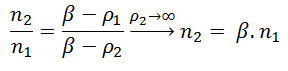
Obviously, the neutron flux cannot drop below the value βn1. The real values are much higher. The integral worth of all control and emergency rods (PWRs) is, for example -9000pcm. It is equal to ρ = -9000/600 = -15β = -0.09. (β= 600pcm = 0.006)
For this negative reactivity, the prompt drop is equal to:
n2/n1 = 0.006/(0.006+0.09)=0.063
which is about ten times higher than in the case of an infinite negative reactivity insertion.
 The neutron flux then continues to fall according to the stable period. The first root of the reactivity equation occurs at s0 = – λ1, the decay constant of the long-lived precursor group. The shortest negative stable period is then e = – 1/λ1 = -80s. The neutron flux cannot be reduced more rapidly than this period. On the other hand, the prompt drop causes an immediate drop to about 6% of rated power. Within a few tens of seconds, the thermal power that originates from nuclear fission is below the thermal power that originates from decay heat.
There is an exception to this behavior, and it is a SCRAM of a heavy water reactor. In a heavy water reactor, the photoneutron source is extremely large after shutdown due to the amount of deuterium in the moderator and many high energy gammas from short-lived fission product decay. This high gamma flux from short-lived fission products will decrease rapidly after shutdown. The photoneutron source is large enough to significantly impact the neutron population immediately after shutdown. The photoneutron source results in flux levels decreasing more slowly so that a heavy water reactor will have a significantly larger negative reactor period after a shutdown.