Facebook Instagram Youtube Twitter

Silver – Electron Affinity – Electronegativity – Ionization Energy of Silver

Electron Affinity and Electronegativity of Silver

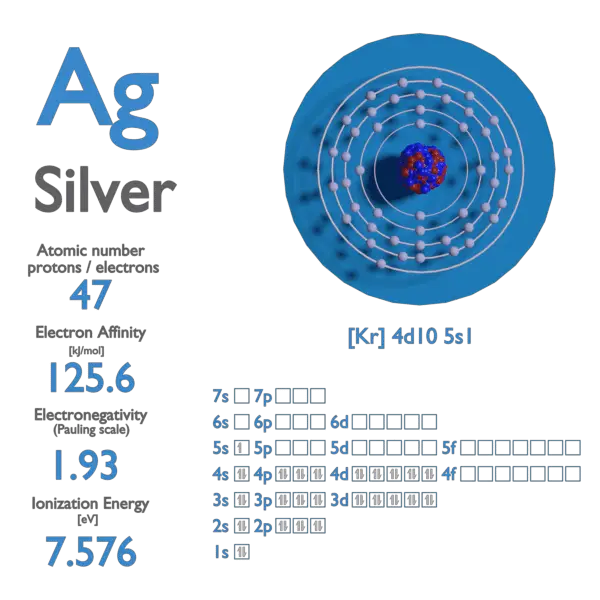
Electron Affinity of Silver is 125.6 kJ/mol.

Electronegativity of Silver is 1.93.

First Ionization Energy of Silver is 7.5762 eV.

Electron Affinity

In chemistry and atomic physics, the electron affinity of an atom or molecule is defined as:

the change in energy (in kJ/mole) of a neutral atom or molecule (in the gaseous phase) when an electron is added to the atom to form a negative ion.

X + e → X + energy        Affinity = – ∆H

Silver - Electron Affinity - Electronegativity - Ionization Energy
In other words, it can be expressed as the neutral atom’s likelihood of gaining an electron. Note that ionization energies measure the tendency of a neutral atom to resist the loss of electrons. Electron affinities are more difficult to measure than ionization energies.

An atom of Silver in the gas phase, for example, gives off energy when it gains an electron to form an ion of Silver.

Ag + e → Ag        – ∆H = Affinity = 125.6 kJ/mol

Electron affinity is one of the most important parameters that guide chemical reactivity. Molecules with high electron affinity form very stable negative ions which are important in the chemical and health industry as they purify the air, lift mood, and most importantly, act as strong oxidizing agents. To use electron affinities properly, it is essential to keep track of signs. When an electron is added to a neutral atom, energy is released. This affinity is known as the first electron affinity, and these energies are negative. By convention, the negative sign shows a release of energy. However, more energy is required to add an electron to a negative ion which overwhelms any release of energy from the electron attachment process. This affinity is known as the second electron affinity, and these energies are positive.

Halogens have the highest electron affinities among all elements. In fact, the electron affinity of Cl, 3.62 eV is the largest of all the elements. Superhalogens are molecules that have electron affinities (EA) greater than that of Cl, the element with the highest EA (3.62 eV).

It is well known that noble gases have closed electronic shell structure and hence have high ionization potentials and low electron affinities, due to which they are chemically inert and resistant to salt formation under most conditions.

Affinities of Nonmetals vs. Affinities of Metals

  • Metals: Metals like to lose valence electrons to form cations to have a fully stable shell. The electron affinity of metals is lower than that of nonmetals. Mercury most weakly attracts an extra electron.
  • Nonmetals: Generally, nonmetals have more positive electron affinity than metals. Nonmetals like to gain electrons to form anions to have a fully stable electron shell. Chlorine most strongly attracts extra electrons. The electron affinities of the noble gases have not been conclusively measured, so they may or may not have slightly negative values.

Learn more about electron affinities.

Electronegativity

Electronegativity, symbol χ, is a chemical property that describes the tendency of an atom to attract electrons towards this atom. For this purpose, a dimensionless quantity, the Pauling scale, symbol χ, is the most commonly used.

The electronegativity of Silver is:

χ = 1.93

In general, an atom’s electronegativity is affected by both its atomic number and the distance at which its valence electrons reside from the charged nucleus. The higher the associated electronegativity number, the more an element or compound attracts electrons towards it.

As it is usually calculated, electronegativity is not a property of an atom alone, but rather a property of an atom in a molecule. Even so, the electronegativity of an atom is strongly correlated with the first ionization energy, and negatively correlated with the electron affinity. Electrons with low ionization energies have low electronegativities because their nuclei do not exert a strong attractive force on electrons. Elements with high ionization energies have high electronegativities due to the strong pull exerted by the positive nucleus on the negative electrons. Therefore the electronegativity is greatest at the top-right of the periodic table and decreases toward the bottom-left.

Caesium is the least electronegative element (0.79); fluorine is the most (3.98).

Learn more about electronegativities.
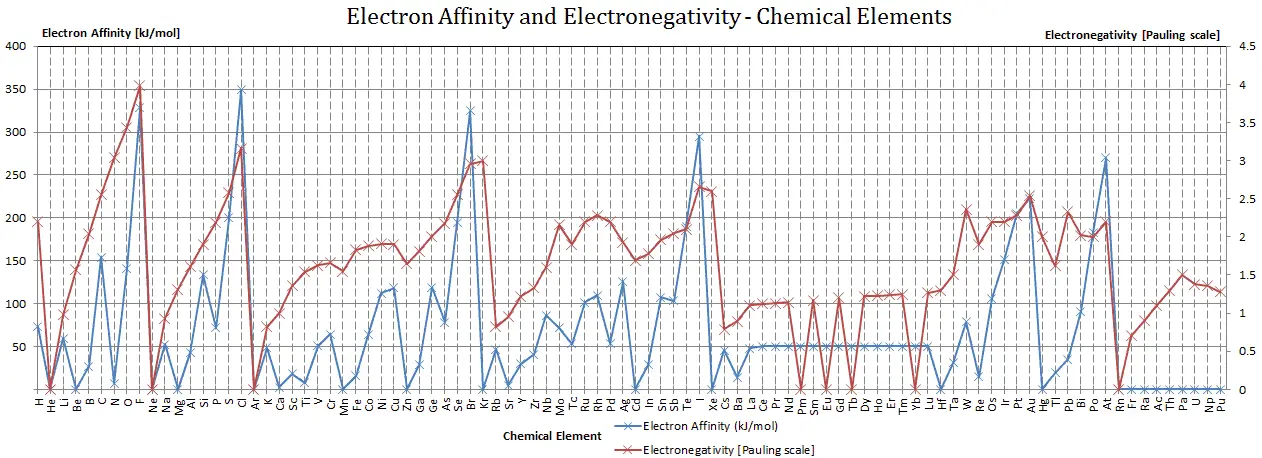
 

electron affinity and electronegativity

First Ionization Energy of Silver

First Ionization Energy of Silver is 7.5762 eV.

Ionization energy, also called ionization potential, is the energy necessary to remove an electron from the neutral atom.

X + energy → X+ + e

where X is any atom or molecule capable of being ionized, X+ is that atom or molecule with an electron removed (positive ion), and e is the removed electron.

A Silver atom, for example, requires the following ionization energy to remove the outermost electron.

Ag + IE → Ag+ + e        IE = 7.5762 eV

The ionization energy associated with removal of the first electron is most commonly used. The nth ionization energy refers to the amount of energy required to remove an electron from the species with a charge of (n-1).

1st ionization energy

X → X+ + e

2nd ionization energy

X+ → X2+ + e

3rd ionization energy

X2+ → X3+ + e

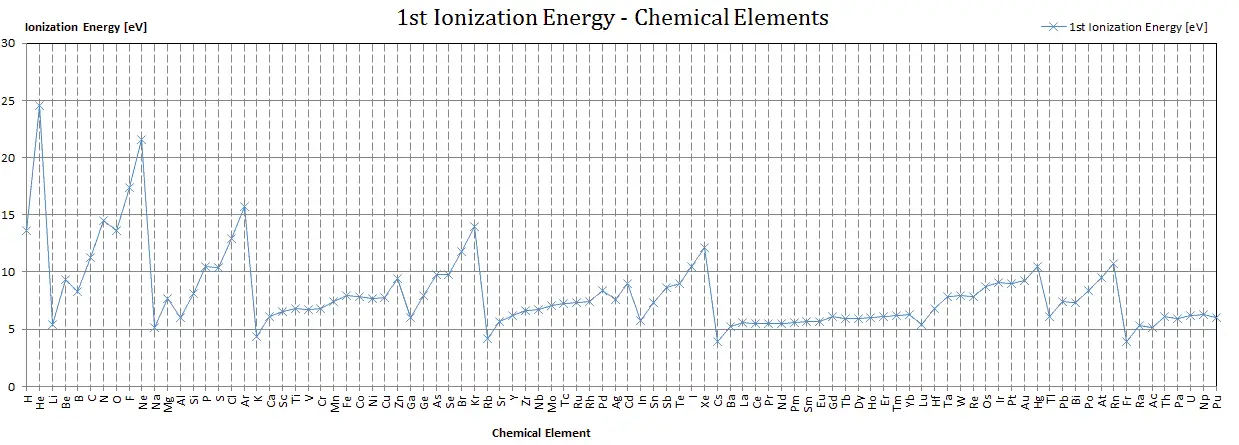
Ionization Energy for different Elements

There is ionization energy for each successive electron removed. The electrons that circle the nucleus move in fairly well-defined orbits. Some of these electrons are more tightly bound in the atom than others. For example, only 7.38 eV is required to remove the outermost electron from a lead atom, while 88,000 eV is required to remove the innermost electron. Helps to understand the reactivity of elements (especially metals, which lose electrons).

In general, the ionization energy increases moving up a group and moving left to right across a period. Moreover:

  • Ionization energy is lowest for the alkali metals which have a single electron outside a closed shell.
  • Ionization energy increases across a row on the periodic maximum for the noble gases which have closed shells.

For example, sodium requires only 496 kJ/mol or 5.14 eV/atom to ionize it. On the other hand neon, the noble gas, immediately preceding it in the periodic table, requires 2081 kJ/mol or 21.56 eV/atom.
Learn more about ionization energy.

ionization energy

Silver – Properties

Element Silver
Atomic Number 47
Symbol Ag
Element Category Transition Metal
Phase at STP Solid
Atomic Mass [amu] 107.8682
Density at STP [g/cm3] 10.49
Electron Configuration [Kr] 4d10 5s1
Possible Oxidation States +1
Electron Affinity [kJ/mol] 125.6
Electronegativity [Pauling scale] 1.93
1st Ionization Energy [eV] 7.5762
Year of Discovery unknown
Discoverer unknown
Thermal properties
Melting Point [Celsius scale] 961.78
Boiling Point [Celsius scale] 2162
Thermal Conductivity [W/m K] 430
Specific Heat [J/g K] 0.235
Heat of Fusion [kJ/mol] 11.3
Heat of Vaporization [kJ/mol] 250.58


Silver in Periodic Table

Hydro­gen1H He­lium2He
Lith­ium3Li Beryl­lium4Be Boron5B Carbon6C Nitro­gen7N Oxy­gen8O Fluor­ine9F Neon10Ne
So­dium11Na Magne­sium12Mg Alumin­ium13Al Sili­con14Si Phos­phorus15P Sulfur16S Chlor­ine17Cl Argon18Ar
Potas­sium19K Cal­cium20Ca Scan­dium21Sc Tita­nium22Ti Vana­dium23V Chrom­ium24Cr Manga­nese25Mn Iron26Fe Cobalt27Co Nickel28Ni Copper29Cu Zinc30Zn Gallium31Ga Germa­nium32Ge Arsenic33As Sele­nium34Se Bromine35Br Kryp­ton36Kr
Rubid­ium37Rb Stront­ium38Sr Yttrium39Y Zirco­nium40Zr Nio­bium41Nb Molyb­denum42Mo Tech­netium43Tc Ruthe­nium44Ru Rho­dium45Rh Pallad­ium46Pd Silver47Ag Cad­mium48Cd Indium49In Tin50Sn Anti­mony51Sb Tellur­ium52Te Iodine53I Xenon54Xe
Cae­sium55Cs Ba­rium56Ba Lan­thanum57La 1 asterisk Haf­nium72Hf Tanta­lum73Ta Tung­sten74W Rhe­nium75Re Os­mium76Os Iridium77Ir Plat­inum78Pt Gold79Au Mer­cury80Hg Thallium81Tl Lead82Pb Bis­muth83Bi Polo­nium84Po Asta­tine85At Radon86Rn
Fran­cium87Fr Ra­dium88Ra Actin­ium89Ac 1 asterisk Ruther­fordium104Rf Dub­nium105Db Sea­borgium106Sg Bohr­ium107Bh Has­sium108Hs Meit­nerium109Mt Darm­stadtium110Ds Roent­genium111Rg Coper­nicium112Cn Nihon­ium113Nh Flerov­ium114Fl Moscov­ium115Mc Liver­morium116Lv Tenness­ine117Ts Oga­nesson118Og
1 asterisk Cerium58Ce Praseo­dymium59Pr Neo­dymium60Nd Prome­thium61Pm Sama­rium62Sm Europ­ium63Eu Gadolin­ium64Gd Ter­bium65Tb Dyspro­sium66Dy Hol­mium67Ho Erbium68Er Thulium69Tm Ytter­bium70Yb Lute­tium71Lu
1 asterisk Thor­ium90Th Protac­tinium91Pa Ura­nium92U Neptu­nium93Np Pluto­nium94Pu Ameri­cium95Am Curium96Cm Berkel­ium97Bk Califor­nium98Cf Einstei­nium99Es Fer­mium100Fm Mende­levium101Md Nobel­ium102No Lawren­cium103Lr


Cadmium – Electron Affinity – Electronegativity – Ionization Energy of Cadmium

Electron Affinity and Electronegativity of Cadmium

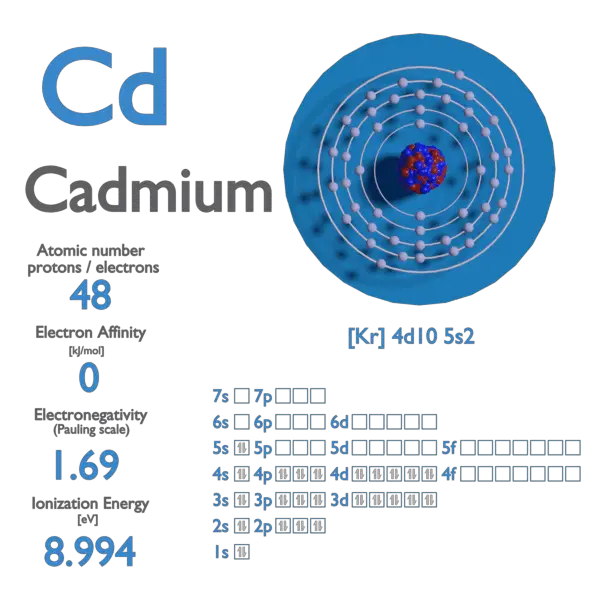
Electron Affinity of Cadmium is — kJ/mol.

Electronegativity of Cadmium is 1.69.

First Ionization Energy of Cadmium is 8.9937 eV.

Electron Affinity

In chemistry and atomic physics, the electron affinity of an atom or molecule is defined as:

the change in energy (in kJ/mole) of a neutral atom or molecule (in the gaseous phase) when an electron is added to the atom to form a negative ion.

X + e → X + energy        Affinity = – ∆H

Cadmium - Electron Affinity - Electronegativity - Ionization Energy
In other words, it can be expressed as the neutral atom’s likelihood of gaining an electron. Note that ionization energies measure the tendency of a neutral atom to resist the loss of electrons. Electron affinities are more difficult to measure than ionization energies.

An atom of Cadmium in the gas phase, for example, gives off energy when it gains an electron to form an ion of Cadmium.

Cd + e → Cd        – ∆H = Affinity = — kJ/mol

Electron affinity is one of the most important parameters that guide chemical reactivity. Molecules with high electron affinity form very stable negative ions which are important in the chemical and health industry as they purify the air, lift mood, and most importantly, act as strong oxidizing agents. To use electron affinities properly, it is essential to keep track of signs. When an electron is added to a neutral atom, energy is released. This affinity is known as the first electron affinity, and these energies are negative. By convention, the negative sign shows a release of energy. However, more energy is required to add an electron to a negative ion which overwhelms any release of energy from the electron attachment process. This affinity is known as the second electron affinity, and these energies are positive.

Halogens have the highest electron affinities among all elements. In fact, the electron affinity of Cl, 3.62 eV is the largest of all the elements. Superhalogens are molecules that have electron affinities (EA) greater than that of Cl, the element with the highest EA (3.62 eV).

It is well known that noble gases have closed electronic shell structure and hence have high ionization potentials and low electron affinities, due to which they are chemically inert and resistant to salt formation under most conditions.

Affinities of Nonmetals vs. Affinities of Metals

  • Metals: Metals like to lose valence electrons to form cations to have a fully stable shell. The electron affinity of metals is lower than that of nonmetals. Mercury most weakly attracts an extra electron.
  • Nonmetals: Generally, nonmetals have more positive electron affinity than metals. Nonmetals like to gain electrons to form anions to have a fully stable electron shell. Chlorine most strongly attracts extra electrons. The electron affinities of the noble gases have not been conclusively measured, so they may or may not have slightly negative values.

Learn more about electron affinities.

Electronegativity

Electronegativity, symbol χ, is a chemical property that describes the tendency of an atom to attract electrons towards this atom. For this purpose, a dimensionless quantity, the Pauling scale, symbol χ, is the most commonly used.

The electronegativity of Cadmium is:

χ = 1.69

In general, an atom’s electronegativity is affected by both its atomic number and the distance at which its valence electrons reside from the charged nucleus. The higher the associated electronegativity number, the more an element or compound attracts electrons towards it.

As it is usually calculated, electronegativity is not a property of an atom alone, but rather a property of an atom in a molecule. Even so, the electronegativity of an atom is strongly correlated with the first ionization energy, and negatively correlated with the electron affinity. Electrons with low ionization energies have low electronegativities because their nuclei do not exert a strong attractive force on electrons. Elements with high ionization energies have high electronegativities due to the strong pull exerted by the positive nucleus on the negative electrons. Therefore the electronegativity is greatest at the top-right of the periodic table and decreases toward the bottom-left.

Caesium is the least electronegative element (0.79); fluorine is the most (3.98).

Learn more about electronegativities.


electron affinity and electronegativity

First Ionization Energy of Cadmium

First Ionization Energy of Cadmium is 8.9937 eV.

Ionization energy, also called ionization potential, is the energy necessary to remove an electron from the neutral atom.

X + energy → X+ + e

where X is any atom or molecule capable of being ionized, X+ is that atom or molecule with an electron removed (positive ion), and e is the removed electron.

A Cadmium atom, for example, requires the following ionization energy to remove the outermost electron.

Cd + IE → Cd+ + e        IE = 8.9937 eV

The ionization energy associated with removal of the first electron is most commonly used. The nth ionization energy refers to the amount of energy required to remove an electron from the species with a charge of (n-1).

1st ionization energy

X → X+ + e

2nd ionization energy

X+ → X2+ + e

3rd ionization energy

X2+ → X3+ + e

Ionization Energy for different Elements

There is ionization energy for each successive electron removed. The electrons that circle the nucleus move in fairly well-defined orbits. Some of these electrons are more tightly bound in the atom than others. For example, only 7.38 eV is required to remove the outermost electron from a lead atom, while 88,000 eV is required to remove the innermost electron. Helps to understand the reactivity of elements (especially metals, which lose electrons).

In general, the ionization energy increases moving up a group and moving left to right across a period. Moreover:

  • Ionization energy is lowest for the alkali metals which have a single electron outside a closed shell.
  • Ionization energy increases across a row on the periodic maximum for the noble gases which have closed shells.

For example, sodium requires only 496 kJ/mol or 5.14 eV/atom to ionize it. On the other hand neon, the noble gas, immediately preceding it in the periodic table, requires 2081 kJ/mol or 21.56 eV/atom.
Learn more about ionization energy.
ionization energy

Cadmium – Properties

Element Cadmium
Atomic Number 48
Symbol Cd
Element Category Transition Metal
Phase at STP Solid
Atomic Mass [amu] 112.411
Density at STP [g/cm3] 8.65
Electron Configuration [Kr] 4d10 5s2
Possible Oxidation States +2
Electron Affinity [kJ/mol]
Electronegativity [Pauling scale] 1.69
1st Ionization Energy [eV] 8.9937
Year of Discovery 1817
Discoverer Stromeyer, Prof. Friedrich
Thermal properties
Melting Point [Celsius scale] 321.07
Boiling Point [Celsius scale] 767
Thermal Conductivity [W/m K] 97
Specific Heat [J/g K] 0.23
Heat of Fusion [kJ/mol] 6.192
Heat of Vaporization [kJ/mol] 99.57


Cadmium in Periodic Table

Hydro­gen1H He­lium2He
Lith­ium3Li Beryl­lium4Be Boron5B Carbon6C Nitro­gen7N Oxy­gen8O Fluor­ine9F Neon10Ne
So­dium11Na Magne­sium12Mg Alumin­ium13Al Sili­con14Si Phos­phorus15P Sulfur16S Chlor­ine17Cl Argon18Ar
Potas­sium19K Cal­cium20Ca Scan­dium21Sc Tita­nium22Ti Vana­dium23V Chrom­ium24Cr Manga­nese25Mn Iron26Fe Cobalt27Co Nickel28Ni Copper29Cu Zinc30Zn Gallium31Ga Germa­nium32Ge Arsenic33As Sele­nium34Se Bromine35Br Kryp­ton36Kr
Rubid­ium37Rb Stront­ium38Sr Yttrium39Y Zirco­nium40Zr Nio­bium41Nb Molyb­denum42Mo Tech­netium43Tc Ruthe­nium44Ru Rho­dium45Rh Pallad­ium46Pd Silver47Ag Cad­mium48Cd Indium49In Tin50Sn Anti­mony51Sb Tellur­ium52Te Iodine53I Xenon54Xe
Cae­sium55Cs Ba­rium56Ba Lan­thanum57La 1 asterisk Haf­nium72Hf Tanta­lum73Ta Tung­sten74W Rhe­nium75Re Os­mium76Os Iridium77Ir Plat­inum78Pt Gold79Au Mer­cury80Hg Thallium81Tl Lead82Pb Bis­muth83Bi Polo­nium84Po Asta­tine85At Radon86Rn
Fran­cium87Fr Ra­dium88Ra Actin­ium89Ac 1 asterisk Ruther­fordium104Rf Dub­nium105Db Sea­borgium106Sg Bohr­ium107Bh Has­sium108Hs Meit­nerium109Mt Darm­stadtium110Ds Roent­genium111Rg Coper­nicium112Cn Nihon­ium113Nh Flerov­ium114Fl Moscov­ium115Mc Liver­morium116Lv Tenness­ine117Ts Oga­nesson118Og
1 asterisk Cerium58Ce Praseo­dymium59Pr Neo­dymium60Nd Prome­thium61Pm Sama­rium62Sm Europ­ium63Eu Gadolin­ium64Gd Ter­bium65Tb Dyspro­sium66Dy Hol­mium67Ho Erbium68Er Thulium69Tm Ytter­bium70Yb Lute­tium71Lu
1 asterisk Thor­ium90Th Protac­tinium91Pa Ura­nium92U Neptu­nium93Np Pluto­nium94Pu Ameri­cium95Am Curium96Cm Berkel­ium97Bk Califor­nium98Cf Einstei­nium99Es Fer­mium100Fm Mende­levium101Md Nobel­ium102No Lawren­cium103Lr


Rhodium – Electron Affinity – Electronegativity – Ionization Energy of Rhodium

Electron Affinity and Electronegativity of Rhodium

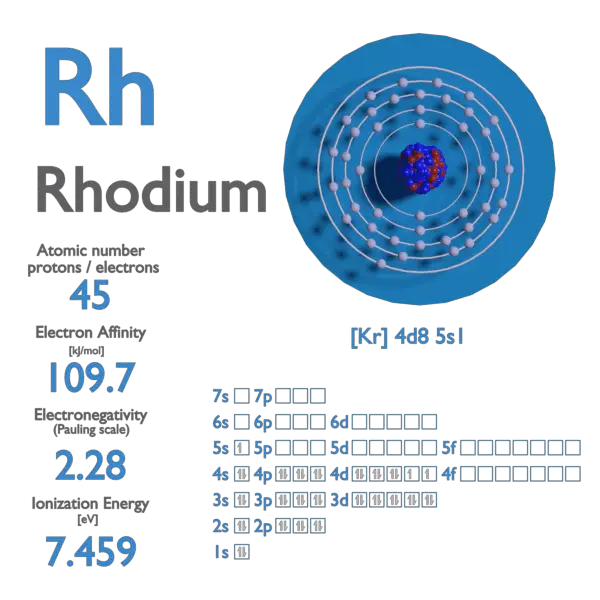
Electron Affinity of Rhodium is 109.7 kJ/mol.

Electronegativity of Rhodium is 2.28.

First Ionization Energy of Rhodium is 7.4589 eV.

Electron Affinity

In chemistry and atomic physics, the electron affinity of an atom or molecule is defined as:

the change in energy (in kJ/mole) of a neutral atom or molecule (in the gaseous phase) when an electron is added to the atom to form a negative ion.

X + e → X + energy        Affinity = – ∆H

Rhodium - Electron Affinity - Electronegativity - Ionization Energy
In other words, it can be expressed as the neutral atom’s likelihood of gaining an electron. Note that ionization energies measure the tendency of a neutral atom to resist the loss of electrons. Electron affinities are more difficult to measure than ionization energies.

An atom of Rhodium in the gas phase, for example, gives off energy when it gains an electron to form an ion of Rhodium.

Rh + e → Rh        – ∆H = Affinity = 109.7 kJ/mol

Electron affinity is one of the most important parameters that guide chemical reactivity. Molecules with high electron affinity form very stable negative ions which are important in the chemical and health industry as they purify the air, lift mood, and most importantly, act as strong oxidizing agents. To use electron affinities properly, it is essential to keep track of signs. When an electron is added to a neutral atom, energy is released. This affinity is known as the first electron affinity, and these energies are negative. By convention, the negative sign shows a release of energy. However, more energy is required to add an electron to a negative ion which overwhelms any release of energy from the electron attachment process. This affinity is known as the second electron affinity, and these energies are positive.

Halogens have the highest electron affinities among all elements. In fact, the electron affinity of Cl, 3.62 eV is the largest of all the elements. Superhalogens are molecules that have electron affinities (EA) greater than that of Cl, the element with the highest EA (3.62 eV).

It is well known that noble gases have closed electronic shell structure and hence have high ionization potentials and low electron affinities, due to which they are chemically inert and resistant to salt formation under most conditions.

Affinities of Nonmetals vs. Affinities of Metals

  • Metals: Metals like to lose valence electrons to form cations to have a fully stable shell. The electron affinity of metals is lower than that of nonmetals. Mercury most weakly attracts an extra electron.
  • Nonmetals: Generally, nonmetals have more positive electron affinity than metals. Nonmetals like to gain electrons to form anions to have a fully stable electron shell. Chlorine most strongly attracts extra electrons. The electron affinities of the noble gases have not been conclusively measured, so they may or may not have slightly negative values.

Learn more about electron affinities.

Electronegativity

Electronegativity, symbol χ, is a chemical property that describes the tendency of an atom to attract electrons towards this atom. For this purpose, a dimensionless quantity, the Pauling scale, symbol χ, is the most commonly used.

The electronegativity of Rhodium is:

χ = 2.28

In general, an atom’s electronegativity is affected by both its atomic number and the distance at which its valence electrons reside from the charged nucleus. The higher the associated electronegativity number, the more an element or compound attracts electrons towards it.

As it is usually calculated, electronegativity is not a property of an atom alone, but rather a property of an atom in a molecule. Even so, the electronegativity of an atom is strongly correlated with the first ionization energy, and negatively correlated with the electron affinity. Electrons with low ionization energies have low electronegativities because their nuclei do not exert a strong attractive force on electrons. Elements with high ionization energies have high electronegativities due to the strong pull exerted by the positive nucleus on the negative electrons. Therefore the electronegativity is greatest at the top-right of the periodic table and decreases toward the bottom-left.

Caesium is the least electronegative element (0.79); fluorine is the most (3.98).

Learn more about electronegativities.


electron affinity and electronegativity

First Ionization Energy of Rhodium

First Ionization Energy of Rhodium is 7.4589 eV.

Ionization energy, also called ionization potential, is the energy necessary to remove an electron from the neutral atom.

X + energy → X+ + e

where X is any atom or molecule capable of being ionized, X+ is that atom or molecule with an electron removed (positive ion), and e is the removed electron.

A Rhodium atom, for example, requires the following ionization energy to remove the outermost electron.

Rh + IE → Rh+ + e        IE = 7.4589 eV

The ionization energy associated with removal of the first electron is most commonly used. The nth ionization energy refers to the amount of energy required to remove an electron from the species with a charge of (n-1).

1st ionization energy

X → X+ + e

2nd ionization energy

X+ → X2+ + e

3rd ionization energy

X2+ → X3+ + e

Ionization Energy for different Elements

There is ionization energy for each successive electron removed. The electrons that circle the nucleus move in fairly well-defined orbits. Some of these electrons are more tightly bound in the atom than others. For example, only 7.38 eV is required to remove the outermost electron from a lead atom, while 88,000 eV is required to remove the innermost electron. Helps to understand the reactivity of elements (especially metals, which lose electrons).

In general, the ionization energy increases moving up a group and moving left to right across a period. Moreover:

  • Ionization energy is lowest for the alkali metals which have a single electron outside a closed shell.
  • Ionization energy increases across a row on the periodic maximum for the noble gases which have closed shells.

For example, sodium requires only 496 kJ/mol or 5.14 eV/atom to ionize it. On the other hand neon, the noble gas, immediately preceding it in the periodic table, requires 2081 kJ/mol or 21.56 eV/atom.

Learn more about ionization energy.

ionization energy

Rhodium – Properties

Element Rhodium
Atomic Number 45
Symbol Rh
Element Category Transition Metal
Phase at STP Solid
Atomic Mass [amu] 102.9055
Density at STP [g/cm3] 12.45
Electron Configuration [Kr] 4d8 5s1
Possible Oxidation States +3
Electron Affinity [kJ/mol] 109.7
Electronegativity [Pauling scale] 2.28
1st Ionization Energy [eV] 7.4589
Year of Discovery 1803
Discoverer Wollaston, William Hyde
Thermal properties
Melting Point [Celsius scale] 1964
Boiling Point [Celsius scale] 3695
Thermal Conductivity [W/m K] 150
Specific Heat [J/g K] 0.242
Heat of Fusion [kJ/mol] 21.5
Heat of Vaporization [kJ/mol] 493


Rhodium in Periodic Table

Hydro­gen1H He­lium2He
Lith­ium3Li Beryl­lium4Be Boron5B Carbon6C Nitro­gen7N Oxy­gen8O Fluor­ine9F Neon10Ne
So­dium11Na Magne­sium12Mg Alumin­ium13Al Sili­con14Si Phos­phorus15P Sulfur16S Chlor­ine17Cl Argon18Ar
Potas­sium19K Cal­cium20Ca Scan­dium21Sc Tita­nium22Ti Vana­dium23V Chrom­ium24Cr Manga­nese25Mn Iron26Fe Cobalt27Co Nickel28Ni Copper29Cu Zinc30Zn Gallium31Ga Germa­nium32Ge Arsenic33As Sele­nium34Se Bromine35Br Kryp­ton36Kr
Rubid­ium37Rb Stront­ium38Sr Yttrium39Y Zirco­nium40Zr Nio­bium41Nb Molyb­denum42Mo Tech­netium43Tc Ruthe­nium44Ru Rho­dium45Rh Pallad­ium46Pd Silver47Ag Cad­mium48Cd Indium49In Tin50Sn Anti­mony51Sb Tellur­ium52Te Iodine53I Xenon54Xe
Cae­sium55Cs Ba­rium56Ba Lan­thanum57La 1 asterisk Haf­nium72Hf Tanta­lum73Ta Tung­sten74W Rhe­nium75Re Os­mium76Os Iridium77Ir Plat­inum78Pt Gold79Au Mer­cury80Hg Thallium81Tl Lead82Pb Bis­muth83Bi Polo­nium84Po Asta­tine85At Radon86Rn
Fran­cium87Fr Ra­dium88Ra Actin­ium89Ac 1 asterisk Ruther­fordium104Rf Dub­nium105Db Sea­borgium106Sg Bohr­ium107Bh Has­sium108Hs Meit­nerium109Mt Darm­stadtium110Ds Roent­genium111Rg Coper­nicium112Cn Nihon­ium113Nh Flerov­ium114Fl Moscov­ium115Mc Liver­morium116Lv Tenness­ine117Ts Oga­nesson118Og
1 asterisk Cerium58Ce Praseo­dymium59Pr Neo­dymium60Nd Prome­thium61Pm Sama­rium62Sm Europ­ium63Eu Gadolin­ium64Gd Ter­bium65Tb Dyspro­sium66Dy Hol­mium67Ho Erbium68Er Thulium69Tm Ytter­bium70Yb Lute­tium71Lu
1 asterisk Thor­ium90Th Protac­tinium91Pa Ura­nium92U Neptu­nium93Np Pluto­nium94Pu Ameri­cium95Am Curium96Cm Berkel­ium97Bk Califor­nium98Cf Einstei­nium99Es Fer­mium100Fm Mende­levium101Md Nobel­ium102No Lawren­cium103Lr


Palladium – Electron Affinity – Electronegativity – Ionization Energy of Palladium

Electron Affinity and Electronegativity of Palladium

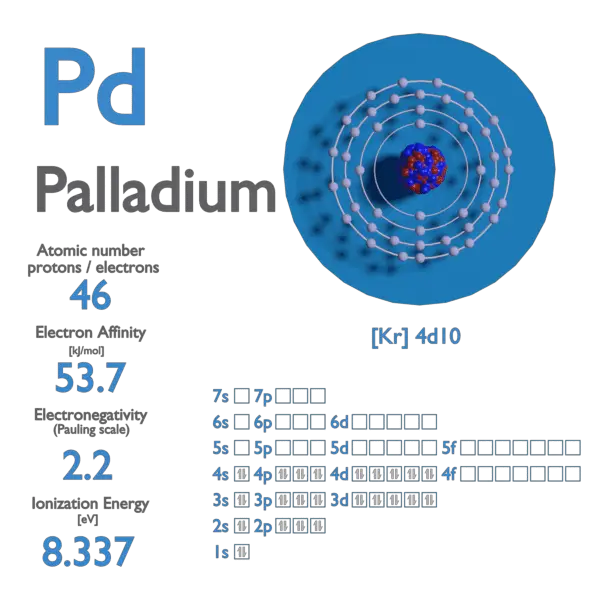
Electron Affinity of Palladium is 53.7 kJ/mol.

Electronegativity of Palladium is 2.2.

First Ionization Energy of Palladium is 8.3369 eV.

Electron Affinity

In chemistry and atomic physics, the electron affinity of an atom or molecule is defined as:

the change in energy (in kJ/mole) of a neutral atom or molecule (in the gaseous phase) when an electron is added to the atom to form a negative ion.

X + e → X + energy        Affinity = – ∆H

Palladium - Electron Affinity - Electronegativity - Ionization Energy
In other words, it can be expressed as the neutral atom’s likelihood of gaining an electron. Note that ionization energies measure the tendency of a neutral atom to resist the loss of electrons. Electron affinities are more difficult to measure than ionization energies.

An atom of Palladium in the gas phase, for example, gives off energy when it gains an electron to form an ion of Palladium.

Pd + e → Pd        – ∆H = Affinity = 53.7 kJ/mol

Electron affinity is one of the most important parameters that guide chemical reactivity. Molecules with high electron affinity form very stable negative ions which are important in the chemical and health industry as they purify the air, lift mood, and most importantly, act as strong oxidizing agents. To use electron affinities properly, it is essential to keep track of signs. When an electron is added to a neutral atom, energy is released. This affinity is known as the first electron affinity, and these energies are negative. By convention, the negative sign shows a release of energy. However, more energy is required to add an electron to a negative ion which overwhelms any release of energy from the electron attachment process. This affinity is known as the second electron affinity, and these energies are positive.

Halogens have the highest electron affinities among all elements. In fact, the electron affinity of Cl, 3.62 eV is the largest of all the elements. Superhalogens are molecules that have electron affinities (EA) greater than that of Cl, the element with the highest EA (3.62 eV).

It is well known that noble gases have closed electronic shell structure and hence have high ionization potentials and low electron affinities, due to which they are chemically inert and resistant to salt formation under most conditions.

Affinities of Nonmetals vs. Affinities of Metals

  • Metals: Metals like to lose valence electrons to form cations to have a fully stable shell. The electron affinity of metals is lower than that of nonmetals. Mercury most weakly attracts an extra electron.
  • Nonmetals: Generally, nonmetals have more positive electron affinity than metals. Nonmetals like to gain electrons to form anions to have a fully stable electron shell. Chlorine most strongly attracts extra electrons. The electron affinities of the noble gases have not been conclusively measured, so they may or may not have slightly negative values.

Learn more about electron affinities.

Electronegativity

Electronegativity, symbol χ, is a chemical property that describes the tendency of an atom to attract electrons towards this atom. For this purpose, a dimensionless quantity, the Pauling scale, symbol χ, is the most commonly used.

The electronegativity of Palladium is:

χ = 2.2

In general, an atom’s electronegativity is affected by both its atomic number and the distance at which its valence electrons reside from the charged nucleus. The higher the associated electronegativity number, the more an element or compound attracts electrons towards it.

As it is usually calculated, electronegativity is not a property of an atom alone, but rather a property of an atom in a molecule. Even so, the electronegativity of an atom is strongly correlated with the first ionization energy, and negatively correlated with the electron affinity. Electrons with low ionization energies have low electronegativities because their nuclei do not exert a strong attractive force on electrons. Elements with high ionization energies have high electronegativities due to the strong pull exerted by the positive nucleus on the negative electrons. Therefore the electronegativity is greatest at the top-right of the periodic table and decreases toward the bottom-left.

Caesium is the least electronegative element (0.79); fluorine is the most (3.98).

Learn more about electronegativities.


electron affinity and electronegativity

First Ionization Energy of Palladium

First Ionization Energy of Palladium is 8.3369 eV.

Ionization energy, also called ionization potential, is the energy necessary to remove an electron from the neutral atom.

X + energy → X+ + e

where X is any atom or molecule capable of being ionized, X+ is that atom or molecule with an electron removed (positive ion), and e is the removed electron.

A Palladium atom, for example, requires the following ionization energy to remove the outermost electron.

Pd + IE → Pd+ + e        IE = 8.3369 eV

The ionization energy associated with removal of the first electron is most commonly used. The nth ionization energy refers to the amount of energy required to remove an electron from the species with a charge of (n-1).

1st ionization energy

X → X+ + e

2nd ionization energy

X+ → X2+ + e

3rd ionization energy

X2+ → X3+ + e

Ionization Energy for different Elements

There is ionization energy for each successive electron removed. The electrons that circle the nucleus move in fairly well-defined orbits. Some of these electrons are more tightly bound in the atom than others. For example, only 7.38 eV is required to remove the outermost electron from a lead atom, while 88,000 eV is required to remove the innermost electron. Helps to understand the reactivity of elements (especially metals, which lose electrons).

In general, the ionization energy increases moving up a group and moving left to right across a period. Moreover:

  • Ionization energy is lowest for the alkali metals which have a single electron outside a closed shell.
  • Ionization energy increases across a row on the periodic maximum for the noble gases which have closed shells.

For example, sodium requires only 496 kJ/mol or 5.14 eV/atom to ionize it. On the other hand neon, the noble gas, immediately preceding it in the periodic table, requires 2081 kJ/mol or 21.56 eV/atom.

Learn more about ionization energy.

ionization energy

Palladium – Properties

Element Palladium
Atomic Number 46
Symbol Pd
Element Category Transition Metal
Phase at STP Solid
Atomic Mass [amu] 106.42
Density at STP [g/cm3] 12.023
Electron Configuration [Kr] 4d10
Possible Oxidation States +2,4
Electron Affinity [kJ/mol] 53.7
Electronegativity [Pauling scale] 2.2
1st Ionization Energy [eV] 8.3369
Year of Discovery 1803
Discoverer Wollaston, William Hyde
Thermal properties
Melting Point [Celsius scale] 1554.9
Boiling Point [Celsius scale] 2963
Thermal Conductivity [W/m K] 72
Specific Heat [J/g K] 0.24
Heat of Fusion [kJ/mol] 17.6
Heat of Vaporization [kJ/mol] 357


Palladium in Periodic Table

Hydro­gen1H He­lium2He
Lith­ium3Li Beryl­lium4Be Boron5B Carbon6C Nitro­gen7N Oxy­gen8O Fluor­ine9F Neon10Ne
So­dium11Na Magne­sium12Mg Alumin­ium13Al Sili­con14Si Phos­phorus15P Sulfur16S Chlor­ine17Cl Argon18Ar
Potas­sium19K Cal­cium20Ca Scan­dium21Sc Tita­nium22Ti Vana­dium23V Chrom­ium24Cr Manga­nese25Mn Iron26Fe Cobalt27Co Nickel28Ni Copper29Cu Zinc30Zn Gallium31Ga Germa­nium32Ge Arsenic33As Sele­nium34Se Bromine35Br Kryp­ton36Kr
Rubid­ium37Rb Stront­ium38Sr Yttrium39Y Zirco­nium40Zr Nio­bium41Nb Molyb­denum42Mo Tech­netium43Tc Ruthe­nium44Ru Rho­dium45Rh Pallad­ium46Pd Silver47Ag Cad­mium48Cd Indium49In Tin50Sn Anti­mony51Sb Tellur­ium52Te Iodine53I Xenon54Xe
Cae­sium55Cs Ba­rium56Ba Lan­thanum57La 1 asterisk Haf­nium72Hf Tanta­lum73Ta Tung­sten74W Rhe­nium75Re Os­mium76Os Iridium77Ir Plat­inum78Pt Gold79Au Mer­cury80Hg Thallium81Tl Lead82Pb Bis­muth83Bi Polo­nium84Po Asta­tine85At Radon86Rn
Fran­cium87Fr Ra­dium88Ra Actin­ium89Ac 1 asterisk Ruther­fordium104Rf Dub­nium105Db Sea­borgium106Sg Bohr­ium107Bh Has­sium108Hs Meit­nerium109Mt Darm­stadtium110Ds Roent­genium111Rg Coper­nicium112Cn Nihon­ium113Nh Flerov­ium114Fl Moscov­ium115Mc Liver­morium116Lv Tenness­ine117Ts Oga­nesson118Og
1 asterisk Cerium58Ce Praseo­dymium59Pr Neo­dymium60Nd Prome­thium61Pm Sama­rium62Sm Europ­ium63Eu Gadolin­ium64Gd Ter­bium65Tb Dyspro­sium66Dy Hol­mium67Ho Erbium68Er Thulium69Tm Ytter­bium70Yb Lute­tium71Lu
1 asterisk Thor­ium90Th Protac­tinium91Pa Ura­nium92U Neptu­nium93Np Pluto­nium94Pu Ameri­cium95Am Curium96Cm Berkel­ium97Bk Califor­nium98Cf Einstei­nium99Es Fer­mium100Fm Mende­levium101Md Nobel­ium102No Lawren­cium103Lr


Technetium – Electron Affinity – Electronegativity – Ionization Energy of Technetium

Electron Affinity and Electronegativity of Technetium

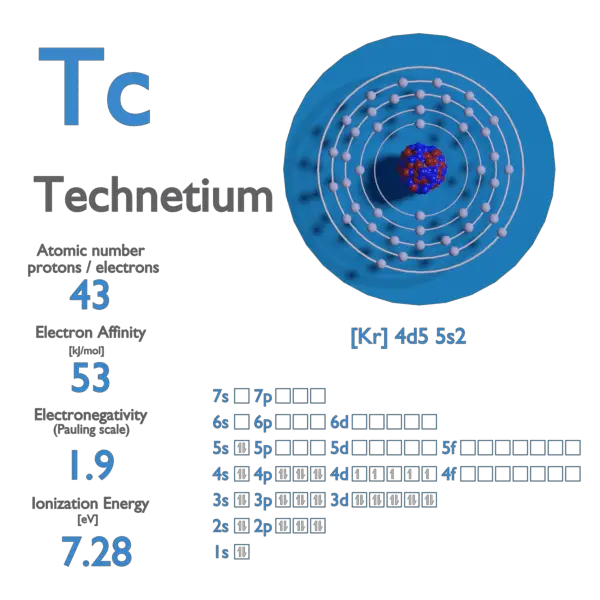
Electron Affinity of Technetium is 53 kJ/mol.

Electronegativity of Technetium is 1.9.

First Ionization Energy of Technetium is 7.28 eV.

Electron Affinity

In chemistry and atomic physics, the electron affinity of an atom or molecule is defined as:

the change in energy (in kJ/mole) of a neutral atom or molecule (in the gaseous phase) when an electron is added to the atom to form a negative ion.

X + e → X + energy        Affinity = – ∆H

Technetium - Electron Affinity - Electronegativity - Ionization Energy
In other words, it can be expressed as the neutral atom’s likelihood of gaining an electron. Note that ionization energies measure the tendency of a neutral atom to resist the loss of electrons. Electron affinities are more difficult to measure than ionization energies.

An atom of Technetium in the gas phase, for example, gives off energy when it gains an electron to form an ion of Technetium.

Tc + e → Tc        – ∆H = Affinity = 53 kJ/mol

Electron affinity is one of the most important parameters that guide chemical reactivity. Molecules with high electron affinity form very stable negative ions which are important in the chemical and health industry as they purify the air, lift mood, and most importantly, act as strong oxidizing agents. To use electron affinities properly, it is essential to keep track of signs. When an electron is added to a neutral atom, energy is released. This affinity is known as the first electron affinity, and these energies are negative. By convention, the negative sign shows a release of energy. However, more energy is required to add an electron to a negative ion which overwhelms any release of energy from the electron attachment process. This affinity is known as the second electron affinity, and these energies are positive.

Halogens have the highest electron affinities among all elements. In fact, the electron affinity of Cl, 3.62 eV is the largest of all the elements. Superhalogens are molecules that have electron affinities (EA) greater than that of Cl, the element with the highest EA (3.62 eV).

It is well known that noble gases have closed electronic shell structure and hence have high ionization potentials and low electron affinities, due to which they are chemically inert and resistant to salt formation under most conditions.

Affinities of Nonmetals vs. Affinities of Metals

  • Metals: Metals like to lose valence electrons to form cations to have a fully stable shell. The electron affinity of metals is lower than that of nonmetals. Mercury most weakly attracts an extra electron.
  • Nonmetals: Generally, nonmetals have more positive electron affinity than metals. Nonmetals like to gain electrons to form anions to have a fully stable electron shell. Chlorine most strongly attracts extra electrons. The electron affinities of the noble gases have not been conclusively measured, so they may or may not have slightly negative values.

Learn more about electron affinities.

Electronegativity

Electronegativity, symbol χ, is a chemical property that describes the tendency of an atom to attract electrons towards this atom. For this purpose, a dimensionless quantity, the Pauling scale, symbol χ, is the most commonly used.

The electronegativity of Technetium is:

χ = 1.9

In general, an atom’s electronegativity is affected by both its atomic number and the distance at which its valence electrons reside from the charged nucleus. The higher the associated electronegativity number, the more an element or compound attracts electrons towards it.

As it is usually calculated, electronegativity is not a property of an atom alone, but rather a property of an atom in a molecule. Even so, the electronegativity of an atom is strongly correlated with the first ionization energy, and negatively correlated with the electron affinity. Electrons with low ionization energies have low electronegativities because their nuclei do not exert a strong attractive force on electrons. Elements with high ionization energies have high electronegativities due to the strong pull exerted by the positive nucleus on the negative electrons. Therefore the electronegativity is greatest at the top-right of the periodic table and decreases toward the bottom-left.

Caesium is the least electronegative element (0.79); fluorine is the most (3.98).

Learn more about electronegativities.


electron affinity and electronegativity

First Ionization Energy of Technetium

First Ionization Energy of Technetium is 7.28 eV.

Ionization energy, also called ionization potential, is the energy necessary to remove an electron from the neutral atom.

X + energy → X+ + e

where X is any atom or molecule capable of being ionized, X+ is that atom or molecule with an electron removed (positive ion), and e is the removed electron.

A Technetium atom, for example, requires the following ionization energy to remove the outermost electron.

Tc + IE → Tc+ + e        IE = 7.28 eV

The ionization energy associated with removal of the first electron is most commonly used. The nth ionization energy refers to the amount of energy required to remove an electron from the species with a charge of (n-1).

1st ionization energy

X → X+ + e

2nd ionization energy

X+ → X2+ + e

3rd ionization energy

X2+ → X3+ + e

Ionization Energy for different Elements

There is ionization energy for each successive electron removed. The electrons that circle the nucleus move in fairly well-defined orbits. Some of these electrons are more tightly bound in the atom than others. For example, only 7.38 eV is required to remove the outermost electron from a lead atom, while 88,000 eV is required to remove the innermost electron. Helps to understand the reactivity of elements (especially metals, which lose electrons).

In general, the ionization energy increases moving up a group and moving left to right across a period. Moreover:

  • Ionization energy is lowest for the alkali metals which have a single electron outside a closed shell.
  • Ionization energy increases across a row on the periodic maximum for the noble gases which have closed shells.

For example, sodium requires only 496 kJ/mol or 5.14 eV/atom to ionize it. On the other hand neon, the noble gas, immediately preceding it in the periodic table, requires 2081 kJ/mol or 21.56 eV/atom.

Learn more about ionization energy.

ionization energy

Technetium – Properties

Element Technetium
Atomic Number 43
Symbol Tc
Element Category Transition Metal
Phase at STP Synthetic
Atomic Mass [amu] 98
Density at STP [g/cm3] 11.5
Electron Configuration [Kr] 4d5 5s2
Possible Oxidation States +4,7
Electron Affinity [kJ/mol] 53
Electronegativity [Pauling scale] 1.9
1st Ionization Energy [eV] 7.28
Year of Discovery 1937
Discoverer Perrier, Carlo & Segrè, Emilio
Thermal properties
Melting Point [Celsius scale] 2157
Boiling Point [Celsius scale] 4265
Thermal Conductivity [W/m K] 50.6
Specific Heat [J/g K] 0.21
Heat of Fusion [kJ/mol] 24
Heat of Vaporization [kJ/mol] 660


Technetium in Periodic Table

Hydro­gen1H He­lium2He
Lith­ium3Li Beryl­lium4Be Boron5B Carbon6C Nitro­gen7N Oxy­gen8O Fluor­ine9F Neon10Ne
So­dium11Na Magne­sium12Mg Alumin­ium13Al Sili­con14Si Phos­phorus15P Sulfur16S Chlor­ine17Cl Argon18Ar
Potas­sium19K Cal­cium20Ca Scan­dium21Sc Tita­nium22Ti Vana­dium23V Chrom­ium24Cr Manga­nese25Mn Iron26Fe Cobalt27Co Nickel28Ni Copper29Cu Zinc30Zn Gallium31Ga Germa­nium32Ge Arsenic33As Sele­nium34Se Bromine35Br Kryp­ton36Kr
Rubid­ium37Rb Stront­ium38Sr Yttrium39Y Zirco­nium40Zr Nio­bium41Nb Molyb­denum42Mo Tech­netium43Tc Ruthe­nium44Ru Rho­dium45Rh Pallad­ium46Pd Silver47Ag Cad­mium48Cd Indium49In Tin50Sn Anti­mony51Sb Tellur­ium52Te Iodine53I Xenon54Xe
Cae­sium55Cs Ba­rium56Ba Lan­thanum57La 1 asterisk Haf­nium72Hf Tanta­lum73Ta Tung­sten74W Rhe­nium75Re Os­mium76Os Iridium77Ir Plat­inum78Pt Gold79Au Mer­cury80Hg Thallium81Tl Lead82Pb Bis­muth83Bi Polo­nium84Po Asta­tine85At Radon86Rn
Fran­cium87Fr Ra­dium88Ra Actin­ium89Ac 1 asterisk Ruther­fordium104Rf Dub­nium105Db Sea­borgium106Sg Bohr­ium107Bh Has­sium108Hs Meit­nerium109Mt Darm­stadtium110Ds Roent­genium111Rg Coper­nicium112Cn Nihon­ium113Nh Flerov­ium114Fl Moscov­ium115Mc Liver­morium116Lv Tenness­ine117Ts Oga­nesson118Og
1 asterisk Cerium58Ce Praseo­dymium59Pr Neo­dymium60Nd Prome­thium61Pm Sama­rium62Sm Europ­ium63Eu Gadolin­ium64Gd Ter­bium65Tb Dyspro­sium66Dy Hol­mium67Ho Erbium68Er Thulium69Tm Ytter­bium70Yb Lute­tium71Lu
1 asterisk Thor­ium90Th Protac­tinium91Pa Ura­nium92U Neptu­nium93Np Pluto­nium94Pu Ameri­cium95Am Curium96Cm Berkel­ium97Bk Califor­nium98Cf Einstei­nium99Es Fer­mium100Fm Mende­levium101Md Nobel­ium102No Lawren­cium103Lr


Ruthenium – Electron Affinity – Electronegativity – Ionization Energy of Ruthenium

Electron Affinity and Electronegativity of Ruthenium

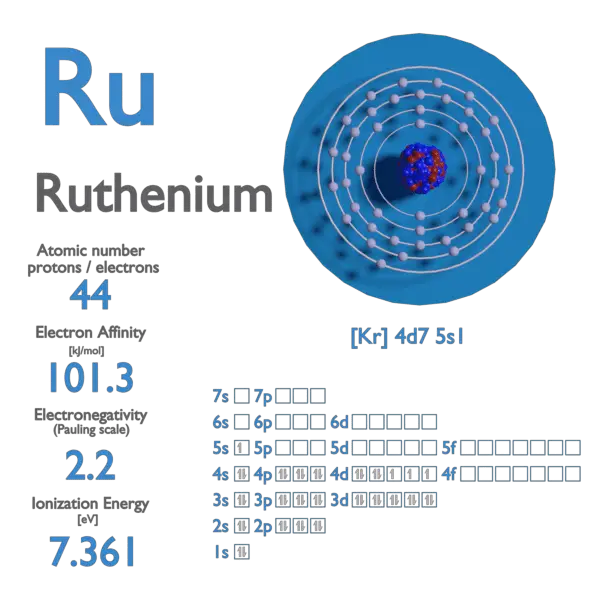
Electron Affinity of Ruthenium is 101.3 kJ/mol.

Electronegativity of Ruthenium is 2.2.

First Ionization Energy of Ruthenium is 7.3605 eV.

Electron Affinity

In chemistry and atomic physics, the electron affinity of an atom or molecule is defined as:

the change in energy (in kJ/mole) of a neutral atom or molecule (in the gaseous phase) when an electron is added to the atom to form a negative ion.

X + e → X + energy        Affinity = – ∆H

Ruthenium - Electron Affinity - Electronegativity - Ionization Energy
In other words, it can be expressed as the neutral atom’s likelihood of gaining an electron. Note that ionization energies measure the tendency of a neutral atom to resist the loss of electrons. Electron affinities are more difficult to measure than ionization energies.

An atom of Ruthenium in the gas phase, for example, gives off energy when it gains an electron to form an ion of Ruthenium.

Ru + e → Ru        – ∆H = Affinity = 101.3 kJ/mol

Electron affinity is one of the most important parameters that guide chemical reactivity. Molecules with high electron affinity form very stable negative ions which are important in the chemical and health industry as they purify the air, lift mood, and most importantly, act as strong oxidizing agents. To use electron affinities properly, it is essential to keep track of signs. When an electron is added to a neutral atom, energy is released. This affinity is known as the first electron affinity, and these energies are negative. By convention, the negative sign shows a release of energy. However, more energy is required to add an electron to a negative ion which overwhelms any release of energy from the electron attachment process. This affinity is known as the second electron affinity, and these energies are positive.

Halogens have the highest electron affinities among all elements. In fact, the electron affinity of Cl, 3.62 eV is the largest of all the elements. Superhalogens are molecules that have electron affinities (EA) greater than that of Cl, the element with the highest EA (3.62 eV).

It is well known that noble gases have closed electronic shell structure and hence have high ionization potentials and low electron affinities, due to which they are chemically inert and resistant to salt formation under most conditions.

Affinities of Nonmetals vs. Affinities of Metals

  • Metals: Metals like to lose valence electrons to form cations to have a fully stable shell. The electron affinity of metals is lower than that of nonmetals. Mercury most weakly attracts an extra electron.
  • Nonmetals: Generally, nonmetals have more positive electron affinity than metals. Nonmetals like to gain electrons to form anions to have a fully stable electron shell. Chlorine most strongly attracts extra electrons. The electron affinities of the noble gases have not been conclusively measured, so they may or may not have slightly negative values.

Learn more about electron affinities.

Electronegativity

Electronegativity, symbol χ, is a chemical property that describes the tendency of an atom to attract electrons towards this atom. For this purpose, a dimensionless quantity, the Pauling scale, symbol χ, is the most commonly used.

The electronegativity of Ruthenium is:

χ = 2.2

In general, an atom’s electronegativity is affected by both its atomic number and the distance at which its valence electrons reside from the charged nucleus. The higher the associated electronegativity number, the more an element or compound attracts electrons towards it.

As it is usually calculated, electronegativity is not a property of an atom alone, but rather a property of an atom in a molecule. Even so, the electronegativity of an atom is strongly correlated with the first ionization energy, and negatively correlated with the electron affinity. Electrons with low ionization energies have low electronegativities because their nuclei do not exert a strong attractive force on electrons. Elements with high ionization energies have high electronegativities due to the strong pull exerted by the positive nucleus on the negative electrons. Therefore the electronegativity is greatest at the top-right of the periodic table and decreases toward the bottom-left.

Caesium is the least electronegative element (0.79); fluorine is the most (3.98).

Learn more about electronegativities.


electron affinity and electronegativity

First Ionization Energy of Ruthenium

First Ionization Energy of Ruthenium is 7.3605 eV.

Ionization energy, also called ionization potential, is the energy necessary to remove an electron from the neutral atom.

X + energy → X+ + e

where X is any atom or molecule capable of being ionized, X+ is that atom or molecule with an electron removed (positive ion), and e is the removed electron.

A Ruthenium atom, for example, requires the following ionization energy to remove the outermost electron.

Ru + IE → Ru+ + e        IE = 7.3605 eV

The ionization energy associated with removal of the first electron is most commonly used. The nth ionization energy refers to the amount of energy required to remove an electron from the species with a charge of (n-1).

1st ionization energy

X → X+ + e

2nd ionization energy

X+ → X2+ + e

3rd ionization energy

X2+ → X3+ + e

Ionization Energy for different Elements

There is ionization energy for each successive electron removed. The electrons that circle the nucleus move in fairly well-defined orbits. Some of these electrons are more tightly bound in the atom than others. For example, only 7.38 eV is required to remove the outermost electron from a lead atom, while 88,000 eV is required to remove the innermost electron. Helps to understand the reactivity of elements (especially metals, which lose electrons).

In general, the ionization energy increases moving up a group and moving left to right across a period. Moreover:

  • Ionization energy is lowest for the alkali metals which have a single electron outside a closed shell.
  • Ionization energy increases across a row on the periodic maximum for the noble gases which have closed shells.

For example, sodium requires only 496 kJ/mol or 5.14 eV/atom to ionize it. On the other hand neon, the noble gas, immediately preceding it in the periodic table, requires 2081 kJ/mol or 21.56 eV/atom.

Learn more about ionization energy.

ionization energy

Ruthenium – Properties

Element Ruthenium
Atomic Number 44
Symbol Ru
Element Category Transition Metal
Phase at STP Solid
Atomic Mass [amu] 101.07
Density at STP [g/cm3] 12.37
Electron Configuration [Kr] 4d7 5s1
Possible Oxidation States +3
Electron Affinity [kJ/mol] 101.3
Electronegativity [Pauling scale] 2.2
1st Ionization Energy [eV] 7.3605
Year of Discovery 1844
Discoverer Klaus, Karl Karlovich
Thermal properties
Melting Point [Celsius scale] 2334
Boiling Point [Celsius scale] 4150
Thermal Conductivity [W/m K] 117
Specific Heat [J/g K] 0.238
Heat of Fusion [kJ/mol] 24
Heat of Vaporization [kJ/mol] 595


Ruthenium in Periodic Table

Hydro­gen1H He­lium2He
Lith­ium3Li Beryl­lium4Be Boron5B Carbon6C Nitro­gen7N Oxy­gen8O Fluor­ine9F Neon10Ne
So­dium11Na Magne­sium12Mg Alumin­ium13Al Sili­con14Si Phos­phorus15P Sulfur16S Chlor­ine17Cl Argon18Ar
Potas­sium19K Cal­cium20Ca Scan­dium21Sc Tita­nium22Ti Vana­dium23V Chrom­ium24Cr Manga­nese25Mn Iron26Fe Cobalt27Co Nickel28Ni Copper29Cu Zinc30Zn Gallium31Ga Germa­nium32Ge Arsenic33As Sele­nium34Se Bromine35Br Kryp­ton36Kr
Rubid­ium37Rb Stront­ium38Sr Yttrium39Y Zirco­nium40Zr Nio­bium41Nb Molyb­denum42Mo Tech­netium43Tc Ruthe­nium44Ru Rho­dium45Rh Pallad­ium46Pd Silver47Ag Cad­mium48Cd Indium49In Tin50Sn Anti­mony51Sb Tellur­ium52Te Iodine53I Xenon54Xe
Cae­sium55Cs Ba­rium56Ba Lan­thanum57La 1 asterisk Haf­nium72Hf Tanta­lum73Ta Tung­sten74W Rhe­nium75Re Os­mium76Os Iridium77Ir Plat­inum78Pt Gold79Au Mer­cury80Hg Thallium81Tl Lead82Pb Bis­muth83Bi Polo­nium84Po Asta­tine85At Radon86Rn
Fran­cium87Fr Ra­dium88Ra Actin­ium89Ac 1 asterisk Ruther­fordium104Rf Dub­nium105Db Sea­borgium106Sg Bohr­ium107Bh Has­sium108Hs Meit­nerium109Mt Darm­stadtium110Ds Roent­genium111Rg Coper­nicium112Cn Nihon­ium113Nh Flerov­ium114Fl Moscov­ium115Mc Liver­morium116Lv Tenness­ine117Ts Oga­nesson118Og
1 asterisk Cerium58Ce Praseo­dymium59Pr Neo­dymium60Nd Prome­thium61Pm Sama­rium62Sm Europ­ium63Eu Gadolin­ium64Gd Ter­bium65Tb Dyspro­sium66Dy Hol­mium67Ho Erbium68Er Thulium69Tm Ytter­bium70Yb Lute­tium71Lu
1 asterisk Thor­ium90Th Protac­tinium91Pa Ura­nium92U Neptu­nium93Np Pluto­nium94Pu Ameri­cium95Am Curium96Cm Berkel­ium97Bk Califor­nium98Cf Einstei­nium99Es Fer­mium100Fm Mende­levium101Md Nobel­ium102No Lawren­cium103Lr


Niobium – Electron Affinity – Electronegativity – Ionization Energy of Niobium

Electron Affinity and Electronegativity of Niobium

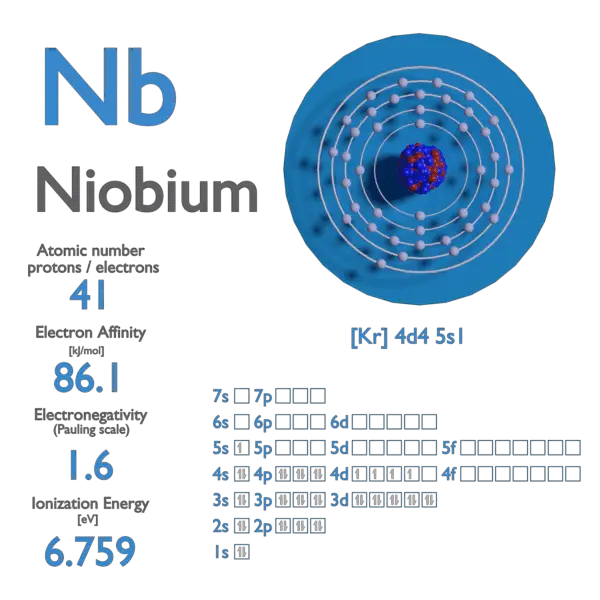
Electron Affinity of Niobium is 86.1 kJ/mol.

Electronegativity of Niobium is 1.6.

First Ionization Energy of Niobium is 6.7589 eV.

Electron Affinity

In chemistry and atomic physics, the electron affinity of an atom or molecule is defined as:

the change in energy (in kJ/mole) of a neutral atom or molecule (in the gaseous phase) when an electron is added to the atom to form a negative ion.

X + e → X + energy        Affinity = – ∆H

Niobium - Electron Affinity - Electronegativity - Ionization Energy
In other words, it can be expressed as the neutral atom’s likelihood of gaining an electron. Note that ionization energies measure the tendency of a neutral atom to resist the loss of electrons. Electron affinities are more difficult to measure than ionization energies.

An atom of Niobium in the gas phase, for example, gives off energy when it gains an electron to form an ion of Niobium.

Nb + e → Nb        – ∆H = Affinity = 86.1 kJ/mol

Electron affinity is one of the most important parameters that guide chemical reactivity. Molecules with high electron affinity form very stable negative ions which are important in the chemical and health industry as they purify the air, lift mood, and most importantly, act as strong oxidizing agents. To use electron affinities properly, it is essential to keep track of signs. When an electron is added to a neutral atom, energy is released. This affinity is known as the first electron affinity, and these energies are negative. By convention, the negative sign shows a release of energy. However, more energy is required to add an electron to a negative ion which overwhelms any release of energy from the electron attachment process. This affinity is known as the second electron affinity, and these energies are positive.

Halogens have the highest electron affinities among all elements. In fact, the electron affinity of Cl, 3.62 eV is the largest of all the elements. Superhalogens are molecules that have electron affinities (EA) greater than that of Cl, the element with the highest EA (3.62 eV).

It is well known that noble gases have closed electronic shell structure and hence have high ionization potentials and low electron affinities, due to which they are chemically inert and resistant to salt formation under most conditions.

Affinities of Nonmetals vs. Affinities of Metals

  • Metals: Metals like to lose valence electrons to form cations to have a fully stable shell. The electron affinity of metals is lower than that of nonmetals. Mercury most weakly attracts an extra electron.
  • Nonmetals: Generally, nonmetals have more positive electron affinity than metals. Nonmetals like to gain electrons to form anions to have a fully stable electron shell. Chlorine most strongly attracts extra electrons. The electron affinities of the noble gases have not been conclusively measured, so they may or may not have slightly negative values.

Learn more about electron affinities.

Electronegativity

Electronegativity, symbol χ, is a chemical property that describes the tendency of an atom to attract electrons towards this atom. For this purpose, a dimensionless quantity, the Pauling scale, symbol χ, is the most commonly used.

The electronegativity of Niobium is:

χ = 1.6

In general, an atom’s electronegativity is affected by both its atomic number and the distance at which its valence electrons reside from the charged nucleus. The higher the associated electronegativity number, the more an element or compound attracts electrons towards it.

As it is usually calculated, electronegativity is not a property of an atom alone, but rather a property of an atom in a molecule. Even so, the electronegativity of an atom is strongly correlated with the first ionization energy, and negatively correlated with the electron affinity. Electrons with low ionization energies have low electronegativities because their nuclei do not exert a strong attractive force on electrons. Elements with high ionization energies have high electronegativities due to the strong pull exerted by the positive nucleus on the negative electrons. Therefore the electronegativity is greatest at the top-right of the periodic table and decreases toward the bottom-left.

Caesium is the least electronegative element (0.79); fluorine is the most (3.98).

Learn more about electronegativities.


electron affinity and electronegativity

First Ionization Energy of Niobium

First Ionization Energy of Niobium is 6.7589 eV.

Ionization energy, also called ionization potential, is the energy necessary to remove an electron from the neutral atom.

X + energy → X+ + e

where X is any atom or molecule capable of being ionized, X+ is that atom or molecule with an electron removed (positive ion), and e is the removed electron.

A Niobium atom, for example, requires the following ionization energy to remove the outermost electron.

Nb + IE → Nb+ + e        IE = 6.7589 eV

The ionization energy associated with removal of the first electron is most commonly used. The nth ionization energy refers to the amount of energy required to remove an electron from the species with a charge of (n-1).

1st ionization energy

X → X+ + e

2nd ionization energy

X+ → X2+ + e

3rd ionization energy

X2+ → X3+ + e

Ionization Energy for different Elements

There is ionization energy for each successive electron removed. The electrons that circle the nucleus move in fairly well-defined orbits. Some of these electrons are more tightly bound in the atom than others. For example, only 7.38 eV is required to remove the outermost electron from a lead atom, while 88,000 eV is required to remove the innermost electron. Helps to understand the reactivity of elements (especially metals, which lose electrons).

In general, the ionization energy increases moving up a group and moving left to right across a period. Moreover:

  • Ionization energy is lowest for the alkali metals which have a single electron outside a closed shell.
  • Ionization energy increases across a row on the periodic maximum for the noble gases which have closed shells.

For example, sodium requires only 496 kJ/mol or 5.14 eV/atom to ionize it. On the other hand neon, the noble gas, immediately preceding it in the periodic table, requires 2081 kJ/mol or 21.56 eV/atom.

Learn more about ionization energy.

ionization energy

Niobium – Properties

Element Niobium
Atomic Number 41
Symbol Nb
Element Category Transition Metal
Phase at STP Solid
Atomic Mass [amu] 92.90638
Density at STP [g/cm3] 8.57
Electron Configuration [Kr] 4d4 5s1
Possible Oxidation States +3,5
Electron Affinity [kJ/mol] 86.1
Electronegativity [Pauling scale] 1.6
1st Ionization Energy [eV] 6.7589
Year of Discovery 1801
Discoverer Hatchet, Charles
Thermal properties
Melting Point [Celsius scale] 2477
Boiling Point [Celsius scale] 4744
Thermal Conductivity [W/m K] 53.7
Specific Heat [J/g K] 0.26
Heat of Fusion [kJ/mol] 26.4
Heat of Vaporization [kJ/mol] 682


Niobium in Periodic Table

Hydro­gen1H He­lium2He
Lith­ium3Li Beryl­lium4Be Boron5B Carbon6C Nitro­gen7N Oxy­gen8O Fluor­ine9F Neon10Ne
So­dium11Na Magne­sium12Mg Alumin­ium13Al Sili­con14Si Phos­phorus15P Sulfur16S Chlor­ine17Cl Argon18Ar
Potas­sium19K Cal­cium20Ca Scan­dium21Sc Tita­nium22Ti Vana­dium23V Chrom­ium24Cr Manga­nese25Mn Iron26Fe Cobalt27Co Nickel28Ni Copper29Cu Zinc30Zn Gallium31Ga Germa­nium32Ge Arsenic33As Sele­nium34Se Bromine35Br Kryp­ton36Kr
Rubid­ium37Rb Stront­ium38Sr Yttrium39Y Zirco­nium40Zr Nio­bium41Nb Molyb­denum42Mo Tech­netium43Tc Ruthe­nium44Ru Rho­dium45Rh Pallad­ium46Pd Silver47Ag Cad­mium48Cd Indium49In Tin50Sn Anti­mony51Sb Tellur­ium52Te Iodine53I Xenon54Xe
Cae­sium55Cs Ba­rium56Ba Lan­thanum57La 1 asterisk Haf­nium72Hf Tanta­lum73Ta Tung­sten74W Rhe­nium75Re Os­mium76Os Iridium77Ir Plat­inum78Pt Gold79Au Mer­cury80Hg Thallium81Tl Lead82Pb Bis­muth83Bi Polo­nium84Po Asta­tine85At Radon86Rn
Fran­cium87Fr Ra­dium88Ra Actin­ium89Ac 1 asterisk Ruther­fordium104Rf Dub­nium105Db Sea­borgium106Sg Bohr­ium107Bh Has­sium108Hs Meit­nerium109Mt Darm­stadtium110Ds Roent­genium111Rg Coper­nicium112Cn Nihon­ium113Nh Flerov­ium114Fl Moscov­ium115Mc Liver­morium116Lv Tenness­ine117Ts Oga­nesson118Og
1 asterisk Cerium58Ce Praseo­dymium59Pr Neo­dymium60Nd Prome­thium61Pm Sama­rium62Sm Europ­ium63Eu Gadolin­ium64Gd Ter­bium65Tb Dyspro­sium66Dy Hol­mium67Ho Erbium68Er Thulium69Tm Ytter­bium70Yb Lute­tium71Lu
1 asterisk Thor­ium90Th Protac­tinium91Pa Ura­nium92U Neptu­nium93Np Pluto­nium94Pu Ameri­cium95Am Curium96Cm Berkel­ium97Bk Califor­nium98Cf Einstei­nium99Es Fer­mium100Fm Mende­levium101Md Nobel­ium102No Lawren­cium103Lr


Molybdenum – Electron Affinity – Electronegativity – Ionization Energy of Molybdenum

Electron Affinity and Electronegativity of Molybdenum

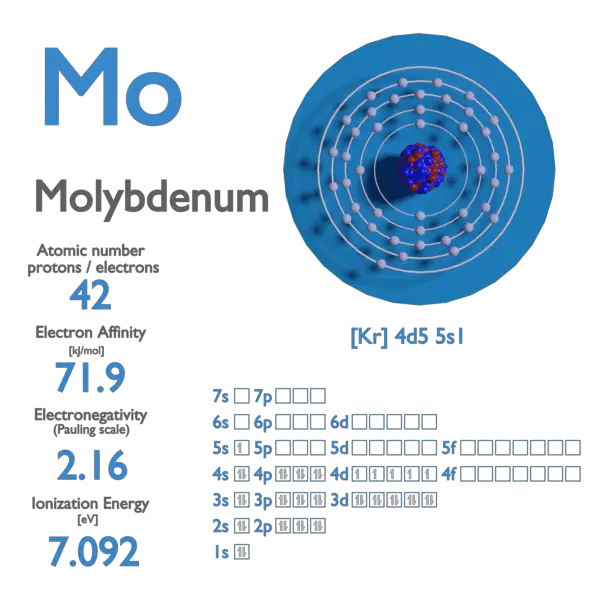
Electron Affinity of Molybdenum is 71.9 kJ/mol.

Electronegativity of Molybdenum is 2.16.

First Ionization Energy of Molybdenum is 7.0924 eV.

Electron Affinity

In chemistry and atomic physics, the electron affinity of an atom or molecule is defined as:

the change in energy (in kJ/mole) of a neutral atom or molecule (in the gaseous phase) when an electron is added to the atom to form a negative ion.

X + e → X + energy        Affinity = – ∆H

Molybdenum - Electron Affinity - Electronegativity - Ionization Energy
In other words, it can be expressed as the neutral atom’s likelihood of gaining an electron. Note that ionization energies measure the tendency of a neutral atom to resist the loss of electrons. Electron affinities are more difficult to measure than ionization energies.

An atom of Molybdenum in the gas phase, for example, gives off energy when it gains an electron to form an ion of Molybdenum.

Mo + e → Mo        – ∆H = Affinity = 71.9 kJ/mol

Electron affinity is one of the most important parameters that guide chemical reactivity. Molecules with high electron affinity form very stable negative ions which are important in the chemical and health industry as they purify the air, lift mood, and most importantly, act as strong oxidizing agents. To use electron affinities properly, it is essential to keep track of signs. When an electron is added to a neutral atom, energy is released. This affinity is known as the first electron affinity, and these energies are negative. By convention, the negative sign shows a release of energy. However, more energy is required to add an electron to a negative ion which overwhelms any release of energy from the electron attachment process. This affinity is known as the second electron affinity, and these energies are positive.

Halogens have the highest electron affinities among all elements. In fact, the electron affinity of Cl, 3.62 eV is the largest of all the elements. Superhalogens are molecules that have electron affinities (EA) greater than that of Cl, the element with the highest EA (3.62 eV).

It is well known that noble gases have closed electronic shell structure and hence have high ionization potentials and low electron affinities, due to which they are chemically inert and resistant to salt formation under most conditions.

Affinities of Nonmetals vs. Affinities of Metals

  • Metals: Metals like to lose valence electrons to form cations to have a fully stable shell. The electron affinity of metals is lower than that of nonmetals. Mercury most weakly attracts an extra electron.
  • Nonmetals: Generally, nonmetals have more positive electron affinity than metals. Nonmetals like to gain electrons to form anions to have a fully stable electron shell. Chlorine most strongly attracts extra electrons. The electron affinities of the noble gases have not been conclusively measured, so they may or may not have slightly negative values.

Learn more about electron affinities.

Electronegativity

Electronegativity, symbol χ, is a chemical property that describes the tendency of an atom to attract electrons towards this atom. For this purpose, a dimensionless quantity, the Pauling scale, symbol χ, is the most commonly used.

The electronegativity of Molybdenum is:

χ = 2.16

In general, an atom’s electronegativity is affected by both its atomic number and the distance at which its valence electrons reside from the charged nucleus. The higher the associated electronegativity number, the more an element or compound attracts electrons towards it.

As it is usually calculated, electronegativity is not a property of an atom alone, but rather a property of an atom in a molecule. Even so, the electronegativity of an atom is strongly correlated with the first ionization energy, and negatively correlated with the electron affinity. Electrons with low ionization energies have low electronegativities because their nuclei do not exert a strong attractive force on electrons. Elements with high ionization energies have high electronegativities due to the strong pull exerted by the positive nucleus on the negative electrons. Therefore the electronegativity is greatest at the top-right of the periodic table and decreases toward the bottom-left.

Caesium is the least electronegative element (0.79); fluorine is the most (3.98).

Learn more about electronegativities.


electron affinity and electronegativity

First Ionization Energy of Molybdenum

First Ionization Energy of Molybdenum is 7.0924 eV.

Ionization energy, also called ionization potential, is the energy necessary to remove an electron from the neutral atom.

X + energy → X+ + e

where X is any atom or molecule capable of being ionized, X+ is that atom or molecule with an electron removed (positive ion), and e is the removed electron.

A Molybdenum atom, for example, requires the following ionization energy to remove the outermost electron.

Mo + IE → Mo+ + e        IE = 7.0924 eV

The ionization energy associated with removal of the first electron is most commonly used. The nth ionization energy refers to the amount of energy required to remove an electron from the species with a charge of (n-1).

1st ionization energy

X → X+ + e

2nd ionization energy

X+ → X2+ + e

3rd ionization energy

X2+ → X3+ + e

Ionization Energy for different Elements

There is ionization energy for each successive electron removed. The electrons that circle the nucleus move in fairly well-defined orbits. Some of these electrons are more tightly bound in the atom than others. For example, only 7.38 eV is required to remove the outermost electron from a lead atom, while 88,000 eV is required to remove the innermost electron. Helps to understand the reactivity of elements (especially metals, which lose electrons).

In general, the ionization energy increases moving up a group and moving left to right across a period. Moreover:

  • Ionization energy is lowest for the alkali metals which have a single electron outside a closed shell.
  • Ionization energy increases across a row on the periodic maximum for the noble gases which have closed shells.

For example, sodium requires only 496 kJ/mol or 5.14 eV/atom to ionize it. On the other hand neon, the noble gas, immediately preceding it in the periodic table, requires 2081 kJ/mol or 21.56 eV/atom.

Learn more about ionization energy.

ionization energy

Molybdenum – Properties

Element Molybdenum
Atomic Number 42
Symbol Mo
Element Category Transition Metal
Phase at STP Solid
Atomic Mass [amu] 95.94
Density at STP [g/cm3] 10.28
Electron Configuration [Kr] 4d5 5s1
Possible Oxidation States +6
Electron Affinity [kJ/mol] 71.9
Electronegativity [Pauling scale] 2.16
1st Ionization Energy [eV] 7.0924
Year of Discovery 1778
Discoverer Scheele, Carl Welhelm
Thermal properties
Melting Point [Celsius scale] 2623
Boiling Point [Celsius scale] 4639
Thermal Conductivity [W/m K] 138
Specific Heat [J/g K] 0.25
Heat of Fusion [kJ/mol] 32
Heat of Vaporization [kJ/mol] 598


Molybdenum in Periodic Table

Hydro­gen1H He­lium2He
Lith­ium3Li Beryl­lium4Be Boron5B Carbon6C Nitro­gen7N Oxy­gen8O Fluor­ine9F Neon10Ne
So­dium11Na Magne­sium12Mg Alumin­ium13Al Sili­con14Si Phos­phorus15P Sulfur16S Chlor­ine17Cl Argon18Ar
Potas­sium19K Cal­cium20Ca Scan­dium21Sc Tita­nium22Ti Vana­dium23V Chrom­ium24Cr Manga­nese25Mn Iron26Fe Cobalt27Co Nickel28Ni Copper29Cu Zinc30Zn Gallium31Ga Germa­nium32Ge Arsenic33As Sele­nium34Se Bromine35Br Kryp­ton36Kr
Rubid­ium37Rb Stront­ium38Sr Yttrium39Y Zirco­nium40Zr Nio­bium41Nb Molyb­denum42Mo Tech­netium43Tc Ruthe­nium44Ru Rho­dium45Rh Pallad­ium46Pd Silver47Ag Cad­mium48Cd Indium49In Tin50Sn Anti­mony51Sb Tellur­ium52Te Iodine53I Xenon54Xe
Cae­sium55Cs Ba­rium56Ba Lan­thanum57La 1 asterisk Haf­nium72Hf Tanta­lum73Ta Tung­sten74W Rhe­nium75Re Os­mium76Os Iridium77Ir Plat­inum78Pt Gold79Au Mer­cury80Hg Thallium81Tl Lead82Pb Bis­muth83Bi Polo­nium84Po Asta­tine85At Radon86Rn
Fran­cium87Fr Ra­dium88Ra Actin­ium89Ac 1 asterisk Ruther­fordium104Rf Dub­nium105Db Sea­borgium106Sg Bohr­ium107Bh Has­sium108Hs Meit­nerium109Mt Darm­stadtium110Ds Roent­genium111Rg Coper­nicium112Cn Nihon­ium113Nh Flerov­ium114Fl Moscov­ium115Mc Liver­morium116Lv Tenness­ine117Ts Oga­nesson118Og
1 asterisk Cerium58Ce Praseo­dymium59Pr Neo­dymium60Nd Prome­thium61Pm Sama­rium62Sm Europ­ium63Eu Gadolin­ium64Gd Ter­bium65Tb Dyspro­sium66Dy Hol­mium67Ho Erbium68Er Thulium69Tm Ytter­bium70Yb Lute­tium71Lu
1 asterisk Thor­ium90Th Protac­tinium91Pa Ura­nium92U Neptu­nium93Np Pluto­nium94Pu Ameri­cium95Am Curium96Cm Berkel­ium97Bk Califor­nium98Cf Einstei­nium99Es Fer­mium100Fm Mende­levium101Md Nobel­ium102No Lawren­cium103Lr


Yttrium – Electron Affinity – Electronegativity – Ionization Energy of Yttrium

Electron Affinity and Electronegativity of Yttrium

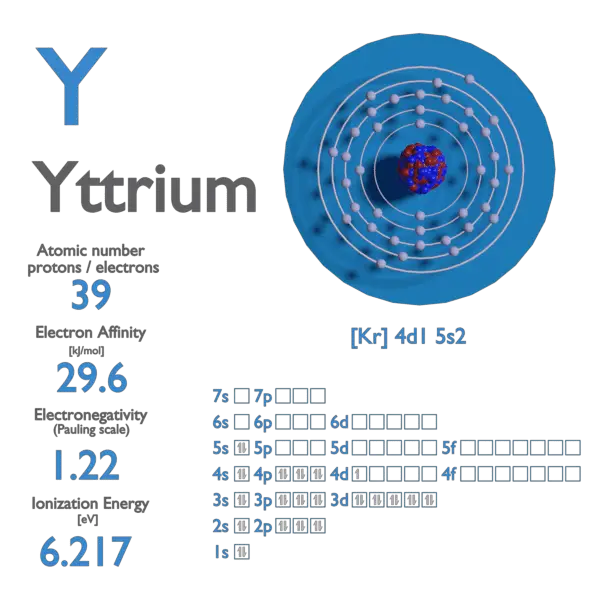
Electron Affinity of Yttrium is 29.6 kJ/mol.

Electronegativity of Yttrium is 1.22.

First Ionization Energy of Yttrium is 6.217 eV.

Electron Affinity

In chemistry and atomic physics, the electron affinity of an atom or molecule is defined as:

the change in energy (in kJ/mole) of a neutral atom or molecule (in the gaseous phase) when an electron is added to the atom to form a negative ion.

X + e → X + energy        Affinity = – ∆H

Yttrium - Electron Affinity - Electronegativity - Ionization Energy
In other words, it can be expressed as the neutral atom’s likelihood of gaining an electron. Note that ionization energies measure the tendency of a neutral atom to resist the loss of electrons. Electron affinities are more difficult to measure than ionization energies.

An atom of Yttrium in the gas phase, for example, gives off energy when it gains an electron to form an ion of Yttrium.

Y + e → Y        – ∆H = Affinity = 29.6 kJ/mol

Electron affinity is one of the most important parameters that guide chemical reactivity. Molecules with high electron affinity form very stable negative ions which are important in the chemical and health industry as they purify the air, lift mood, and most importantly, act as strong oxidizing agents. To use electron affinities properly, it is essential to keep track of signs. When an electron is added to a neutral atom, energy is released. This affinity is known as the first electron affinity, and these energies are negative. By convention, the negative sign shows a release of energy. However, more energy is required to add an electron to a negative ion which overwhelms any release of energy from the electron attachment process. This affinity is known as the second electron affinity, and these energies are positive.

Halogens have the highest electron affinities among all elements. In fact, the electron affinity of Cl, 3.62 eV is the largest of all the elements. Superhalogens are molecules that have electron affinities (EA) greater than that of Cl, the element with the highest EA (3.62 eV).

It is well known that noble gases have closed electronic shell structure and hence have high ionization potentials and low electron affinities, due to which they are chemically inert and resistant to salt formation under most conditions.

Affinities of Nonmetals vs. Affinities of Metals

  • Metals: Metals like to lose valence electrons to form cations to have a fully stable shell. The electron affinity of metals is lower than that of nonmetals. Mercury most weakly attracts an extra electron.
  • Nonmetals: Generally, nonmetals have more positive electron affinity than metals. Nonmetals like to gain electrons to form anions to have a fully stable electron shell. Chlorine most strongly attracts extra electrons. The electron affinities of the noble gases have not been conclusively measured, so they may or may not have slightly negative values.

Learn more about electron affinities.

Electronegativity

Electronegativity, symbol χ, is a chemical property that describes the tendency of an atom to attract electrons towards this atom. For this purpose, a dimensionless quantity, the Pauling scale, symbol χ, is the most commonly used.

The electronegativity of Yttrium is:

χ = 1.22

In general, an atom’s electronegativity is affected by both its atomic number and the distance at which its valence electrons reside from the charged nucleus. The higher the associated electronegativity number, the more an element or compound attracts electrons towards it.

As it is usually calculated, electronegativity is not a property of an atom alone, but rather a property of an atom in a molecule. Even so, the electronegativity of an atom is strongly correlated with the first ionization energy, and negatively correlated with the electron affinity. Electrons with low ionization energies have low electronegativities because their nuclei do not exert a strong attractive force on electrons. Elements with high ionization energies have high electronegativities due to the strong pull exerted by the positive nucleus on the negative electrons. Therefore the electronegativity is greatest at the top-right of the periodic table and decreases toward the bottom-left.

Caesium is the least electronegative element (0.79); fluorine is the most (3.98).

Learn more about electronegativities.


electron affinity and electronegativity

First Ionization Energy of Yttrium

First Ionization Energy of Yttrium is 6.217 eV.

Ionization energy, also called ionization potential, is the energy necessary to remove an electron from the neutral atom.

X + energy → X+ + e

where X is any atom or molecule capable of being ionized, X+ is that atom or molecule with an electron removed (positive ion), and e is the removed electron.

A Yttrium atom, for example, requires the following ionization energy to remove the outermost electron.

Y + IE → Y+ + e        IE = 6.217 eV

The ionization energy associated with removal of the first electron is most commonly used. The nth ionization energy refers to the amount of energy required to remove an electron from the species with a charge of (n-1).

1st ionization energy

X → X+ + e

2nd ionization energy

X+ → X2+ + e

3rd ionization energy

X2+ → X3+ + e

Ionization Energy for different Elements

There is ionization energy for each successive electron removed. The electrons that circle the nucleus move in fairly well-defined orbits. Some of these electrons are more tightly bound in the atom than others. For example, only 7.38 eV is required to remove the outermost electron from a lead atom, while 88,000 eV is required to remove the innermost electron. Helps to understand the reactivity of elements (especially metals, which lose electrons).

In general, the ionization energy increases moving up a group and moving left to right across a period. Moreover:

  • Ionization energy is lowest for the alkali metals which have a single electron outside a closed shell.
  • Ionization energy increases across a row on the periodic maximum for the noble gases which have closed shells.

For example, sodium requires only 496 kJ/mol or 5.14 eV/atom to ionize it. On the other hand neon, the noble gas, immediately preceding it in the periodic table, requires 2081 kJ/mol or 21.56 eV/atom.

Learn more about ionization energy.

ionization energy

Yttrium – Properties

Element Yttrium
Atomic Number 39
Symbol Y
Element Category Transition Metal
Phase at STP Solid
Atomic Mass [amu] 88.90585
Density at STP [g/cm3] 4.472
Electron Configuration [Kr] 4d1 5s2
Possible Oxidation States +3
Electron Affinity [kJ/mol] 29.6
Electronegativity [Pauling scale] 1.22
1st Ionization Energy [eV] 6.217
Year of Discovery 1789
Discoverer Gadolin, Johan
Thermal properties
Melting Point [Celsius scale] 1526
Boiling Point [Celsius scale] 3345
Thermal Conductivity [W/m K] 17.2
Specific Heat [J/g K] 0.3
Heat of Fusion [kJ/mol] 11.4
Heat of Vaporization [kJ/mol] 363


Yttrium in Periodic Table

Hydro­gen1H He­lium2He
Lith­ium3Li Beryl­lium4Be Boron5B Carbon6C Nitro­gen7N Oxy­gen8O Fluor­ine9F Neon10Ne
So­dium11Na Magne­sium12Mg Alumin­ium13Al Sili­con14Si Phos­phorus15P Sulfur16S Chlor­ine17Cl Argon18Ar
Potas­sium19K Cal­cium20Ca Scan­dium21Sc Tita­nium22Ti Vana­dium23V Chrom­ium24Cr Manga­nese25Mn Iron26Fe Cobalt27Co Nickel28Ni Copper29Cu Zinc30Zn Gallium31Ga Germa­nium32Ge Arsenic33As Sele­nium34Se Bromine35Br Kryp­ton36Kr
Rubid­ium37Rb Stront­ium38Sr Yttrium39Y Zirco­nium40Zr Nio­bium41Nb Molyb­denum42Mo Tech­netium43Tc Ruthe­nium44Ru Rho­dium45Rh Pallad­ium46Pd Silver47Ag Cad­mium48Cd Indium49In Tin50Sn Anti­mony51Sb Tellur­ium52Te Iodine53I Xenon54Xe
Cae­sium55Cs Ba­rium56Ba Lan­thanum57La 1 asterisk Haf­nium72Hf Tanta­lum73Ta Tung­sten74W Rhe­nium75Re Os­mium76Os Iridium77Ir Plat­inum78Pt Gold79Au Mer­cury80Hg Thallium81Tl Lead82Pb Bis­muth83Bi Polo­nium84Po Asta­tine85At Radon86Rn
Fran­cium87Fr Ra­dium88Ra Actin­ium89Ac 1 asterisk Ruther­fordium104Rf Dub­nium105Db Sea­borgium106Sg Bohr­ium107Bh Has­sium108Hs Meit­nerium109Mt Darm­stadtium110Ds Roent­genium111Rg Coper­nicium112Cn Nihon­ium113Nh Flerov­ium114Fl Moscov­ium115Mc Liver­morium116Lv Tenness­ine117Ts Oga­nesson118Og
1 asterisk Cerium58Ce Praseo­dymium59Pr Neo­dymium60Nd Prome­thium61Pm Sama­rium62Sm Europ­ium63Eu Gadolin­ium64Gd Ter­bium65Tb Dyspro­sium66Dy Hol­mium67Ho Erbium68Er Thulium69Tm Ytter­bium70Yb Lute­tium71Lu
1 asterisk Thor­ium90Th Protac­tinium91Pa Ura­nium92U Neptu­nium93Np Pluto­nium94Pu Ameri­cium95Am Curium96Cm Berkel­ium97Bk Califor­nium98Cf Einstei­nium99Es Fer­mium100Fm Mende­levium101Md Nobel­ium102No Lawren­cium103Lr


Zirconium – Electron Affinity – Electronegativity – Ionization Energy of Zirconium

Electron Affinity and Electronegativity of Zirconium

Electron Affinity of Zirconium is 41.1 kJ/mol.

Electronegativity of Zirconium is 1.33.

First Ionization Energy of Zirconium is 6.6339 eV.

Electron Affinity

In chemistry and atomic physics, the electron affinity of an atom or molecule is defined as:

the change in energy (in kJ/mole) of a neutral atom or molecule (in the gaseous phase) when an electron is added to the atom to form a negative ion.

X + e → X + energy        Affinity = – ∆H

Zirconium - Electron Affinity - Electronegativity - Ionization Energy
In other words, it can be expressed as the neutral atom’s likelihood of gaining an electron. Note that ionization energies measure the tendency of a neutral atom to resist the loss of electrons. Electron affinities are more difficult to measure than ionization energies.

An atom of Zirconium in the gas phase, for example, gives off energy when it gains an electron to form an ion of Zirconium.

Zr + e → Zr        – ∆H = Affinity = 41.1 kJ/mol

Electron affinity is one of the most important parameters that guide chemical reactivity. Molecules with high electron affinity form very stable negative ions which are important in the chemical and health industry as they purify the air, lift mood, and most importantly, act as strong oxidizing agents. To use electron affinities properly, it is essential to keep track of signs. When an electron is added to a neutral atom, energy is released. This affinity is known as the first electron affinity, and these energies are negative. By convention, the negative sign shows a release of energy. However, more energy is required to add an electron to a negative ion which overwhelms any release of energy from the electron attachment process. This affinity is known as the second electron affinity, and these energies are positive.

Halogens have the highest electron affinities among all elements. In fact, the electron affinity of Cl, 3.62 eV is the largest of all the elements. Superhalogens are molecules that have electron affinities (EA) greater than that of Cl, the element with the highest EA (3.62 eV).

It is well known that noble gases have closed electronic shell structure and hence have high ionization potentials and low electron affinities, due to which they are chemically inert and resistant to salt formation under most conditions.

Affinities of Nonmetals vs. Affinities of Metals

  • Metals: Metals like to lose valence electrons to form cations to have a fully stable shell. The electron affinity of metals is lower than that of nonmetals. Mercury most weakly attracts an extra electron.
  • Nonmetals: Generally, nonmetals have more positive electron affinity than metals. Nonmetals like to gain electrons to form anions to have a fully stable electron shell. Chlorine most strongly attracts extra electrons. The electron affinities of the noble gases have not been conclusively measured, so they may or may not have slightly negative values.

Learn more about electron affinities.

Electronegativity

Electronegativity, symbol χ, is a chemical property that describes the tendency of an atom to attract electrons towards this atom. For this purpose, a dimensionless quantity, the Pauling scale, symbol χ, is the most commonly used.

The electronegativity of Zirconium is:

χ = 1.33

In general, an atom’s electronegativity is affected by both its atomic number and the distance at which its valence electrons reside from the charged nucleus. The higher the associated electronegativity number, the more an element or compound attracts electrons towards it.

As it is usually calculated, electronegativity is not a property of an atom alone, but rather a property of an atom in a molecule. Even so, the electronegativity of an atom is strongly correlated with the first ionization energy, and negatively correlated with the electron affinity. Electrons with low ionization energies have low electronegativities because their nuclei do not exert a strong attractive force on electrons. Elements with high ionization energies have high electronegativities due to the strong pull exerted by the positive nucleus on the negative electrons. Therefore the electronegativity is greatest at the top-right of the periodic table and decreases toward the bottom-left.

Caesium is the least electronegative element (0.79); fluorine is the most (3.98).

Learn more about electronegativities.


electron affinity and electronegativity

First Ionization Energy of Zirconium

First Ionization Energy of Zirconium is 6.6339 eV.

Ionization energy, also called ionization potential, is the energy necessary to remove an electron from the neutral atom.

X + energy → X+ + e

where X is any atom or molecule capable of being ionized, X+ is that atom or molecule with an electron removed (positive ion), and e is the removed electron.

A Zirconium atom, for example, requires the following ionization energy to remove the outermost electron.

Zr + IE → Zr+ + e        IE = 6.6339 eV

The ionization energy associated with removal of the first electron is most commonly used. The nth ionization energy refers to the amount of energy required to remove an electron from the species with a charge of (n-1).

1st ionization energy

X → X+ + e

2nd ionization energy

X+ → X2+ + e

3rd ionization energy

X2+ → X3+ + e

Ionization Energy for different Elements

There is ionization energy for each successive electron removed. The electrons that circle the nucleus move in fairly well-defined orbits. Some of these electrons are more tightly bound in the atom than others. For example, only 7.38 eV is required to remove the outermost electron from a lead atom, while 88,000 eV is required to remove the innermost electron. Helps to understand the reactivity of elements (especially metals, which lose electrons).

In general, the ionization energy increases moving up a group and moving left to right across a period. Moreover:

  • Ionization energy is lowest for the alkali metals which have a single electron outside a closed shell.
  • Ionization energy increases across a row on the periodic maximum for the noble gases which have closed shells.

For example, sodium requires only 496 kJ/mol or 5.14 eV/atom to ionize it. On the other hand neon, the noble gas, immediately preceding it in the periodic table, requires 2081 kJ/mol or 21.56 eV/atom.

Learn more about ionization energy.

ionization energy

Zirconium – Properties

Element Zirconium
Atomic Number 40
Symbol Zr
Element Category Transition Metal
Phase at STP Solid
Atomic Mass [amu] 91.224
Density at STP [g/cm3] 6.511
Electron Configuration [Kr] 4d2 5s2
Possible Oxidation States +4
Electron Affinity [kJ/mol] 41.1
Electronegativity [Pauling scale] 1.33
1st Ionization Energy [eV] 6.6339
Year of Discovery 1789
Discoverer Klaproth, Martin Heinrich
Thermal properties
Melting Point [Celsius scale] 1855
Boiling Point [Celsius scale] 4409
Thermal Conductivity [W/m K] 22.7
Specific Heat [J/g K] 0.27
Heat of Fusion [kJ/mol] 16.9
Heat of Vaporization [kJ/mol] 58.2


Zirconium in Periodic Table

Hydro­gen1H He­lium2He
Lith­ium3Li Beryl­lium4Be Boron5B Carbon6C Nitro­gen7N Oxy­gen8O Fluor­ine9F Neon10Ne
So­dium11Na Magne­sium12Mg Alumin­ium13Al Sili­con14Si Phos­phorus15P Sulfur16S Chlor­ine17Cl Argon18Ar
Potas­sium19K Cal­cium20Ca Scan­dium21Sc Tita­nium22Ti Vana­dium23V Chrom­ium24Cr Manga­nese25Mn Iron26Fe Cobalt27Co Nickel28Ni Copper29Cu Zinc30Zn Gallium31Ga Germa­nium32Ge Arsenic33As Sele­nium34Se Bromine35Br Kryp­ton36Kr
Rubid­ium37Rb Stront­ium38Sr Yttrium39Y Zirco­nium40Zr Nio­bium41Nb Molyb­denum42Mo Tech­netium43Tc Ruthe­nium44Ru Rho­dium45Rh Pallad­ium46Pd Silver47Ag Cad­mium48Cd Indium49In Tin50Sn Anti­mony51Sb Tellur­ium52Te Iodine53I Xenon54Xe
Cae­sium55Cs Ba­rium56Ba Lan­thanum57La 1 asterisk Haf­nium72Hf Tanta­lum73Ta Tung­sten74W Rhe­nium75Re Os­mium76Os Iridium77Ir Plat­inum78Pt Gold79Au Mer­cury80Hg Thallium81Tl Lead82Pb Bis­muth83Bi Polo­nium84Po Asta­tine85At Radon86Rn
Fran­cium87Fr Ra­dium88Ra Actin­ium89Ac 1 asterisk Ruther­fordium104Rf Dub­nium105Db Sea­borgium106Sg Bohr­ium107Bh Has­sium108Hs Meit­nerium109Mt Darm­stadtium110Ds Roent­genium111Rg Coper­nicium112Cn Nihon­ium113Nh Flerov­ium114Fl Moscov­ium115Mc Liver­morium116Lv Tenness­ine117Ts Oga­nesson118Og
1 asterisk Cerium58Ce Praseo­dymium59Pr Neo­dymium60Nd Prome­thium61Pm Sama­rium62Sm Europ­ium63Eu Gadolin­ium64Gd Ter­bium65Tb Dyspro­sium66Dy Hol­mium67Ho Erbium68Er Thulium69Tm Ytter­bium70Yb Lute­tium71Lu
1 asterisk Thor­ium90Th Protac­tinium91Pa Ura­nium92U Neptu­nium93Np Pluto­nium94Pu Ameri­cium95Am Curium96Cm Berkel­ium97Bk Califor­nium98Cf Einstei­nium99Es Fer­mium100Fm Mende­levium101Md Nobel­ium102No Lawren­cium103Lr