Facebook Instagram Youtube Twitter

Holmium – Melting Point – Boiling Point

Holmium – Melting Point and Boiling Point

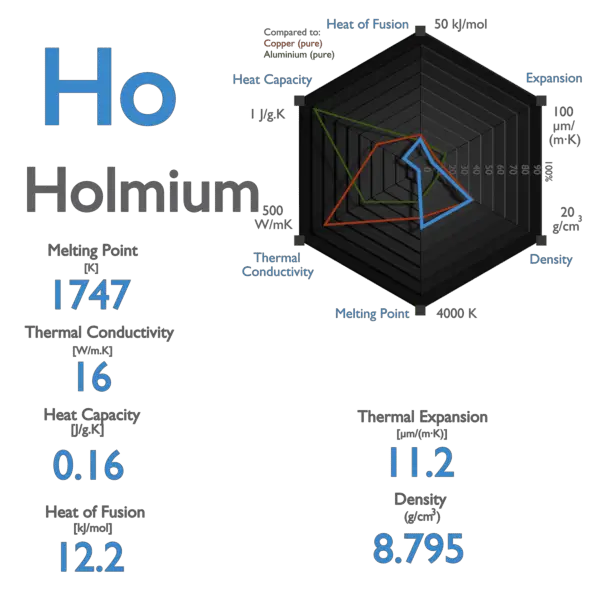
Melting point of Holmium is 1474°C.

Boiling point of Holmium is 2700°C.

Note that these points are associated with the standard atmospheric pressure.
Holmium - Melting Point - Boiling Point

Boiling Point – Saturation

In thermodynamics, saturation defines a condition in which a mixture of vapor and liquid can exist together at a given temperature and pressure. The temperature at which vaporization (boiling) starts to occur for a given pressure is called the saturation temperature or boiling point. The pressure at which vaporization (boiling) starts to occur for a given temperature is called the saturation pressure. When considered as the temperature of the reverse change from vapor to liquid, it is called the condensation point.

Melting Point

In thermodynamics, the melting point defines a condition where the solid and liquid can exist in equilibrium. Adding heat will convert the solid into a liquid with no temperature change. The melting point of a substance depends on pressure and is usually specified at standard pressure. When considered as the temperature of the reverse change from liquid to solid, it is called the freezing point or crystallization point.

The first theory explaining the mechanism of melting in bulk was proposed by Lindemann, who used the vibration of atoms in the crystal to explain the melting transition. Solids are similar to liquids in that both are condensed states, with particles that are far closer together than those of a gas. The atoms in a solid are tightly bound to each other, either in a regular geometric lattice (crystalline solids, which include metals and ordinary ice) or irregularly (an amorphous solid such as common window glass), and are typically low in energy. The motion of individual atoms, ions, or molecules in a solid is restricted to vibrational motion about a fixed point. As a solid is heated, its particles vibrate more rapidly as the solid absorbs kinetic energy. At some point, the amplitude of vibration becomes so large that the atoms start to invade the space of their nearest neighbors and disturb them, and the melting process initiates. The melting point is the temperature at which the disruptive vibrations of the particles of the solid overcome the attractive forces operating within the solid.
melting and boiling point

Holmium – Properties

Element Holmium
Atomic Number 67
Symbol Ho
Element Category Rare Earth Metal
Phase at STP Solid
Atomic Mass [amu] 164.9303
Density at STP [g/cm3] 8.795
Electron Configuration [Xe] 4f11 6s2
Possible Oxidation States +3
Electron Affinity [kJ/mol] 50
Electronegativity [Pauling scale] 1.23
1st Ionization Energy [eV] 6.0216
Year of Discovery 1879
Discoverer Cleve, Per Theodor
Thermal properties
Melting Point [Celsius scale] 1474
Boiling Point [Celsius scale] 2700
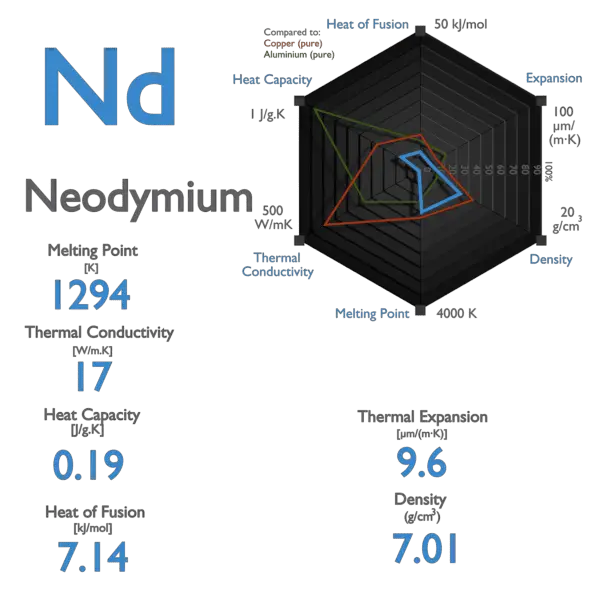
Thermal Conductivity [W/m K] 16
Specific Heat [J/g K] 0.16
Heat of Fusion [kJ/mol] 12.2
Heat of Vaporization [kJ/mol] 241


Holmium in Periodic Table

Hydro­gen1H He­lium2He
Lith­ium3Li Beryl­lium4Be Boron5B Carbon6C Nitro­gen7N Oxy­gen8O Fluor­ine9F Neon10Ne
So­dium11Na Magne­sium12Mg Alumin­ium13Al Sili­con14Si Phos­phorus15P Sulfur16S Chlor­ine17Cl Argon18Ar
Potas­sium19K Cal­cium20Ca Scan­dium21Sc Tita­nium22Ti Vana­dium23V Chrom­ium24Cr Manga­nese25Mn Iron26Fe Cobalt27Co Nickel28Ni Copper29Cu Zinc30Zn Gallium31Ga Germa­nium32Ge Arsenic33As Sele­nium34Se Bromine35Br Kryp­ton36Kr
Rubid­ium37Rb Stront­ium38Sr Yttrium39Y Zirco­nium40Zr Nio­bium41Nb Molyb­denum42Mo Tech­netium43Tc Ruthe­nium44Ru Rho­dium45Rh Pallad­ium46Pd Silver47Ag Cad­mium48Cd Indium49In Tin50Sn Anti­mony51Sb Tellur­ium52Te Iodine53I Xenon54Xe
Cae­sium55Cs Ba­rium56Ba Lan­thanum57La 1 asterisk Haf­nium72Hf Tanta­lum73Ta Tung­sten74W Rhe­nium75Re Os­mium76Os Iridium77Ir Plat­inum78Pt Gold79Au Mer­cury80Hg Thallium81Tl Lead82Pb Bis­muth83Bi Polo­nium84Po Asta­tine85At Radon86Rn
Fran­cium87Fr Ra­dium88Ra Actin­ium89Ac 1 asterisk Ruther­fordium104Rf Dub­nium105Db Sea­borgium106Sg Bohr­ium107Bh Has­sium108Hs Meit­nerium109Mt Darm­stadtium110Ds Roent­genium111Rg Coper­nicium112Cn Nihon­ium113Nh Flerov­ium114Fl Moscov­ium115Mc Liver­morium116Lv Tenness­ine117Ts Oga­nesson118Og
1 asterisk Cerium58Ce Praseo­dymium59Pr Neo­dymium60Nd Prome­thium61Pm Sama­rium62Sm Europ­ium63Eu Gadolin­ium64Gd Ter­bium65Tb Dyspro­sium66Dy Hol­mium67Ho Erbium68Er Thulium69Tm Ytter­bium70Yb Lute­tium71Lu
1 asterisk Thor­ium90Th Protac­tinium91Pa Ura­nium92U Neptu­nium93Np Pluto­nium94Pu Ameri­cium95Am Curium96Cm Berkel­ium97Bk Califor­nium98Cf Einstei­nium99Es Fer­mium100Fm Mende­levium101Md Nobel­ium102No Lawren­cium103Lr


Erbium – Melting Point – Boiling Point

Erbium – Melting Point and Boiling Point

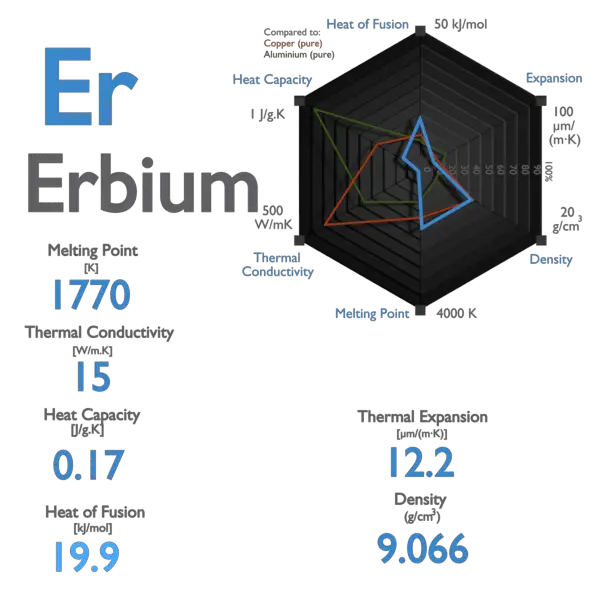
Melting point of Erbium is 1529°C.

Boiling point of Erbium is 2868°C.

Note that these points are associated with the standard atmospheric pressure.

Erbium - Melting Point - Boiling Point

Boiling Point – Saturation

In thermodynamics, saturation defines a condition in which a mixture of vapor and liquid can exist together at a given temperature and pressure. The temperature at which vaporization (boiling) starts to occur for a given pressure is called the saturation temperature or boiling point. The pressure at which vaporization (boiling) starts to occur for a given temperature is called the saturation pressure. When considered as the temperature of the reverse change from vapor to liquid, it is called the condensation point.

Melting Point

In thermodynamics, the melting point defines a condition where the solid and liquid can exist in equilibrium. Adding heat will convert the solid into a liquid with no temperature change. The melting point of a substance depends on pressure and is usually specified at standard pressure. When considered as the temperature of the reverse change from liquid to solid, it is called the freezing point or crystallization point.

The first theory explaining the mechanism of melting in bulk was proposed by Lindemann, who used the vibration of atoms in the crystal to explain the melting transition. Solids are similar to liquids in that both are condensed states, with particles that are far closer together than those of a gas. The atoms in a solid are tightly bound to each other, either in a regular geometric lattice (crystalline solids, which include metals and ordinary ice) or irregularly (an amorphous solid such as common window glass), and are typically low in energy. The motion of individual atoms, ions, or molecules in a solid is restricted to vibrational motion about a fixed point. As a solid is heated, its particles vibrate more rapidly as the solid absorbs kinetic energy. At some point, the amplitude of vibration becomes so large that the atoms start to invade the space of their nearest neighbors and disturb them, and the melting process initiates. The melting point is the temperature at which the disruptive vibrations of the particles of the solid overcome the attractive forces operating within the solid.
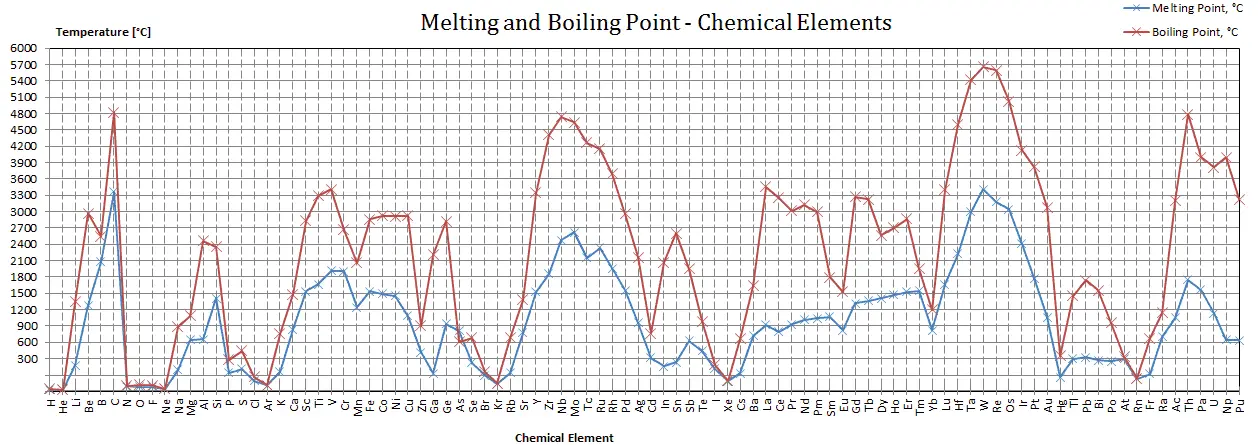
melting and boiling point

Erbium – Properties

Element Erbium
Atomic Number 68
Symbol Er
Element Category Rare Earth Metal
Phase at STP Solid
Atomic Mass [amu] 167.259
Density at STP [g/cm3] 9.066
Electron Configuration [Xe] 4f12 6s2
Possible Oxidation States +3
Electron Affinity [kJ/mol] 50
Electronegativity [Pauling scale] 1.24
1st Ionization Energy [eV] 6.1078
Year of Discovery 1842
Discoverer Mosander, Carl Gustav
Thermal properties
Melting Point [Celsius scale] 1529
Boiling Point [Celsius scale] 2868
Thermal Conductivity [W/m K] 15
Specific Heat [J/g K] 0.17
Heat of Fusion [kJ/mol] 19.9
Heat of Vaporization [kJ/mol] 261


Erbium in Periodic Table

Hydro­gen1H He­lium2He
Lith­ium3Li Beryl­lium4Be Boron5B Carbon6C Nitro­gen7N Oxy­gen8O Fluor­ine9F Neon10Ne
So­dium11Na Magne­sium12Mg Alumin­ium13Al Sili­con14Si Phos­phorus15P Sulfur16S Chlor­ine17Cl Argon18Ar
Potas­sium19K Cal­cium20Ca Scan­dium21Sc Tita­nium22Ti Vana­dium23V Chrom­ium24Cr Manga­nese25Mn Iron26Fe Cobalt27Co Nickel28Ni Copper29Cu Zinc30Zn Gallium31Ga Germa­nium32Ge Arsenic33As Sele­nium34Se Bromine35Br Kryp­ton36Kr
Rubid­ium37Rb Stront­ium38Sr Yttrium39Y Zirco­nium40Zr Nio­bium41Nb Molyb­denum42Mo Tech­netium43Tc Ruthe­nium44Ru Rho­dium45Rh Pallad­ium46Pd Silver47Ag Cad­mium48Cd Indium49In Tin50Sn Anti­mony51Sb Tellur­ium52Te Iodine53I Xenon54Xe
Cae­sium55Cs Ba­rium56Ba Lan­thanum57La 1 asterisk Haf­nium72Hf Tanta­lum73Ta Tung­sten74W Rhe­nium75Re Os­mium76Os Iridium77Ir Plat­inum78Pt Gold79Au Mer­cury80Hg Thallium81Tl Lead82Pb Bis­muth83Bi Polo­nium84Po Asta­tine85At Radon86Rn
Fran­cium87Fr Ra­dium88Ra Actin­ium89Ac 1 asterisk Ruther­fordium104Rf Dub­nium105Db Sea­borgium106Sg Bohr­ium107Bh Has­sium108Hs Meit­nerium109Mt Darm­stadtium110Ds Roent­genium111Rg Coper­nicium112Cn Nihon­ium113Nh Flerov­ium114Fl Moscov­ium115Mc Liver­morium116Lv Tenness­ine117Ts Oga­nesson118Og
1 asterisk Cerium58Ce Praseo­dymium59Pr Neo­dymium60Nd Prome­thium61Pm Sama­rium62Sm Europ­ium63Eu Gadolin­ium64Gd Ter­bium65Tb Dyspro­sium66Dy Hol­mium67Ho Erbium68Er Thulium69Tm Ytter­bium70Yb Lute­tium71Lu
1 asterisk Thor­ium90Th Protac­tinium91Pa Ura­nium92U Neptu­nium93Np Pluto­nium94Pu Ameri­cium95Am Curium96Cm Berkel­ium97Bk Califor­nium98Cf Einstei­nium99Es Fer­mium100Fm Mende­levium101Md Nobel­ium102No Lawren­cium103Lr


Terbium – Melting Point – Boiling Point

Terbium – Melting Point and Boiling Point

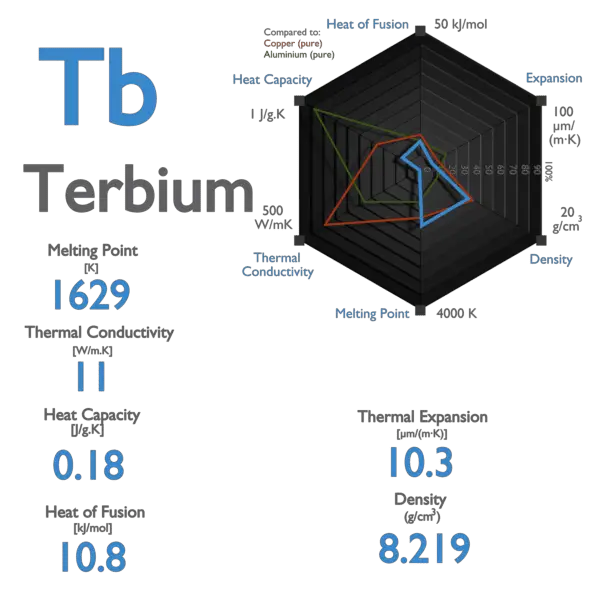
Melting point of Terbium is 1365°C.

Boiling point of Terbium is 3230°C.

Note that these points are associated with the standard atmospheric pressure.

Terbium - Melting Point - Boiling Point

Boiling Point – Saturation

In thermodynamics, saturation defines a condition in which a mixture of vapor and liquid can exist together at a given temperature and pressure. The temperature at which vaporization (boiling) starts to occur for a given pressure is called the saturation temperature or boiling point. The pressure at which vaporization (boiling) starts to occur for a given temperature is called the saturation pressure. When considered as the temperature of the reverse change from vapor to liquid, it is called the condensation point.

Melting Point

In thermodynamics, the melting point defines a condition where the solid and liquid can exist in equilibrium. Adding heat will convert the solid into a liquid with no temperature change. The melting point of a substance depends on pressure and is usually specified at standard pressure. When considered as the temperature of the reverse change from liquid to solid, it is called the freezing point or crystallization point.

The first theory explaining the mechanism of melting in bulk was proposed by Lindemann, who used the vibration of atoms in the crystal to explain the melting transition. Solids are similar to liquids in that both are condensed states, with particles that are far closer together than those of a gas. The atoms in a solid are tightly bound to each other, either in a regular geometric lattice (crystalline solids, which include metals and ordinary ice) or irregularly (an amorphous solid such as common window glass), and are typically low in energy. The motion of individual atoms, ions, or molecules in a solid is restricted to vibrational motion about a fixed point. As a solid is heated, its particles vibrate more rapidly as the solid absorbs kinetic energy. At some point, the amplitude of vibration becomes so large that the atoms start to invade the space of their nearest neighbors and disturb them, and the melting process initiates. The melting point is the temperature at which the disruptive vibrations of the particles of the solid overcome the attractive forces operating within the solid.

melting and boiling point

Terbium – Properties

Element Terbium
Atomic Number 65
Symbol Tb
Element Category Rare Earth Metal
Phase at STP Solid
Atomic Mass [amu] 158.9253
Density at STP [g/cm3] 8.219
Electron Configuration [Xe] 4f9 6s2
Possible Oxidation States +3
Electron Affinity [kJ/mol] 50
Electronegativity [Pauling scale]
1st Ionization Energy [eV] 5.8939
Year of Discovery 1843
Discoverer Mosander, Carl Gustav
Thermal properties
Melting Point [Celsius scale] 1365
Boiling Point [Celsius scale] 3230
Thermal Conductivity [W/m K] 11
Specific Heat [J/g K] 0.18
Heat of Fusion [kJ/mol] 10.8
Heat of Vaporization [kJ/mol] 330.9


Terbium in Periodic Table

Hydro­gen1H He­lium2He
Lith­ium3Li Beryl­lium4Be Boron5B Carbon6C Nitro­gen7N Oxy­gen8O Fluor­ine9F Neon10Ne
So­dium11Na Magne­sium12Mg Alumin­ium13Al Sili­con14Si Phos­phorus15P Sulfur16S Chlor­ine17Cl Argon18Ar
Potas­sium19K Cal­cium20Ca Scan­dium21Sc Tita­nium22Ti Vana­dium23V Chrom­ium24Cr Manga­nese25Mn Iron26Fe Cobalt27Co Nickel28Ni Copper29Cu Zinc30Zn Gallium31Ga Germa­nium32Ge Arsenic33As Sele­nium34Se Bromine35Br Kryp­ton36Kr
Rubid­ium37Rb Stront­ium38Sr Yttrium39Y Zirco­nium40Zr Nio­bium41Nb Molyb­denum42Mo Tech­netium43Tc Ruthe­nium44Ru Rho­dium45Rh Pallad­ium46Pd Silver47Ag Cad­mium48Cd Indium49In Tin50Sn Anti­mony51Sb Tellur­ium52Te Iodine53I Xenon54Xe
Cae­sium55Cs Ba­rium56Ba Lan­thanum57La 1 asterisk Haf­nium72Hf Tanta­lum73Ta Tung­sten74W Rhe­nium75Re Os­mium76Os Iridium77Ir Plat­inum78Pt Gold79Au Mer­cury80Hg Thallium81Tl Lead82Pb Bis­muth83Bi Polo­nium84Po Asta­tine85At Radon86Rn
Fran­cium87Fr Ra­dium88Ra Actin­ium89Ac 1 asterisk Ruther­fordium104Rf Dub­nium105Db Sea­borgium106Sg Bohr­ium107Bh Has­sium108Hs Meit­nerium109Mt Darm­stadtium110Ds Roent­genium111Rg Coper­nicium112Cn Nihon­ium113Nh Flerov­ium114Fl Moscov­ium115Mc Liver­morium116Lv Tenness­ine117Ts Oga­nesson118Og
1 asterisk Cerium58Ce Praseo­dymium59Pr Neo­dymium60Nd Prome­thium61Pm Sama­rium62Sm Europ­ium63Eu Gadolin­ium64Gd Ter­bium65Tb Dyspro­sium66Dy Hol­mium67Ho Erbium68Er Thulium69Tm Ytter­bium70Yb Lute­tium71Lu
1 asterisk Thor­ium90Th Protac­tinium91Pa Ura­nium92U Neptu­nium93Np Pluto­nium94Pu Ameri­cium95Am Curium96Cm Berkel­ium97Bk Califor­nium98Cf Einstei­nium99Es Fer­mium100Fm Mende­levium101Md Nobel­ium102No Lawren­cium103Lr


Dysprosium – Melting Point – Boiling Point

Dysprosium – Melting Point and Boiling Point

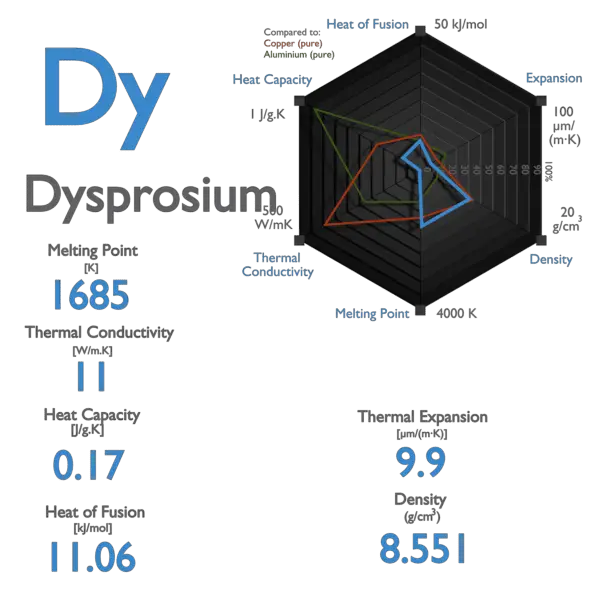
Melting point of Dysprosium is 1412°C.

Boiling point of Dysprosium is 2567°C.

Note that these points are associated with the standard atmospheric pressure.

Dysprosium - Melting Point - Boiling Point

Boiling Point – Saturation

In thermodynamics, saturation defines a condition in which a mixture of vapor and liquid can exist together at a given temperature and pressure. The temperature at which vaporization (boiling) starts to occur for a given pressure is called the saturation temperature or boiling point. The pressure at which vaporization (boiling) starts to occur for a given temperature is called the saturation pressure. When considered as the temperature of the reverse change from vapor to liquid, it is called the condensation point.

Melting Point

In thermodynamics, the melting point defines a condition where the solid and liquid can exist in equilibrium. Adding heat will convert the solid into a liquid with no temperature change. The melting point of a substance depends on pressure and is usually specified at standard pressure. When considered as the temperature of the reverse change from liquid to solid, it is called the freezing point or crystallization point.

The first theory explaining the mechanism of melting in bulk was proposed by Lindemann, who used the vibration of atoms in the crystal to explain the melting transition. Solids are similar to liquids in that both are condensed states, with particles that are far closer together than those of a gas. The atoms in a solid are tightly bound to each other, either in a regular geometric lattice (crystalline solids, which include metals and ordinary ice) or irregularly (an amorphous solid such as common window glass), and are typically low in energy. The motion of individual atoms, ions, or molecules in a solid is restricted to vibrational motion about a fixed point. As a solid is heated, its particles vibrate more rapidly as the solid absorbs kinetic energy. At some point, the amplitude of vibration becomes so large that the atoms start to invade the space of their nearest neighbors and disturb them, and the melting process initiates. The melting point is the temperature at which the disruptive vibrations of the particles of the solid overcome the attractive forces operating within the solid.

melting and boiling point

Dysprosium – Properties

Element Dysprosium
Atomic Number 66
Symbol Dy
Element Category Rare Earth Metal
Phase at STP Solid
Atomic Mass [amu] 162.5
Density at STP [g/cm3] 8.551
Electron Configuration [Xe] 4f10 6s2
Possible Oxidation States +3
Electron Affinity [kJ/mol] 50
Electronegativity [Pauling scale] 1.22
1st Ionization Energy [eV] 5.9389
Year of Discovery 1886
Discoverer Lecoq de Boisbaudran, Paul-Émile
Thermal properties
Melting Point [Celsius scale] 1412
Boiling Point [Celsius scale] 2567
Thermal Conductivity [W/m K] 11
Specific Heat [J/g K] 0.17
Heat of Fusion [kJ/mol] 11.06
Heat of Vaporization [kJ/mol] 230.1


Dysprosium in Periodic Table

Hydro­gen1H He­lium2He
Lith­ium3Li Beryl­lium4Be Boron5B Carbon6C Nitro­gen7N Oxy­gen8O Fluor­ine9F Neon10Ne
So­dium11Na Magne­sium12Mg Alumin­ium13Al Sili­con14Si Phos­phorus15P Sulfur16S Chlor­ine17Cl Argon18Ar
Potas­sium19K Cal­cium20Ca Scan­dium21Sc Tita­nium22Ti Vana­dium23V Chrom­ium24Cr Manga­nese25Mn Iron26Fe Cobalt27Co Nickel28Ni Copper29Cu Zinc30Zn Gallium31Ga Germa­nium32Ge Arsenic33As Sele­nium34Se Bromine35Br Kryp­ton36Kr
Rubid­ium37Rb Stront­ium38Sr Yttrium39Y Zirco­nium40Zr Nio­bium41Nb Molyb­denum42Mo Tech­netium43Tc Ruthe­nium44Ru Rho­dium45Rh Pallad­ium46Pd Silver47Ag Cad­mium48Cd Indium49In Tin50Sn Anti­mony51Sb Tellur­ium52Te Iodine53I Xenon54Xe
Cae­sium55Cs Ba­rium56Ba Lan­thanum57La 1 asterisk Haf­nium72Hf Tanta­lum73Ta Tung­sten74W Rhe­nium75Re Os­mium76Os Iridium77Ir Plat­inum78Pt Gold79Au Mer­cury80Hg Thallium81Tl Lead82Pb Bis­muth83Bi Polo­nium84Po Asta­tine85At Radon86Rn
Fran­cium87Fr Ra­dium88Ra Actin­ium89Ac 1 asterisk Ruther­fordium104Rf Dub­nium105Db Sea­borgium106Sg Bohr­ium107Bh Has­sium108Hs Meit­nerium109Mt Darm­stadtium110Ds Roent­genium111Rg Coper­nicium112Cn Nihon­ium113Nh Flerov­ium114Fl Moscov­ium115Mc Liver­morium116Lv Tenness­ine117Ts Oga­nesson118Og
1 asterisk Cerium58Ce Praseo­dymium59Pr Neo­dymium60Nd Prome­thium61Pm Sama­rium62Sm Europ­ium63Eu Gadolin­ium64Gd Ter­bium65Tb Dyspro­sium66Dy Hol­mium67Ho Erbium68Er Thulium69Tm Ytter­bium70Yb Lute­tium71Lu
1 asterisk Thor­ium90Th Protac­tinium91Pa Ura­nium92U Neptu­nium93Np Pluto­nium94Pu Ameri­cium95Am Curium96Cm Berkel­ium97Bk Califor­nium98Cf Einstei­nium99Es Fer­mium100Fm Mende­levium101Md Nobel­ium102No Lawren­cium103Lr


Europium – Melting Point – Boiling Point

Europium – Melting Point and Boiling Point

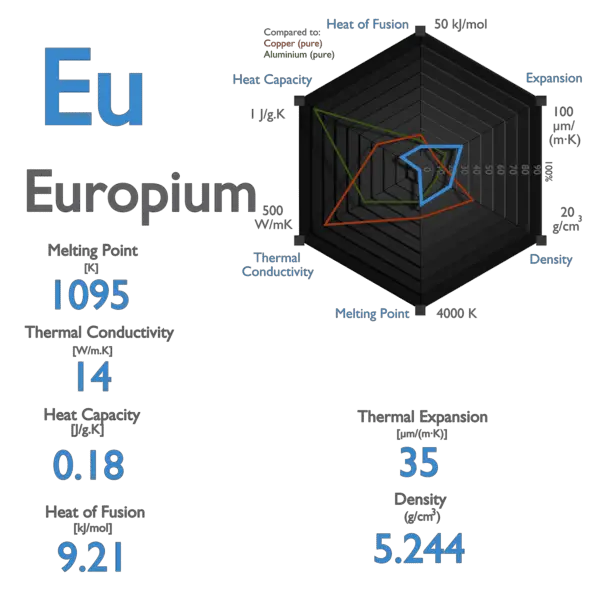
Melting point of Europium is 822°C.

Boiling point of Europium is 1529°C.

Note that these points are associated with the standard atmospheric pressure.

Europium - Melting Point - Boiling Point

Boiling Point – Saturation

In thermodynamics, saturation defines a condition in which a mixture of vapor and liquid can exist together at a given temperature and pressure. The temperature at which vaporization (boiling) starts to occur for a given pressure is called the saturation temperature or boiling point. The pressure at which vaporization (boiling) starts to occur for a given temperature is called the saturation pressure. When considered as the temperature of the reverse change from vapor to liquid, it is called the condensation point.

Melting Point

In thermodynamics, the melting point defines a condition where the solid and liquid can exist in equilibrium. Adding heat will convert the solid into a liquid with no temperature change. The melting point of a substance depends on pressure and is usually specified at standard pressure. When considered as the temperature of the reverse change from liquid to solid, it is called the freezing point or crystallization point.

The first theory explaining the mechanism of melting in bulk was proposed by Lindemann, who used the vibration of atoms in the crystal to explain the melting transition. Solids are similar to liquids in that both are condensed states, with particles that are far closer together than those of a gas. The atoms in a solid are tightly bound to each other, either in a regular geometric lattice (crystalline solids, which include metals and ordinary ice) or irregularly (an amorphous solid such as common window glass), and are typically low in energy. The motion of individual atoms, ions, or molecules in a solid is restricted to vibrational motion about a fixed point. As a solid is heated, its particles vibrate more rapidly as the solid absorbs kinetic energy. At some point, the amplitude of vibration becomes so large that the atoms start to invade the space of their nearest neighbors and disturb them, and the melting process initiates. The melting point is the temperature at which the disruptive vibrations of the particles of the solid overcome the attractive forces operating within the solid.

melting and boiling point

Europium – Properties

Element Europium
Atomic Number 63
Symbol Eu
Element Category Rare Earth Metal
Phase at STP Solid
Atomic Mass [amu] 151.964
Density at STP [g/cm3] 5.244
Electron Configuration [Xe] 4f7 6s2
Possible Oxidation States +2,3
Electron Affinity [kJ/mol] 50
Electronegativity [Pauling scale]
1st Ionization Energy [eV] 5.6704
Year of Discovery 1901
Discoverer Demarçay, Eugène-Antole
Thermal properties
Melting Point [Celsius scale] 822
Boiling Point [Celsius scale] 1529
Thermal Conductivity [W/m K] 14
Specific Heat [J/g K] 0.18
Heat of Fusion [kJ/mol] 9.21
Heat of Vaporization [kJ/mol] 143.5


Europium in Periodic Table

Hydro­gen1H He­lium2He
Lith­ium3Li Beryl­lium4Be Boron5B Carbon6C Nitro­gen7N Oxy­gen8O Fluor­ine9F Neon10Ne
So­dium11Na Magne­sium12Mg Alumin­ium13Al Sili­con14Si Phos­phorus15P Sulfur16S Chlor­ine17Cl Argon18Ar
Potas­sium19K Cal­cium20Ca Scan­dium21Sc Tita­nium22Ti Vana­dium23V Chrom­ium24Cr Manga­nese25Mn Iron26Fe Cobalt27Co Nickel28Ni Copper29Cu Zinc30Zn Gallium31Ga Germa­nium32Ge Arsenic33As Sele­nium34Se Bromine35Br Kryp­ton36Kr
Rubid­ium37Rb Stront­ium38Sr Yttrium39Y Zirco­nium40Zr Nio­bium41Nb Molyb­denum42Mo Tech­netium43Tc Ruthe­nium44Ru Rho­dium45Rh Pallad­ium46Pd Silver47Ag Cad­mium48Cd Indium49In Tin50Sn Anti­mony51Sb Tellur­ium52Te Iodine53I Xenon54Xe
Cae­sium55Cs Ba­rium56Ba Lan­thanum57La 1 asterisk Haf­nium72Hf Tanta­lum73Ta Tung­sten74W Rhe­nium75Re Os­mium76Os Iridium77Ir Plat­inum78Pt Gold79Au Mer­cury80Hg Thallium81Tl Lead82Pb Bis­muth83Bi Polo­nium84Po Asta­tine85At Radon86Rn
Fran­cium87Fr Ra­dium88Ra Actin­ium89Ac 1 asterisk Ruther­fordium104Rf Dub­nium105Db Sea­borgium106Sg Bohr­ium107Bh Has­sium108Hs Meit­nerium109Mt Darm­stadtium110Ds Roent­genium111Rg Coper­nicium112Cn Nihon­ium113Nh Flerov­ium114Fl Moscov­ium115Mc Liver­morium116Lv Tenness­ine117Ts Oga­nesson118Og
1 asterisk Cerium58Ce Praseo­dymium59Pr Neo­dymium60Nd Prome­thium61Pm Sama­rium62Sm Europ­ium63Eu Gadolin­ium64Gd Ter­bium65Tb Dyspro­sium66Dy Hol­mium67Ho Erbium68Er Thulium69Tm Ytter­bium70Yb Lute­tium71Lu
1 asterisk Thor­ium90Th Protac­tinium91Pa Ura­nium92U Neptu­nium93Np Pluto­nium94Pu Ameri­cium95Am Curium96Cm Berkel­ium97Bk Califor­nium98Cf Einstei­nium99Es Fer­mium100Fm Mende­levium101Md Nobel­ium102No Lawren­cium103Lr


Gadolinium – Melting Point – Boiling Point

Gadolinium – Melting Point and Boiling Point

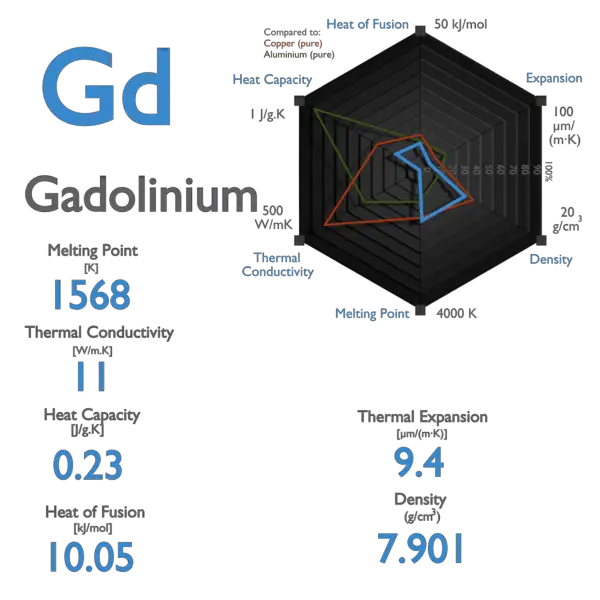
Melting point of Gadolinium is 1313°C.

Boiling point of Gadolinium is 3273°C.

Note that these points are associated with the standard atmospheric pressure.

Gadolinium - Melting Point - Boiling Point

Boiling Point – Saturation

In thermodynamics, saturation defines a condition in which a mixture of vapor and liquid can exist together at a given temperature and pressure. The temperature at which vaporization (boiling) starts to occur for a given pressure is called the saturation temperature or boiling point. The pressure at which vaporization (boiling) starts to occur for a given temperature is called the saturation pressure. When considered as the temperature of the reverse change from vapor to liquid, it is called the condensation point.

Melting Point

In thermodynamics, the melting point defines a condition where the solid and liquid can exist in equilibrium. Adding heat will convert the solid into a liquid with no temperature change. The melting point of a substance depends on pressure and is usually specified at standard pressure. When considered as the temperature of the reverse change from liquid to solid, it is called the freezing point or crystallization point.

The first theory explaining the mechanism of melting in bulk was proposed by Lindemann, who used the vibration of atoms in the crystal to explain the melting transition. Solids are similar to liquids in that both are condensed states, with particles that are far closer together than those of a gas. The atoms in a solid are tightly bound to each other, either in a regular geometric lattice (crystalline solids, which include metals and ordinary ice) or irregularly (an amorphous solid such as common window glass), and are typically low in energy. The motion of individual atoms, ions, or molecules in a solid is restricted to vibrational motion about a fixed point. As a solid is heated, its particles vibrate more rapidly as the solid absorbs kinetic energy. At some point, the amplitude of vibration becomes so large that the atoms start to invade the space of their nearest neighbors and disturb them, and the melting process initiates. The melting point is the temperature at which the disruptive vibrations of the particles of the solid overcome the attractive forces operating within the solid.

melting and boiling point

Gadolinium – Properties

Element Gadolinium
Atomic Number 64
Symbol Gd
Element Category Rare Earth Metal
Phase at STP Solid
Atomic Mass [amu] 157.25
Density at STP [g/cm3] 7.901
Electron Configuration [Xe] 4f7 5d1 6s2
Possible Oxidation States +3
Electron Affinity [kJ/mol] 50
Electronegativity [Pauling scale] 1.2
1st Ionization Energy [eV] 6.15
Year of Discovery 1880
Discoverer De Marignac, Charles Galissard
Thermal properties
Melting Point [Celsius scale] 1313
Boiling Point [Celsius scale] 3273
Thermal Conductivity [W/m K] 11
Specific Heat [J/g K] 0.23
Heat of Fusion [kJ/mol] 10.05
Heat of Vaporization [kJ/mol] 359.4


Gadolinium in Periodic Table

Hydro­gen1H He­lium2He
Lith­ium3Li Beryl­lium4Be Boron5B Carbon6C Nitro­gen7N Oxy­gen8O Fluor­ine9F Neon10Ne
So­dium11Na Magne­sium12Mg Alumin­ium13Al Sili­con14Si Phos­phorus15P Sulfur16S Chlor­ine17Cl Argon18Ar
Potas­sium19K Cal­cium20Ca Scan­dium21Sc Tita­nium22Ti Vana­dium23V Chrom­ium24Cr Manga­nese25Mn Iron26Fe Cobalt27Co Nickel28Ni Copper29Cu Zinc30Zn Gallium31Ga Germa­nium32Ge Arsenic33As Sele­nium34Se Bromine35Br Kryp­ton36Kr
Rubid­ium37Rb Stront­ium38Sr Yttrium39Y Zirco­nium40Zr Nio­bium41Nb Molyb­denum42Mo Tech­netium43Tc Ruthe­nium44Ru Rho­dium45Rh Pallad­ium46Pd Silver47Ag Cad­mium48Cd Indium49In Tin50Sn Anti­mony51Sb Tellur­ium52Te Iodine53I Xenon54Xe
Cae­sium55Cs Ba­rium56Ba Lan­thanum57La 1 asterisk Haf­nium72Hf Tanta­lum73Ta Tung­sten74W Rhe­nium75Re Os­mium76Os Iridium77Ir Plat­inum78Pt Gold79Au Mer­cury80Hg Thallium81Tl Lead82Pb Bis­muth83Bi Polo­nium84Po Asta­tine85At Radon86Rn
Fran­cium87Fr Ra­dium88Ra Actin­ium89Ac 1 asterisk Ruther­fordium104Rf Dub­nium105Db Sea­borgium106Sg Bohr­ium107Bh Has­sium108Hs Meit­nerium109Mt Darm­stadtium110Ds Roent­genium111Rg Coper­nicium112Cn Nihon­ium113Nh Flerov­ium114Fl Moscov­ium115Mc Liver­morium116Lv Tenness­ine117Ts Oga­nesson118Og
1 asterisk Cerium58Ce Praseo­dymium59Pr Neo­dymium60Nd Prome­thium61Pm Sama­rium62Sm Europ­ium63Eu Gadolin­ium64Gd Ter­bium65Tb Dyspro­sium66Dy Hol­mium67Ho Erbium68Er Thulium69Tm Ytter­bium70Yb Lute­tium71Lu
1 asterisk Thor­ium90Th Protac­tinium91Pa Ura­nium92U Neptu­nium93Np Pluto­nium94Pu Ameri­cium95Am Curium96Cm Berkel­ium97Bk Califor­nium98Cf Einstei­nium99Es Fer­mium100Fm Mende­levium101Md Nobel­ium102No Lawren­cium103Lr


Promethium – Melting Point – Boiling Point

Promethium – Melting Point and Boiling Point

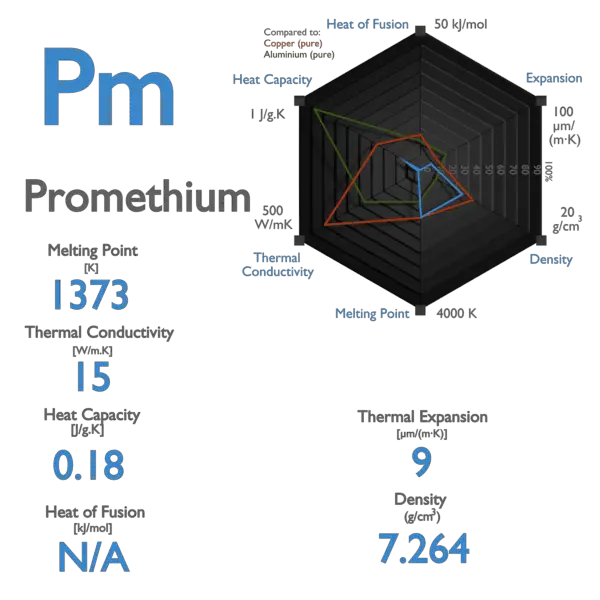
Melting point of Promethium is 1042°C.

Boiling point of Promethium is 3000°C.

Note that these points are associated with the standard atmospheric pressure.

Promethium - Melting Point - Boiling Point

Boiling Point – Saturation

In thermodynamics, saturation defines a condition in which a mixture of vapor and liquid can exist together at a given temperature and pressure. The temperature at which vaporization (boiling) starts to occur for a given pressure is called the saturation temperature or boiling point. The pressure at which vaporization (boiling) starts to occur for a given temperature is called the saturation pressure. When considered as the temperature of the reverse change from vapor to liquid, it is called the condensation point.

Melting Point

In thermodynamics, the melting point defines a condition where the solid and liquid can exist in equilibrium. Adding heat will convert the solid into a liquid with no temperature change. The melting point of a substance depends on pressure and is usually specified at standard pressure. When considered as the temperature of the reverse change from liquid to solid, it is called the freezing point or crystallization point.

The first theory explaining the mechanism of melting in bulk was proposed by Lindemann, who used the vibration of atoms in the crystal to explain the melting transition. Solids are similar to liquids in that both are condensed states, with particles that are far closer together than those of a gas. The atoms in a solid are tightly bound to each other, either in a regular geometric lattice (crystalline solids, which include metals and ordinary ice) or irregularly (an amorphous solid such as common window glass), and are typically low in energy. The motion of individual atoms, ions, or molecules in a solid is restricted to vibrational motion about a fixed point. As a solid is heated, its particles vibrate more rapidly as the solid absorbs kinetic energy. At some point, the amplitude of vibration becomes so large that the atoms start to invade the space of their nearest neighbors and disturb them, and the melting process initiates. The melting point is the temperature at which the disruptive vibrations of the particles of the solid overcome the attractive forces operating within the solid.

melting and boiling point

Promethium – Properties

Element Promethium
Atomic Number 61
Symbol Pm
Element Category Rare Earth Metal
Phase at STP Synthetic
Atomic Mass [amu] 145
Density at STP [g/cm3] 7.264
Electron Configuration [Xe] 4f5 6s2
Possible Oxidation States +3
Electron Affinity [kJ/mol] 50
Electronegativity [Pauling scale]
1st Ionization Energy [eV] 5.55
Year of Discovery 1944
Discoverer Marinsky, Jacob A. & Coryell, Charles D. & Glendenin, Lawerence. E.
Thermal properties
Melting Point [Celsius scale] 1042
Boiling Point [Celsius scale] 3000
Thermal Conductivity [W/m K] 15
Specific Heat [J/g K] 0.18
Heat of Fusion [kJ/mol]
Heat of Vaporization [kJ/mol]


Promethium in Periodic Table

Hydro­gen1H He­lium2He
Lith­ium3Li Beryl­lium4Be Boron5B Carbon6C Nitro­gen7N Oxy­gen8O Fluor­ine9F Neon10Ne
So­dium11Na Magne­sium12Mg Alumin­ium13Al Sili­con14Si Phos­phorus15P Sulfur16S Chlor­ine17Cl Argon18Ar
Potas­sium19K Cal­cium20Ca Scan­dium21Sc Tita­nium22Ti Vana­dium23V Chrom­ium24Cr Manga­nese25Mn Iron26Fe Cobalt27Co Nickel28Ni Copper29Cu Zinc30Zn Gallium31Ga Germa­nium32Ge Arsenic33As Sele­nium34Se Bromine35Br Kryp­ton36Kr
Rubid­ium37Rb Stront­ium38Sr Yttrium39Y Zirco­nium40Zr Nio­bium41Nb Molyb­denum42Mo Tech­netium43Tc Ruthe­nium44Ru Rho­dium45Rh Pallad­ium46Pd Silver47Ag Cad­mium48Cd Indium49In Tin50Sn Anti­mony51Sb Tellur­ium52Te Iodine53I Xenon54Xe
Cae­sium55Cs Ba­rium56Ba Lan­thanum57La 1 asterisk Haf­nium72Hf Tanta­lum73Ta Tung­sten74W Rhe­nium75Re Os­mium76Os Iridium77Ir Plat­inum78Pt Gold79Au Mer­cury80Hg Thallium81Tl Lead82Pb Bis­muth83Bi Polo­nium84Po Asta­tine85At Radon86Rn
Fran­cium87Fr Ra­dium88Ra Actin­ium89Ac 1 asterisk Ruther­fordium104Rf Dub­nium105Db Sea­borgium106Sg Bohr­ium107Bh Has­sium108Hs Meit­nerium109Mt Darm­stadtium110Ds Roent­genium111Rg Coper­nicium112Cn Nihon­ium113Nh Flerov­ium114Fl Moscov­ium115Mc Liver­morium116Lv Tenness­ine117Ts Oga­nesson118Og
1 asterisk Cerium58Ce Praseo­dymium59Pr Neo­dymium60Nd Prome­thium61Pm Sama­rium62Sm Europ­ium63Eu Gadolin­ium64Gd Ter­bium65Tb Dyspro­sium66Dy Hol­mium67Ho Erbium68Er Thulium69Tm Ytter­bium70Yb Lute­tium71Lu
1 asterisk Thor­ium90Th Protac­tinium91Pa Ura­nium92U Neptu­nium93Np Pluto­nium94Pu Ameri­cium95Am Curium96Cm Berkel­ium97Bk Califor­nium98Cf Einstei­nium99Es Fer­mium100Fm Mende­levium101Md Nobel­ium102No Lawren­cium103Lr


Samarium – Melting Point – Boiling Point

Samarium – Melting Point and Boiling Point

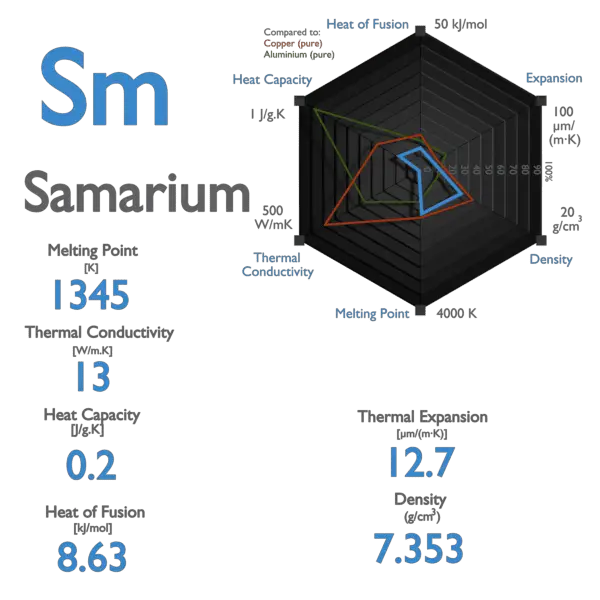
Melting point of Samarium is 1074°C.

Boiling point of Samarium is 1794°C.

Note that these points are associated with the standard atmospheric pressure.

Samarium - Melting Point - Boiling Point

Boiling Point – Saturation

In thermodynamics, saturation defines a condition in which a mixture of vapor and liquid can exist together at a given temperature and pressure. The temperature at which vaporization (boiling) starts to occur for a given pressure is called the saturation temperature or boiling point. The pressure at which vaporization (boiling) starts to occur for a given temperature is called the saturation pressure. When considered as the temperature of the reverse change from vapor to liquid, it is called the condensation point.

Melting Point

In thermodynamics, the melting point defines a condition where the solid and liquid can exist in equilibrium. Adding heat will convert the solid into a liquid with no temperature change. The melting point of a substance depends on pressure and is usually specified at standard pressure. When considered as the temperature of the reverse change from liquid to solid, it is called the freezing point or crystallization point.

The first theory explaining the mechanism of melting in bulk was proposed by Lindemann, who used the vibration of atoms in the crystal to explain the melting transition. Solids are similar to liquids in that both are condensed states, with particles that are far closer together than those of a gas. The atoms in a solid are tightly bound to each other, either in a regular geometric lattice (crystalline solids, which include metals and ordinary ice) or irregularly (an amorphous solid such as common window glass), and are typically low in energy. The motion of individual atoms, ions, or molecules in a solid is restricted to vibrational motion about a fixed point. As a solid is heated, its particles vibrate more rapidly as the solid absorbs kinetic energy. At some point, the amplitude of vibration becomes so large that the atoms start to invade the space of their nearest neighbors and disturb them, and the melting process initiates. The melting point is the temperature at which the disruptive vibrations of the particles of the solid overcome the attractive forces operating within the solid.

melting and boiling point

Samarium – Properties

Element Samarium
Atomic Number 62
Symbol Sm
Element Category Rare Earth Metal
Phase at STP Solid
Atomic Mass [amu] 150.36
Density at STP [g/cm3] 7.353
Electron Configuration [Xe] 4f6 6s2
Possible Oxidation States +2,3
Electron Affinity [kJ/mol] 50
Electronegativity [Pauling scale] 1.17
1st Ionization Energy [eV] 5.6437
Year of Discovery 1879
Discoverer Lecoq de Boisbaudran, Paul-Émile
Thermal properties
Melting Point [Celsius scale] 1074
Boiling Point [Celsius scale] 1794
Thermal Conductivity [W/m K] 13
Specific Heat [J/g K] 0.2
Heat of Fusion [kJ/mol] 8.63
Heat of Vaporization [kJ/mol] 166.4


Samarium in Periodic Table

Hydro­gen1H He­lium2He
Lith­ium3Li Beryl­lium4Be Boron5B Carbon6C Nitro­gen7N Oxy­gen8O Fluor­ine9F Neon10Ne
So­dium11Na Magne­sium12Mg Alumin­ium13Al Sili­con14Si Phos­phorus15P Sulfur16S Chlor­ine17Cl Argon18Ar
Potas­sium19K Cal­cium20Ca Scan­dium21Sc Tita­nium22Ti Vana­dium23V Chrom­ium24Cr Manga­nese25Mn Iron26Fe Cobalt27Co Nickel28Ni Copper29Cu Zinc30Zn Gallium31Ga Germa­nium32Ge Arsenic33As Sele­nium34Se Bromine35Br Kryp­ton36Kr
Rubid­ium37Rb Stront­ium38Sr Yttrium39Y Zirco­nium40Zr Nio­bium41Nb Molyb­denum42Mo Tech­netium43Tc Ruthe­nium44Ru Rho­dium45Rh Pallad­ium46Pd Silver47Ag Cad­mium48Cd Indium49In Tin50Sn Anti­mony51Sb Tellur­ium52Te Iodine53I Xenon54Xe
Cae­sium55Cs Ba­rium56Ba Lan­thanum57La 1 asterisk Haf­nium72Hf Tanta­lum73Ta Tung­sten74W Rhe­nium75Re Os­mium76Os Iridium77Ir Plat­inum78Pt Gold79Au Mer­cury80Hg Thallium81Tl Lead82Pb Bis­muth83Bi Polo­nium84Po Asta­tine85At Radon86Rn
Fran­cium87Fr Ra­dium88Ra Actin­ium89Ac 1 asterisk Ruther­fordium104Rf Dub­nium105Db Sea­borgium106Sg Bohr­ium107Bh Has­sium108Hs Meit­nerium109Mt Darm­stadtium110Ds Roent­genium111Rg Coper­nicium112Cn Nihon­ium113Nh Flerov­ium114Fl Moscov­ium115Mc Liver­morium116Lv Tenness­ine117Ts Oga­nesson118Og
1 asterisk Cerium58Ce Praseo­dymium59Pr Neo­dymium60Nd Prome­thium61Pm Sama­rium62Sm Europ­ium63Eu Gadolin­ium64Gd Ter­bium65Tb Dyspro­sium66Dy Hol­mium67Ho Erbium68Er Thulium69Tm Ytter­bium70Yb Lute­tium71Lu
1 asterisk Thor­ium90Th Protac­tinium91Pa Ura­nium92U Neptu­nium93Np Pluto­nium94Pu Ameri­cium95Am Curium96Cm Berkel­ium97Bk Califor­nium98Cf Einstei­nium99Es Fer­mium100Fm Mende­levium101Md Nobel­ium102No Lawren­cium103Lr


Praseodymium – Melting Point – Boiling Point

Praseodymium – Melting Point and Boiling Point

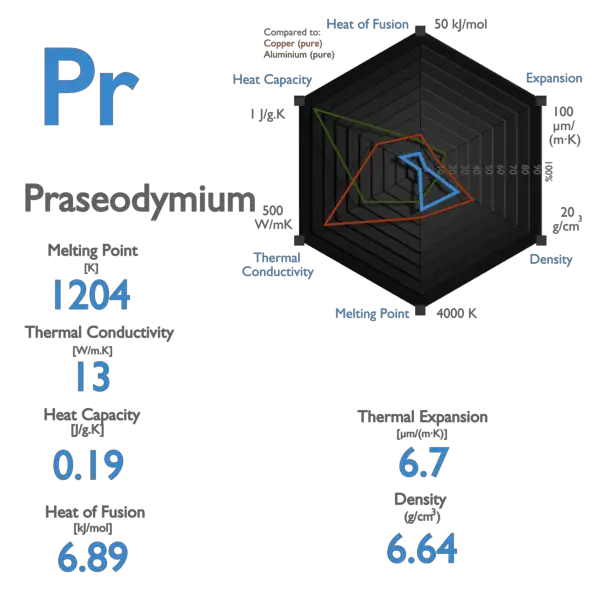
Melting point of Praseodymium is 931°C.

Boiling point of Praseodymium is 3017°C.

Note that these points are associated with the standard atmospheric pressure.

Praseodymium - Melting Point - Boiling Point

Boiling Point – Saturation

In thermodynamics, saturation defines a condition in which a mixture of vapor and liquid can exist together at a given temperature and pressure. The temperature at which vaporization (boiling) starts to occur for a given pressure is called the saturation temperature or boiling point. The pressure at which vaporization (boiling) starts to occur for a given temperature is called the saturation pressure. When considered as the temperature of the reverse change from vapor to liquid, it is called the condensation point.

Melting Point

In thermodynamics, the melting point defines a condition where the solid and liquid can exist in equilibrium. Adding heat will convert the solid into a liquid with no temperature change. The melting point of a substance depends on pressure and is usually specified at standard pressure. When considered as the temperature of the reverse change from liquid to solid, it is called the freezing point or crystallization point.

The first theory explaining the mechanism of melting in bulk was proposed by Lindemann, who used the vibration of atoms in the crystal to explain the melting transition. Solids are similar to liquids in that both are condensed states, with particles that are far closer together than those of a gas. The atoms in a solid are tightly bound to each other, either in a regular geometric lattice (crystalline solids, which include metals and ordinary ice) or irregularly (an amorphous solid such as common window glass), and are typically low in energy. The motion of individual atoms, ions, or molecules in a solid is restricted to vibrational motion about a fixed point. As a solid is heated, its particles vibrate more rapidly as the solid absorbs kinetic energy. At some point, the amplitude of vibration becomes so large that the atoms start to invade the space of their nearest neighbors and disturb them, and the melting process initiates. The melting point is the temperature at which the disruptive vibrations of the particles of the solid overcome the attractive forces operating within the solid.

melting and boiling point

Praseodymium – Properties

Element Praseodymium
Atomic Number 59
Symbol Pr
Element Category Rare Earth Metal
Phase at STP Solid
Atomic Mass [amu] 140.9077
Density at STP [g/cm3] 6.64
Electron Configuration [Xe] 4f3 6s2
Possible Oxidation States +3
Electron Affinity [kJ/mol] 50
Electronegativity [Pauling scale] 1.13
1st Ionization Energy [eV] 5.464
Year of Discovery 1885
Discoverer Von Welsbach, Baron Auer
Thermal properties
Melting Point [Celsius scale] 931
Boiling Point [Celsius scale] 3017
Thermal Conductivity [W/m K] 13
Specific Heat [J/g K] 0.19
Heat of Fusion [kJ/mol] 6.89
Heat of Vaporization [kJ/mol] 296.8


Praseodymium in Periodic Table

Hydro­gen1H He­lium2He
Lith­ium3Li Beryl­lium4Be Boron5B Carbon6C Nitro­gen7N Oxy­gen8O Fluor­ine9F Neon10Ne
So­dium11Na Magne­sium12Mg Alumin­ium13Al Sili­con14Si Phos­phorus15P Sulfur16S Chlor­ine17Cl Argon18Ar
Potas­sium19K Cal­cium20Ca Scan­dium21Sc Tita­nium22Ti Vana­dium23V Chrom­ium24Cr Manga­nese25Mn Iron26Fe Cobalt27Co Nickel28Ni Copper29Cu Zinc30Zn Gallium31Ga Germa­nium32Ge Arsenic33As Sele­nium34Se Bromine35Br Kryp­ton36Kr
Rubid­ium37Rb Stront­ium38Sr Yttrium39Y Zirco­nium40Zr Nio­bium41Nb Molyb­denum42Mo Tech­netium43Tc Ruthe­nium44Ru Rho­dium45Rh Pallad­ium46Pd Silver47Ag Cad­mium48Cd Indium49In Tin50Sn Anti­mony51Sb Tellur­ium52Te Iodine53I Xenon54Xe
Cae­sium55Cs Ba­rium56Ba Lan­thanum57La 1 asterisk Haf­nium72Hf Tanta­lum73Ta Tung­sten74W Rhe­nium75Re Os­mium76Os Iridium77Ir Plat­inum78Pt Gold79Au Mer­cury80Hg Thallium81Tl Lead82Pb Bis­muth83Bi Polo­nium84Po Asta­tine85At Radon86Rn
Fran­cium87Fr Ra­dium88Ra Actin­ium89Ac 1 asterisk Ruther­fordium104Rf Dub­nium105Db Sea­borgium106Sg Bohr­ium107Bh Has­sium108Hs Meit­nerium109Mt Darm­stadtium110Ds Roent­genium111Rg Coper­nicium112Cn Nihon­ium113Nh Flerov­ium114Fl Moscov­ium115Mc Liver­morium116Lv Tenness­ine117Ts Oga­nesson118Og
1 asterisk Cerium58Ce Praseo­dymium59Pr Neo­dymium60Nd Prome­thium61Pm Sama­rium62Sm Europ­ium63Eu Gadolin­ium64Gd Ter­bium65Tb Dyspro­sium66Dy Hol­mium67Ho Erbium68Er Thulium69Tm Ytter­bium70Yb Lute­tium71Lu
1 asterisk Thor­ium90Th Protac­tinium91Pa Ura­nium92U Neptu­nium93Np Pluto­nium94Pu Ameri­cium95Am Curium96Cm Berkel­ium97Bk Califor­nium98Cf Einstei­nium99Es Fer­mium100Fm Mende­levium101Md Nobel­ium102No Lawren­cium103Lr


Neodymium – Melting Point – Boiling Point

Neodymium – Melting Point and Boiling Point

Melting point of Neodymium is 1016°C.

Boiling point of Neodymium is 3127°C.

Note that these points are associated with the standard atmospheric pressure.

Neodymium - Melting Point - Boiling Point

Boiling Point – Saturation

In thermodynamics, saturation defines a condition in which a mixture of vapor and liquid can exist together at a given temperature and pressure. The temperature at which vaporization (boiling) starts to occur for a given pressure is called the saturation temperature or boiling point. The pressure at which vaporization (boiling) starts to occur for a given temperature is called the saturation pressure. When considered as the temperature of the reverse change from vapor to liquid, it is called the condensation point.

Melting Point

In thermodynamics, the melting point defines a condition where the solid and liquid can exist in equilibrium. Adding heat will convert the solid into a liquid with no temperature change. The melting point of a substance depends on pressure and is usually specified at standard pressure. When considered as the temperature of the reverse change from liquid to solid, it is called the freezing point or crystallization point.

The first theory explaining the mechanism of melting in bulk was proposed by Lindemann, who used the vibration of atoms in the crystal to explain the melting transition. Solids are similar to liquids in that both are condensed states, with particles that are far closer together than those of a gas. The atoms in a solid are tightly bound to each other, either in a regular geometric lattice (crystalline solids, which include metals and ordinary ice) or irregularly (an amorphous solid such as common window glass), and are typically low in energy. The motion of individual atoms, ions, or molecules in a solid is restricted to vibrational motion about a fixed point. As a solid is heated, its particles vibrate more rapidly as the solid absorbs kinetic energy. At some point, the amplitude of vibration becomes so large that the atoms start to invade the space of their nearest neighbors and disturb them, and the melting process initiates. The melting point is the temperature at which the disruptive vibrations of the particles of the solid overcome the attractive forces operating within the solid.

melting and boiling point

Neodymium – Properties

Element Neodymium
Atomic Number 60
Symbol Nd
Element Category Rare Earth Metal
Phase at STP Solid
Atomic Mass [amu] 144.24
Density at STP [g/cm3] 7.01
Electron Configuration [Xe] 4f4 6s2
Possible Oxidation States +3
Electron Affinity [kJ/mol] 50
Electronegativity [Pauling scale] 1.14
1st Ionization Energy [eV] 5.525
Year of Discovery 1885
Discoverer Von Welsbach, Baron Auer
Thermal properties
Melting Point [Celsius scale] 1016
Boiling Point [Celsius scale] 3127
Thermal Conductivity [W/m K] 17
Specific Heat [J/g K] 0.19
Heat of Fusion [kJ/mol] 7.14
Heat of Vaporization [kJ/mol] 273


Neodymium in Periodic Table

Hydro­gen1H He­lium2He
Lith­ium3Li Beryl­lium4Be Boron5B Carbon6C Nitro­gen7N Oxy­gen8O Fluor­ine9F Neon10Ne
So­dium11Na Magne­sium12Mg Alumin­ium13Al Sili­con14Si Phos­phorus15P Sulfur16S Chlor­ine17Cl Argon18Ar
Potas­sium19K Cal­cium20Ca Scan­dium21Sc Tita­nium22Ti Vana­dium23V Chrom­ium24Cr Manga­nese25Mn Iron26Fe Cobalt27Co Nickel28Ni Copper29Cu Zinc30Zn Gallium31Ga Germa­nium32Ge Arsenic33As Sele­nium34Se Bromine35Br Kryp­ton36Kr
Rubid­ium37Rb Stront­ium38Sr Yttrium39Y Zirco­nium40Zr Nio­bium41Nb Molyb­denum42Mo Tech­netium43Tc Ruthe­nium44Ru Rho­dium45Rh Pallad­ium46Pd Silver47Ag Cad­mium48Cd Indium49In Tin50Sn Anti­mony51Sb Tellur­ium52Te Iodine53I Xenon54Xe
Cae­sium55Cs Ba­rium56Ba Lan­thanum57La 1 asterisk Haf­nium72Hf Tanta­lum73Ta Tung­sten74W Rhe­nium75Re Os­mium76Os Iridium77Ir Plat­inum78Pt Gold79Au Mer­cury80Hg Thallium81Tl Lead82Pb Bis­muth83Bi Polo­nium84Po Asta­tine85At Radon86Rn
Fran­cium87Fr Ra­dium88Ra Actin­ium89Ac 1 asterisk Ruther­fordium104Rf Dub­nium105Db Sea­borgium106Sg Bohr­ium107Bh Has­sium108Hs Meit­nerium109Mt Darm­stadtium110Ds Roent­genium111Rg Coper­nicium112Cn Nihon­ium113Nh Flerov­ium114Fl Moscov­ium115Mc Liver­morium116Lv Tenness­ine117Ts Oga­nesson118Og
1 asterisk Cerium58Ce Praseo­dymium59Pr Neo­dymium60Nd Prome­thium61Pm Sama­rium62Sm Europ­ium63Eu Gadolin­ium64Gd Ter­bium65Tb Dyspro­sium66Dy Hol­mium67Ho Erbium68Er Thulium69Tm Ytter­bium70Yb Lute­tium71Lu
1 asterisk Thor­ium90Th Protac­tinium91Pa Ura­nium92U Neptu­nium93Np Pluto­nium94Pu Ameri­cium95Am Curium96Cm Berkel­ium97Bk Califor­nium98Cf Einstei­nium99Es Fer­mium100Fm Mende­levium101Md Nobel­ium102No Lawren­cium103Lr