Facebook Instagram Youtube Twitter

Lanthanum – Atomic Number – Atomic Mass – Density of Lanthanum

Atomic Number of Lanthanum

Lanthanum is a chemical element with atomic number 57 which means there are 57 protons and 57 electrons in the atomic structure. The chemical symbol for Lanthanum is La.

Since the number of electrons is responsible for the chemical behavior of atoms, the atomic number identifies the various chemical elements.

How does the atomic number determine the chemical behavior of atoms?

Atomic Mass of Lanthanum

Atomic mass of Lanthanum is 138.9055 u. 
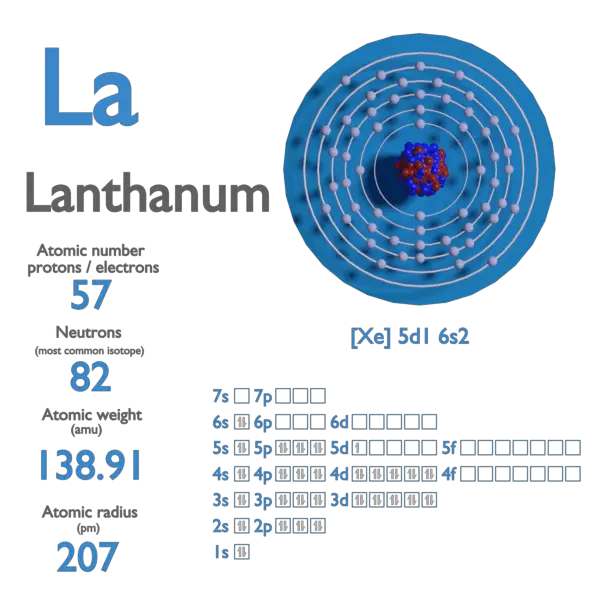
Proton Number - Atomic Number - Density of Lanthanum
Note that each element may contain more isotopes. Therefore this resulting atomic mass is calculated from naturally-occurring isotopes and their abundance.

The unit of measure for mass is the atomic mass unit (amu). One atomic mass unit is equal to 1.66 x 10⁻²⁴ grams. One unified atomic mass unit is approximately the mass of one nucleon (either a single proton or neutron) and is numerically equivalent to 1 g/mol.

For 12C, the atomic mass is exactly 12u, since the atomic mass unit is defined from it. For other isotopes, the isotopic mass usually differs and is usually within 0.1 u of the mass number. For example, 63Cu (29 protons and 34 neutrons) has a mass number of 63, and an isotopic mass in its nuclear ground state is 62.91367 u.

There are two reasons for the difference between mass number and isotopic mass, known as the mass defect:

  1. The neutron is slightly heavier than the proton. This increases the mass of nuclei with more neutrons than protons relative to the atomic mass unit scale based on 12C with equal numbers of protons and neutrons.
  2. The nuclear binding energy varies between nuclei. A nucleus with greater binding energy has lower total energy, and therefore a lower mass according to Einstein’s mass-energy equivalence relation E = mc2. For 63Cu, the atomic mass is less than 63, so this must be the dominant factor.

The atomic mass number determines especially the atomic mass of atoms. The mass number is different for each different isotope of a chemical element.

How does the atomic mass determine the density of materials?

Density of Lanthanum

Density of Lanthanum is 6.146g/cm3.
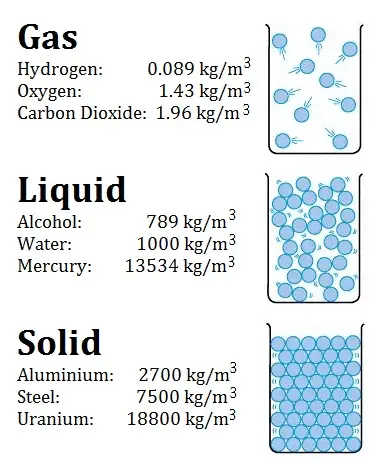
Density - Gas - Liquid - Solid

Typical densities of various substances at atmospheric pressure.

Density is defined as the mass per unit volume. It is an intensive property, which is mathematically defined as mass divided by volume:

ρ = m/V

In other words, the density (ρ) of a substance is the total mass (m) of that substance divided by the total volume (V) occupied by that substance. The standard SI unit is kilograms per cubic meter (kg/m3). The Standard English unit is pounds mass per cubic foot (lbm/ft3).

See also: What is Density

See also: Densest Materials of the Earth
density - chemical elements

Lanthanum – Properties Summary

Element Lanthanum
Atomic Number 57
Symbol La
Element Category Rare Earth Metal
Phase at STP Solid
Atomic Mass [amu] 138.9055
Density at STP [g/cm3] 6.146
Electron Configuration [Xe] 5d1 6s2
Possible Oxidation States +3
Electron Affinity [kJ/mol] 48
Electronegativity [Pauling scale] 1.1
1st Ionization Energy [eV] 5.577
Year of Discovery 1839
Discoverer Mosander, Carl Gustav
Thermal properties
Melting Point [Celsius scale] 920
Boiling Point [Celsius scale] 3454
Thermal Conductivity [W/m K] 13
Specific Heat [J/g K] 0.19
Heat of Fusion [kJ/mol] 6.2
Heat of Vaporization [kJ/mol] 414


Lanthanum in Periodic Table

Hydro­gen1H He­lium2He
Lith­ium3Li Beryl­lium4Be Boron5B Carbon6C Nitro­gen7N Oxy­gen8O Fluor­ine9F Neon10Ne
So­dium11Na Magne­sium12Mg Alumin­ium13Al Sili­con14Si Phos­phorus15P Sulfur16S Chlor­ine17Cl Argon18Ar
Potas­sium19K Cal­cium20Ca Scan­dium21Sc Tita­nium22Ti Vana­dium23V Chrom­ium24Cr Manga­nese25Mn Iron26Fe Cobalt27Co Nickel28Ni Copper29Cu Zinc30Zn Gallium31Ga Germa­nium32Ge Arsenic33As Sele­nium34Se Bromine35Br Kryp­ton36Kr
Rubid­ium37Rb Stront­ium38Sr Yttrium39Y Zirco­nium40Zr Nio­bium41Nb Molyb­denum42Mo Tech­netium43Tc Ruthe­nium44Ru Rho­dium45Rh Pallad­ium46Pd Silver47Ag Cad­mium48Cd Indium49In Tin50Sn Anti­mony51Sb Tellur­ium52Te Iodine53I Xenon54Xe
Cae­sium55Cs Ba­rium56Ba Lan­thanum57La 1 asterisk Haf­nium72Hf Tanta­lum73Ta Tung­sten74W Rhe­nium75Re Os­mium76Os Iridium77Ir Plat­inum78Pt Gold79Au Mer­cury80Hg Thallium81Tl Lead82Pb Bis­muth83Bi Polo­nium84Po Asta­tine85At Radon86Rn
Fran­cium87Fr Ra­dium88Ra Actin­ium89Ac 1 asterisk Ruther­fordium104Rf Dub­nium105Db Sea­borgium106Sg Bohr­ium107Bh Has­sium108Hs Meit­nerium109Mt Darm­stadtium110Ds Roent­genium111Rg Coper­nicium112Cn Nihon­ium113Nh Flerov­ium114Fl Moscov­ium115Mc Liver­morium116Lv Tenness­ine117Ts Oga­nesson118Og
1 asterisk Cerium58Ce Praseo­dymium59Pr Neo­dymium60Nd Prome­thium61Pm Sama­rium62Sm Europ­ium63Eu Gadolin­ium64Gd Ter­bium65Tb Dyspro­sium66Dy Hol­mium67Ho Erbium68Er Thulium69Tm Ytter­bium70Yb Lute­tium71Lu
1 asterisk Thor­ium90Th Protac­tinium91Pa Ura­nium92U Neptu­nium93Np Pluto­nium94Pu Ameri­cium95Am Curium96Cm Berkel­ium97Bk Califor­nium98Cf Einstei­nium99Es Fer­mium100Fm Mende­levium101Md Nobel­ium102No Lawren­cium103Lr

–
–
–

Cerium – Atomic Number – Atomic Mass – Density of Cerium

Atomic Number of Cerium

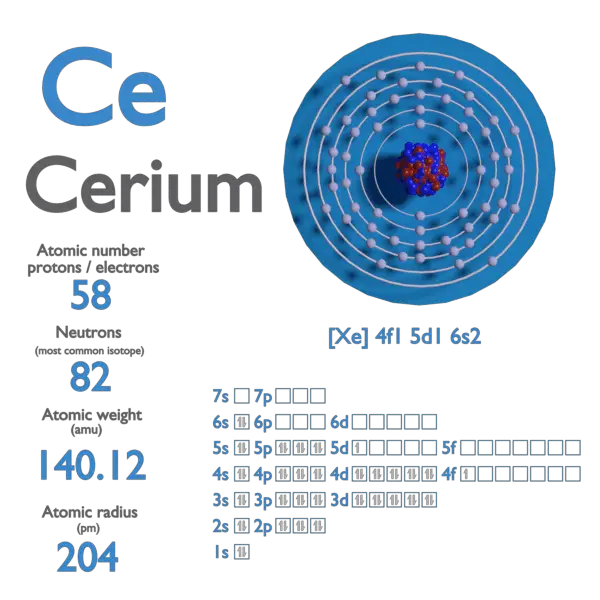
Cerium is a chemical element with atomic number 58 which means there are 58 protons and 58 electrons in the atomic structure. The chemical symbol for Cerium is Ce.

Since the number of electrons is responsible for the chemical behavior of atoms, the atomic number identifies the various chemical elements.

How does the atomic number determine the chemical behavior of atoms?

Atomic Mass of Cerium

Atomic mass of Cerium is 140.116 u. 

Proton Number - Atomic Number - Density of Cerium
Note that each element may contain more isotopes. Therefore this resulting atomic mass is calculated from naturally-occurring isotopes and their abundance.

The unit of measure for mass is the atomic mass unit (amu). One atomic mass unit is equal to 1.66 x 10⁻²⁴ grams. One unified atomic mass unit is approximately the mass of one nucleon (either a single proton or neutron) and is numerically equivalent to 1 g/mol.

For 12C, the atomic mass is exactly 12u, since the atomic mass unit is defined from it. For other isotopes, the isotopic mass usually differs and is usually within 0.1 u of the mass number. For example, 63Cu (29 protons and 34 neutrons) has a mass number of 63, and an isotopic mass in its nuclear ground state is 62.91367 u.

There are two reasons for the difference between mass number and isotopic mass, known as the mass defect:

  1. The neutron is slightly heavier than the proton. This increases the mass of nuclei with more neutrons than protons relative to the atomic mass unit scale based on 12C with equal numbers of protons and neutrons.
  2. The nuclear binding energy varies between nuclei. A nucleus with greater binding energy has lower total energy, and therefore a lower mass according to Einstein’s mass-energy equivalence relation E = mc2. For 63Cu, the atomic mass is less than 63, so this must be the dominant factor.

The atomic mass number determines especially the atomic mass of atoms. The mass number is different for each different isotope of a chemical element.

How does the atomic mass determine the density of materials?

Density of Cerium

Density of Cerium is 6.689g/cm3.
Density - Gas - Liquid - Solid

Typical densities of various substances at atmospheric pressure.

Density is defined as the mass per unit volume. It is an intensive property, which is mathematically defined as mass divided by volume:

ρ = m/V

In other words, the density (ρ) of a substance is the total mass (m) of that substance divided by the total volume (V) occupied by that substance. The standard SI unit is kilograms per cubic meter (kg/m3). The Standard English unit is pounds mass per cubic foot (lbm/ft3).

See also: What is Density

See also: Densest Materials of the Earth
density - chemical elements

Cerium – Properties Summary

Element Cerium
Atomic Number 58
Symbol Ce
Element Category Rare Earth Metal
Phase at STP Solid
Atomic Mass [amu] 140.116
Density at STP [g/cm3] 6.689
Electron Configuration [Xe] 4f1 5d1 6s2
Possible Oxidation States +3,4
Electron Affinity [kJ/mol] 50
Electronegativity [Pauling scale] 1.12
1st Ionization Energy [eV] 5.5387
Year of Discovery 1803
Discoverer Hisinger, Wilhelm & Berzelius, Jöns Jacob/Klaproth, Martin Heinrich
Thermal properties
Melting Point [Celsius scale] 798
Boiling Point [Celsius scale] 3257
Thermal Conductivity [W/m K] 11
Specific Heat [J/g K] 0.19
Heat of Fusion [kJ/mol] 5.46
Heat of Vaporization [kJ/mol] 414


Cerium in Periodic Table

Hydro­gen1H He­lium2He
Lith­ium3Li Beryl­lium4Be Boron5B Carbon6C Nitro­gen7N Oxy­gen8O Fluor­ine9F Neon10Ne
So­dium11Na Magne­sium12Mg Alumin­ium13Al Sili­con14Si Phos­phorus15P Sulfur16S Chlor­ine17Cl Argon18Ar
Potas­sium19K Cal­cium20Ca Scan­dium21Sc Tita­nium22Ti Vana­dium23V Chrom­ium24Cr Manga­nese25Mn Iron26Fe Cobalt27Co Nickel28Ni Copper29Cu Zinc30Zn Gallium31Ga Germa­nium32Ge Arsenic33As Sele­nium34Se Bromine35Br Kryp­ton36Kr
Rubid­ium37Rb Stront­ium38Sr Yttrium39Y Zirco­nium40Zr Nio­bium41Nb Molyb­denum42Mo Tech­netium43Tc Ruthe­nium44Ru Rho­dium45Rh Pallad­ium46Pd Silver47Ag Cad­mium48Cd Indium49In Tin50Sn Anti­mony51Sb Tellur­ium52Te Iodine53I Xenon54Xe
Cae­sium55Cs Ba­rium56Ba Lan­thanum57La 1 asterisk Haf­nium72Hf Tanta­lum73Ta Tung­sten74W Rhe­nium75Re Os­mium76Os Iridium77Ir Plat­inum78Pt Gold79Au Mer­cury80Hg Thallium81Tl Lead82Pb Bis­muth83Bi Polo­nium84Po Asta­tine85At Radon86Rn
Fran­cium87Fr Ra­dium88Ra Actin­ium89Ac 1 asterisk Ruther­fordium104Rf Dub­nium105Db Sea­borgium106Sg Bohr­ium107Bh Has­sium108Hs Meit­nerium109Mt Darm­stadtium110Ds Roent­genium111Rg Coper­nicium112Cn Nihon­ium113Nh Flerov­ium114Fl Moscov­ium115Mc Liver­morium116Lv Tenness­ine117Ts Oga­nesson118Og
1 asterisk Cerium58Ce Praseo­dymium59Pr Neo­dymium60Nd Prome­thium61Pm Sama­rium62Sm Europ­ium63Eu Gadolin­ium64Gd Ter­bium65Tb Dyspro­sium66Dy Hol­mium67Ho Erbium68Er Thulium69Tm Ytter­bium70Yb Lute­tium71Lu
1 asterisk Thor­ium90Th Protac­tinium91Pa Ura­nium92U Neptu­nium93Np Pluto­nium94Pu Ameri­cium95Am Curium96Cm Berkel­ium97Bk Califor­nium98Cf Einstei­nium99Es Fer­mium100Fm Mende­levium101Md Nobel­ium102No Lawren­cium103Lr

–
–
–

Caesium – Atomic Number – Atomic Mass – Density of Caesium

Atomic Number of Caesium

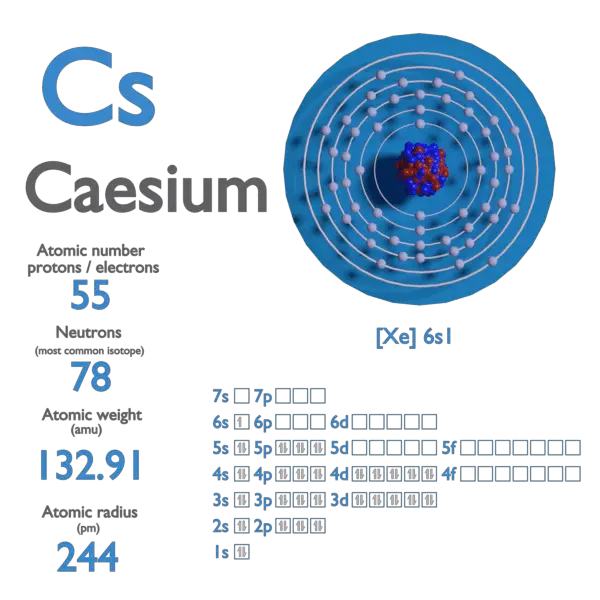
Caesium is a chemical element with atomic number 55 which means there are 55 protons and 55 electrons in the atomic structure. The chemical symbol for Caesium is Cs.

Since the number of electrons is responsible for the chemical behavior of atoms, the atomic number identifies the various chemical elements.

How does the atomic number determine the chemical behavior of atoms?

Atomic Mass of Caesium

Atomic mass of Caesium is 132.9055 u. 

Proton Number - Atomic Number - Density of Caesium
Note that each element may contain more isotopes. Therefore this resulting atomic mass is calculated from naturally-occurring isotopes and their abundance.

The unit of measure for mass is the atomic mass unit (amu). One atomic mass unit is equal to 1.66 x 10⁻²⁴ grams. One unified atomic mass unit is approximately the mass of one nucleon (either a single proton or neutron) and is numerically equivalent to 1 g/mol.

For 12C, the atomic mass is exactly 12u, since the atomic mass unit is defined from it. For other isotopes, the isotopic mass usually differs and is usually within 0.1 u of the mass number. For example, 63Cu (29 protons and 34 neutrons) has a mass number of 63, and an isotopic mass in its nuclear ground state is 62.91367 u.

There are two reasons for the difference between mass number and isotopic mass, known as the mass defect:

  1. The neutron is slightly heavier than the proton. This increases the mass of nuclei with more neutrons than protons relative to the atomic mass unit scale based on 12C with equal numbers of protons and neutrons.
  2. The nuclear binding energy varies between nuclei. A nucleus with greater binding energy has lower total energy, and therefore a lower mass according to Einstein’s mass-energy equivalence relation E = mc2. For 63Cu, the atomic mass is less than 63, so this must be the dominant factor.

The atomic mass number determines especially the atomic mass of atoms. The mass number is different for each different isotope of a chemical element.

How does the atomic mass determine the density of materials?

Density of Caesium

Density of Caesium is 1.879g/cm3.
Density - Gas - Liquid - Solid

Typical densities of various substances at atmospheric pressure.

Density is defined as the mass per unit volume. It is an intensive property, which is mathematically defined as mass divided by volume:

ρ = m/V

In other words, the density (ρ) of a substance is the total mass (m) of that substance divided by the total volume (V) occupied by that substance. The standard SI unit is kilograms per cubic meter (kg/m3). The Standard English unit is pounds mass per cubic foot (lbm/ft3).

See also: What is Density

See also: Densest Materials of the Earth
density - chemical elements

Caesium – Properties Summary

Element Caesium
Atomic Number 55
Symbol Cs
Element Category Alkali Metal
Phase at STP Solid
Atomic Mass [amu] 132.9055
Density at STP [g/cm3] 1.879
Electron Configuration [Xe] 6s1
Possible Oxidation States +1
Electron Affinity [kJ/mol] 45.5
Electronegativity [Pauling scale] 0.79
1st Ionization Energy [eV] 3.8939
Year of Discovery 1860
Discoverer Kirchhoff, Gustav & Bunsen, Robert
Thermal properties
Melting Point [Celsius scale] 28.4
Boiling Point [Celsius scale] 669
Thermal Conductivity [W/m K] 36
Specific Heat [J/g K] 0.24
Heat of Fusion [kJ/mol] 2.092
Heat of Vaporization [kJ/mol] 67.74


Caesium in Periodic Table

Hydro­gen1H He­lium2He
Lith­ium3Li Beryl­lium4Be Boron5B Carbon6C Nitro­gen7N Oxy­gen8O Fluor­ine9F Neon10Ne
So­dium11Na Magne­sium12Mg Alumin­ium13Al Sili­con14Si Phos­phorus15P Sulfur16S Chlor­ine17Cl Argon18Ar
Potas­sium19K Cal­cium20Ca Scan­dium21Sc Tita­nium22Ti Vana­dium23V Chrom­ium24Cr Manga­nese25Mn Iron26Fe Cobalt27Co Nickel28Ni Copper29Cu Zinc30Zn Gallium31Ga Germa­nium32Ge Arsenic33As Sele­nium34Se Bromine35Br Kryp­ton36Kr
Rubid­ium37Rb Stront­ium38Sr Yttrium39Y Zirco­nium40Zr Nio­bium41Nb Molyb­denum42Mo Tech­netium43Tc Ruthe­nium44Ru Rho­dium45Rh Pallad­ium46Pd Silver47Ag Cad­mium48Cd Indium49In Tin50Sn Anti­mony51Sb Tellur­ium52Te Iodine53I Xenon54Xe
Cae­sium55Cs Ba­rium56Ba Lan­thanum57La 1 asterisk Haf­nium72Hf Tanta­lum73Ta Tung­sten74W Rhe­nium75Re Os­mium76Os Iridium77Ir Plat­inum78Pt Gold79Au Mer­cury80Hg Thallium81Tl Lead82Pb Bis­muth83Bi Polo­nium84Po Asta­tine85At Radon86Rn
Fran­cium87Fr Ra­dium88Ra Actin­ium89Ac 1 asterisk Ruther­fordium104Rf Dub­nium105Db Sea­borgium106Sg Bohr­ium107Bh Has­sium108Hs Meit­nerium109Mt Darm­stadtium110Ds Roent­genium111Rg Coper­nicium112Cn Nihon­ium113Nh Flerov­ium114Fl Moscov­ium115Mc Liver­morium116Lv Tenness­ine117Ts Oga­nesson118Og
1 asterisk Cerium58Ce Praseo­dymium59Pr Neo­dymium60Nd Prome­thium61Pm Sama­rium62Sm Europ­ium63Eu Gadolin­ium64Gd Ter­bium65Tb Dyspro­sium66Dy Hol­mium67Ho Erbium68Er Thulium69Tm Ytter­bium70Yb Lute­tium71Lu
1 asterisk Thor­ium90Th Protac­tinium91Pa Ura­nium92U Neptu­nium93Np Pluto­nium94Pu Ameri­cium95Am Curium96Cm Berkel­ium97Bk Califor­nium98Cf Einstei­nium99Es Fer­mium100Fm Mende­levium101Md Nobel­ium102No Lawren­cium103Lr

–
–
–

Barium – Atomic Number – Atomic Mass – Density of Barium

Atomic Number of Barium

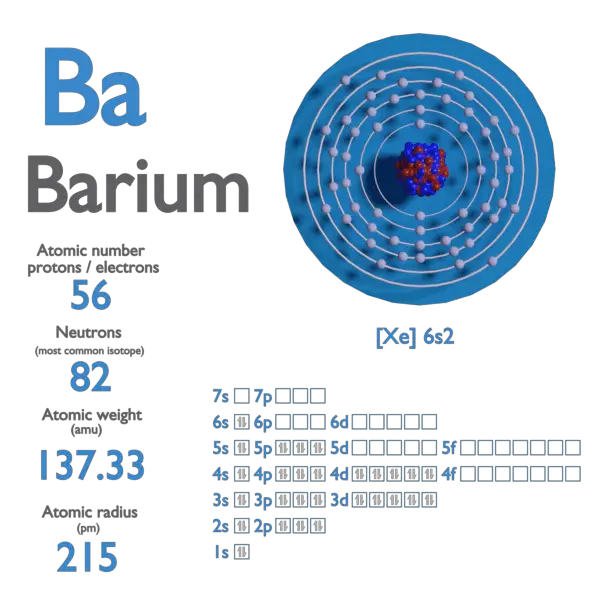
Barium is a chemical element with atomic number 56 which means there are 56 protons and 56 electrons in the atomic structure. The chemical symbol for Barium is Ba.

Since the number of electrons is responsible for the chemical behavior of atoms, the atomic number identifies the various chemical elements.

How does the atomic number determine the chemical behavior of atoms?

Atomic Mass of Barium

Atomic mass of Barium is 137.327 u. 

Proton Number - Atomic Number - Density of Barium
Note that each element may contain more isotopes. Therefore this resulting atomic mass is calculated from naturally-occurring isotopes and their abundance.

The unit of measure for mass is the atomic mass unit (amu). One atomic mass unit is equal to 1.66 x 10⁻²⁴ grams. One unified atomic mass unit is approximately the mass of one nucleon (either a single proton or neutron) and is numerically equivalent to 1 g/mol.

For 12C, the atomic mass is exactly 12u, since the atomic mass unit is defined from it. For other isotopes, the isotopic mass usually differs and is usually within 0.1 u of the mass number. For example, 63Cu (29 protons and 34 neutrons) has a mass number of 63, and an isotopic mass in its nuclear ground state is 62.91367 u.

There are two reasons for the difference between mass number and isotopic mass, known as the mass defect:

  1. The neutron is slightly heavier than the proton. This increases the mass of nuclei with more neutrons than protons relative to the atomic mass unit scale based on 12C with equal numbers of protons and neutrons.
  2. The nuclear binding energy varies between nuclei. A nucleus with greater binding energy has lower total energy, and therefore a lower mass according to Einstein’s mass-energy equivalence relation E = mc2. For 63Cu, the atomic mass is less than 63, so this must be the dominant factor.

The atomic mass number determines especially the atomic mass of atoms. The mass number is different for each different isotope of a chemical element.

How does the atomic mass determine the density of materials?

Density of Barium

Density of Barium is 3.51g/cm3.
Density - Gas - Liquid - Solid

Typical densities of various substances at atmospheric pressure.

Density is defined as the mass per unit volume. It is an intensive property, which is mathematically defined as mass divided by volume:

ρ = m/V

In other words, the density (ρ) of a substance is the total mass (m) of that substance divided by the total volume (V) occupied by that substance. The standard SI unit is kilograms per cubic meter (kg/m3). The Standard English unit is pounds mass per cubic foot (lbm/ft3).

See also: What is Density

See also: Densest Materials of the Earth
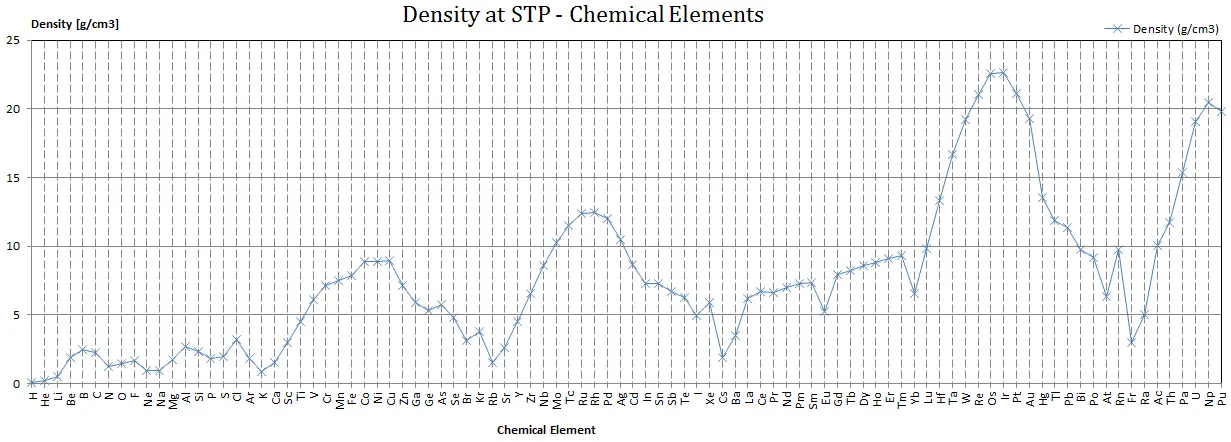
density - chemical elements

Barium – Properties Summary

Element Barium
Atomic Number 56
Symbol Ba
Element Category Alkaline Earth Metal
Phase at STP Solid
Atomic Mass [amu] 137.327
Density at STP [g/cm3] 3.51
Electron Configuration [Xe] 6s2
Possible Oxidation States +2
Electron Affinity [kJ/mol] 13.95
Electronegativity [Pauling scale] 0.89
1st Ionization Energy [eV] 5.2117
Year of Discovery 1808
Discoverer Davy, Sir Humphry
Thermal properties
Melting Point [Celsius scale] 725
Boiling Point [Celsius scale] 1640
Thermal Conductivity [W/m K] 18
Specific Heat [J/g K] 0.204
Heat of Fusion [kJ/mol] 7.75
Heat of Vaporization [kJ/mol] 142


Barium in Periodic Table

Hydro­gen1H He­lium2He
Lith­ium3Li Beryl­lium4Be Boron5B Carbon6C Nitro­gen7N Oxy­gen8O Fluor­ine9F Neon10Ne
So­dium11Na Magne­sium12Mg Alumin­ium13Al Sili­con14Si Phos­phorus15P Sulfur16S Chlor­ine17Cl Argon18Ar
Potas­sium19K Cal­cium20Ca Scan­dium21Sc Tita­nium22Ti Vana­dium23V Chrom­ium24Cr Manga­nese25Mn Iron26Fe Cobalt27Co Nickel28Ni Copper29Cu Zinc30Zn Gallium31Ga Germa­nium32Ge Arsenic33As Sele­nium34Se Bromine35Br Kryp­ton36Kr
Rubid­ium37Rb Stront­ium38Sr Yttrium39Y Zirco­nium40Zr Nio­bium41Nb Molyb­denum42Mo Tech­netium43Tc Ruthe­nium44Ru Rho­dium45Rh Pallad­ium46Pd Silver47Ag Cad­mium48Cd Indium49In Tin50Sn Anti­mony51Sb Tellur­ium52Te Iodine53I Xenon54Xe
Cae­sium55Cs Ba­rium56Ba Lan­thanum57La 1 asterisk Haf­nium72Hf Tanta­lum73Ta Tung­sten74W Rhe­nium75Re Os­mium76Os Iridium77Ir Plat­inum78Pt Gold79Au Mer­cury80Hg Thallium81Tl Lead82Pb Bis­muth83Bi Polo­nium84Po Asta­tine85At Radon86Rn
Fran­cium87Fr Ra­dium88Ra Actin­ium89Ac 1 asterisk Ruther­fordium104Rf Dub­nium105Db Sea­borgium106Sg Bohr­ium107Bh Has­sium108Hs Meit­nerium109Mt Darm­stadtium110Ds Roent­genium111Rg Coper­nicium112Cn Nihon­ium113Nh Flerov­ium114Fl Moscov­ium115Mc Liver­morium116Lv Tenness­ine117Ts Oga­nesson118Og
1 asterisk Cerium58Ce Praseo­dymium59Pr Neo­dymium60Nd Prome­thium61Pm Sama­rium62Sm Europ­ium63Eu Gadolin­ium64Gd Ter­bium65Tb Dyspro­sium66Dy Hol­mium67Ho Erbium68Er Thulium69Tm Ytter­bium70Yb Lute­tium71Lu
1 asterisk Thor­ium90Th Protac­tinium91Pa Ura­nium92U Neptu­nium93Np Pluto­nium94Pu Ameri­cium95Am Curium96Cm Berkel­ium97Bk Califor­nium98Cf Einstei­nium99Es Fer­mium100Fm Mende­levium101Md Nobel­ium102No Lawren­cium103Lr

–
–
–

Iodine – Atomic Number – Atomic Mass – Density of Iodine

Atomic Number of Iodine

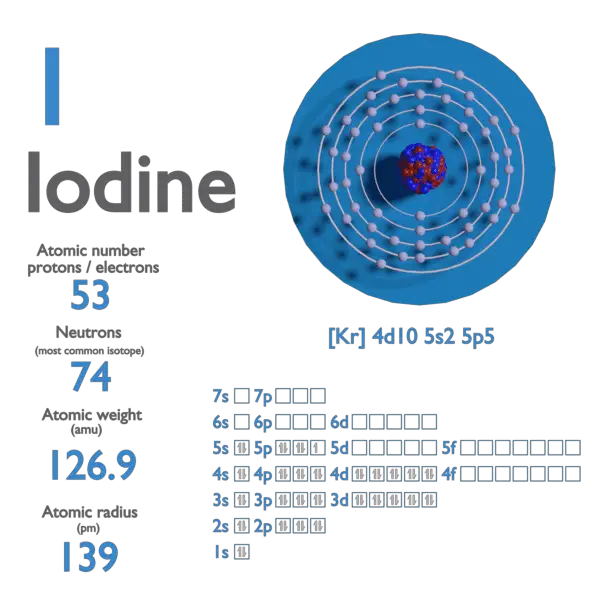
Iodine is a chemical element with atomic number 53 which means there are 53 protons and 53 electrons in the atomic structure. The chemical symbol for Iodine is I.

Since the number of electrons is responsible for the chemical behavior of atoms, the atomic number identifies the various chemical elements.

How does the atomic number determine the chemical behavior of atoms?

Atomic Mass of Iodine

Atomic mass of Iodine is 126.90447 u. 

Proton Number - Atomic Number - Density of Iodine
Note that each element may contain more isotopes. Therefore this resulting atomic mass is calculated from naturally-occurring isotopes and their abundance.

The unit of measure for mass is the atomic mass unit (amu). One atomic mass unit is equal to 1.66 x 10⁻²⁴ grams. One unified atomic mass unit is approximately the mass of one nucleon (either a single proton or neutron) and is numerically equivalent to 1 g/mol.

For 12C, the atomic mass is exactly 12u, since the atomic mass unit is defined from it. For other isotopes, the isotopic mass usually differs and is usually within 0.1 u of the mass number. For example, 63Cu (29 protons and 34 neutrons) has a mass number of 63, and an isotopic mass in its nuclear ground state is 62.91367 u.

There are two reasons for the difference between mass number and isotopic mass, known as the mass defect:

  1. The neutron is slightly heavier than the proton. This increases the mass of nuclei with more neutrons than protons relative to the atomic mass unit scale based on 12C with equal numbers of protons and neutrons.
  2. The nuclear binding energy varies between nuclei. A nucleus with greater binding energy has lower total energy, and therefore a lower mass according to Einstein’s mass-energy equivalence relation E = mc2. For 63Cu, the atomic mass is less than 63, so this must be the dominant factor.

The atomic mass number determines especially the atomic mass of atoms. The mass number is different for each different isotope of a chemical element.

How does the atomic mass determine the density of materials?

Density of Iodine

Density of Iodine is 4.94g/cm3.
Density - Gas - Liquid - Solid

Typical densities of various substances at atmospheric pressure.

Density is defined as the mass per unit volume. It is an intensive property, which is mathematically defined as mass divided by volume:

ρ = m/V

In other words, the density (ρ) of a substance is the total mass (m) of that substance divided by the total volume (V) occupied by that substance. The standard SI unit is kilograms per cubic meter (kg/m3). The Standard English unit is pounds mass per cubic foot (lbm/ft3).

See also: What is Density

See also: Densest Materials of the Earth

density - chemical elements

Iodine – Properties Summary

Element Iodine
Atomic Number 53
Symbol I
Element Category Halogen
Phase at STP Solid
Atomic Mass [amu] 126.90447
Density at STP [g/cm3] 4.94
Electron Configuration [Kr] 4d10 5s2 5p5
Possible Oxidation States +1,5,7/-1
Electron Affinity [kJ/mol] 295.2
Electronegativity [Pauling scale] 2.66
1st Ionization Energy [eV] 10.4513
Year of Discovery 1811
Discoverer Courtois, Bernard
Thermal properties
Melting Point [Celsius scale] 113.5
Boiling Point [Celsius scale] 184
Thermal Conductivity [W/m K] 0.449
Specific Heat [J/g K] 0.214
Heat of Fusion [kJ/mol] 7.824
Heat of Vaporization [kJ/mol] 20.752


Iodine in Periodic Table

Hydro­gen1H He­lium2He
Lith­ium3Li Beryl­lium4Be Boron5B Carbon6C Nitro­gen7N Oxy­gen8O Fluor­ine9F Neon10Ne
So­dium11Na Magne­sium12Mg Alumin­ium13Al Sili­con14Si Phos­phorus15P Sulfur16S Chlor­ine17Cl Argon18Ar
Potas­sium19K Cal­cium20Ca Scan­dium21Sc Tita­nium22Ti Vana­dium23V Chrom­ium24Cr Manga­nese25Mn Iron26Fe Cobalt27Co Nickel28Ni Copper29Cu Zinc30Zn Gallium31Ga Germa­nium32Ge Arsenic33As Sele­nium34Se Bromine35Br Kryp­ton36Kr
Rubid­ium37Rb Stront­ium38Sr Yttrium39Y Zirco­nium40Zr Nio­bium41Nb Molyb­denum42Mo Tech­netium43Tc Ruthe­nium44Ru Rho­dium45Rh Pallad­ium46Pd Silver47Ag Cad­mium48Cd Indium49In Tin50Sn Anti­mony51Sb Tellur­ium52Te Iodine53I Xenon54Xe
Cae­sium55Cs Ba­rium56Ba Lan­thanum57La 1 asterisk Haf­nium72Hf Tanta­lum73Ta Tung­sten74W Rhe­nium75Re Os­mium76Os Iridium77Ir Plat­inum78Pt Gold79Au Mer­cury80Hg Thallium81Tl Lead82Pb Bis­muth83Bi Polo­nium84Po Asta­tine85At Radon86Rn
Fran­cium87Fr Ra­dium88Ra Actin­ium89Ac 1 asterisk Ruther­fordium104Rf Dub­nium105Db Sea­borgium106Sg Bohr­ium107Bh Has­sium108Hs Meit­nerium109Mt Darm­stadtium110Ds Roent­genium111Rg Coper­nicium112Cn Nihon­ium113Nh Flerov­ium114Fl Moscov­ium115Mc Liver­morium116Lv Tenness­ine117Ts Oga­nesson118Og
1 asterisk Cerium58Ce Praseo­dymium59Pr Neo­dymium60Nd Prome­thium61Pm Sama­rium62Sm Europ­ium63Eu Gadolin­ium64Gd Ter­bium65Tb Dyspro­sium66Dy Hol­mium67Ho Erbium68Er Thulium69Tm Ytter­bium70Yb Lute­tium71Lu
1 asterisk Thor­ium90Th Protac­tinium91Pa Ura­nium92U Neptu­nium93Np Pluto­nium94Pu Ameri­cium95Am Curium96Cm Berkel­ium97Bk Califor­nium98Cf Einstei­nium99Es Fer­mium100Fm Mende­levium101Md Nobel­ium102No Lawren­cium103Lr

–
–
–

Xenon – Atomic Number – Atomic Mass – Density of Xenon

Atomic Number of Xenon

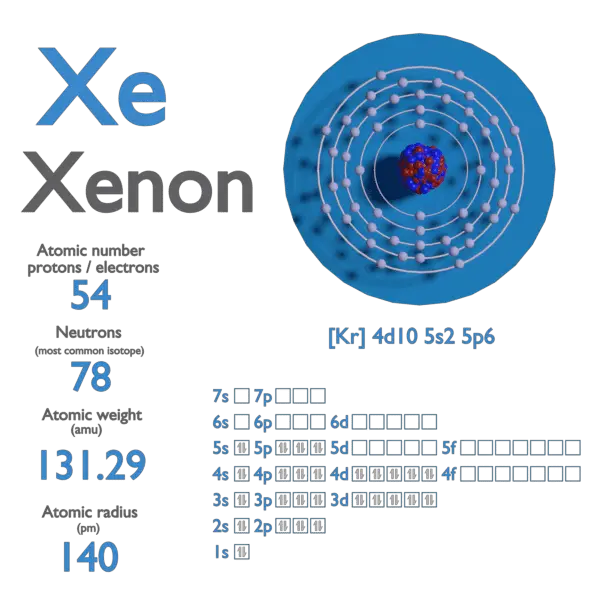
Xenon is a chemical element with atomic number 54 which means there are 54 protons and 54 electrons in the atomic structure. The chemical symbol for Xenon is Xe.

Since the number of electrons is responsible for the chemical behavior of atoms, the atomic number identifies the various chemical elements.

How does the atomic number determine the chemical behavior of atoms?

Atomic Mass of Xenon

Atomic mass of Xenon is 131.293 u. 

Proton Number - Atomic Number - Density of Xenon
Note that each element may contain more isotopes. Therefore this resulting atomic mass is calculated from naturally-occurring isotopes and their abundance.

The unit of measure for mass is the atomic mass unit (amu). One atomic mass unit is equal to 1.66 x 10⁻²⁴ grams. One unified atomic mass unit is approximately the mass of one nucleon (either a single proton or neutron) and is numerically equivalent to 1 g/mol.

For 12C, the atomic mass is exactly 12u, since the atomic mass unit is defined from it. For other isotopes, the isotopic mass usually differs and is usually within 0.1 u of the mass number. For example, 63Cu (29 protons and 34 neutrons) has a mass number of 63, and an isotopic mass in its nuclear ground state is 62.91367 u.

There are two reasons for the difference between mass number and isotopic mass, known as the mass defect:

  1. The neutron is slightly heavier than the proton. This increases the mass of nuclei with more neutrons than protons relative to the atomic mass unit scale based on 12C with equal numbers of protons and neutrons.
  2. The nuclear binding energy varies between nuclei. A nucleus with greater binding energy has lower total energy, and therefore a lower mass according to Einstein’s mass-energy equivalence relation E = mc2. For 63Cu, the atomic mass is less than 63, so this must be the dominant factor.

The atomic mass number determines especially the atomic mass of atoms. The mass number is different for each different isotope of a chemical element.

How does the atomic mass determine the density of materials?

Density of Xenon

Density of Xenon is 5.9g/cm3.
Density - Gas - Liquid - Solid

Typical densities of various substances at atmospheric pressure.

Density is defined as the mass per unit volume. It is an intensive property, which is mathematically defined as mass divided by volume:

ρ = m/V

In other words, the density (ρ) of a substance is the total mass (m) of that substance divided by the total volume (V) occupied by that substance. The standard SI unit is kilograms per cubic meter (kg/m3). The Standard English unit is pounds mass per cubic foot (lbm/ft3).

See also: What is Density

See also: Densest Materials of the Earth

density - chemical elements

Xenon – Properties Summary

Element Xenon
Atomic Number 54
Symbol Xe
Element Category Noble Gas
Phase at STP Gas
Atomic Mass [amu] 131.293
Density at STP [g/cm3] 5.9
Electron Configuration [Kr] 4d10 5s2 5p6
Possible Oxidation States 0
Electron Affinity [kJ/mol] —
Electronegativity [Pauling scale] 2.6
1st Ionization Energy [eV] 12.1299
Year of Discovery 1898
Discoverer Ramsay, William & Travers, Morris William
Thermal properties
Melting Point [Celsius scale] -111.8
Boiling Point [Celsius scale] -107.1
Thermal Conductivity [W/m K] 0.00565
Specific Heat [J/g K] 0.158
Heat of Fusion [kJ/mol] 2.297
Heat of Vaporization [kJ/mol] 12.636


Xenon in Periodic Table

Hydro­gen1H He­lium2He
Lith­ium3Li Beryl­lium4Be Boron5B Carbon6C Nitro­gen7N Oxy­gen8O Fluor­ine9F Neon10Ne
So­dium11Na Magne­sium12Mg Alumin­ium13Al Sili­con14Si Phos­phorus15P Sulfur16S Chlor­ine17Cl Argon18Ar
Potas­sium19K Cal­cium20Ca Scan­dium21Sc Tita­nium22Ti Vana­dium23V Chrom­ium24Cr Manga­nese25Mn Iron26Fe Cobalt27Co Nickel28Ni Copper29Cu Zinc30Zn Gallium31Ga Germa­nium32Ge Arsenic33As Sele­nium34Se Bromine35Br Kryp­ton36Kr
Rubid­ium37Rb Stront­ium38Sr Yttrium39Y Zirco­nium40Zr Nio­bium41Nb Molyb­denum42Mo Tech­netium43Tc Ruthe­nium44Ru Rho­dium45Rh Pallad­ium46Pd Silver47Ag Cad­mium48Cd Indium49In Tin50Sn Anti­mony51Sb Tellur­ium52Te Iodine53I Xenon54Xe
Cae­sium55Cs Ba­rium56Ba Lan­thanum57La 1 asterisk Haf­nium72Hf Tanta­lum73Ta Tung­sten74W Rhe­nium75Re Os­mium76Os Iridium77Ir Plat­inum78Pt Gold79Au Mer­cury80Hg Thallium81Tl Lead82Pb Bis­muth83Bi Polo­nium84Po Asta­tine85At Radon86Rn
Fran­cium87Fr Ra­dium88Ra Actin­ium89Ac 1 asterisk Ruther­fordium104Rf Dub­nium105Db Sea­borgium106Sg Bohr­ium107Bh Has­sium108Hs Meit­nerium109Mt Darm­stadtium110Ds Roent­genium111Rg Coper­nicium112Cn Nihon­ium113Nh Flerov­ium114Fl Moscov­ium115Mc Liver­morium116Lv Tenness­ine117Ts Oga­nesson118Og
1 asterisk Cerium58Ce Praseo­dymium59Pr Neo­dymium60Nd Prome­thium61Pm Sama­rium62Sm Europ­ium63Eu Gadolin­ium64Gd Ter­bium65Tb Dyspro­sium66Dy Hol­mium67Ho Erbium68Er Thulium69Tm Ytter­bium70Yb Lute­tium71Lu
1 asterisk Thor­ium90Th Protac­tinium91Pa Ura­nium92U Neptu­nium93Np Pluto­nium94Pu Ameri­cium95Am Curium96Cm Berkel­ium97Bk Califor­nium98Cf Einstei­nium99Es Fer­mium100Fm Mende­levium101Md Nobel­ium102No Lawren­cium103Lr

–
–
–

Antimony – Atomic Number – Atomic Mass – Density of Antimony

Atomic Number of Antimony

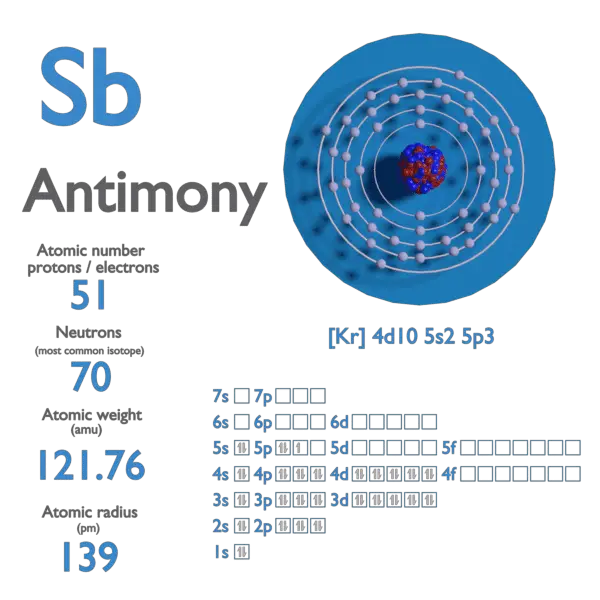
Antimony is a chemical element with atomic number 51 which means there are 51 protons and 51 electrons in the atomic structure. The chemical symbol for Antimony is Sb.

Since the number of electrons is responsible for the chemical behavior of atoms, the atomic number identifies the various chemical elements.

How does the atomic number determine the chemical behavior of atoms?

Atomic Mass of Antimony

Atomic mass of Antimony is 121.76 u. 

Proton Number - Atomic Number - Density of Antimony
Note that each element may contain more isotopes. Therefore this resulting atomic mass is calculated from naturally-occurring isotopes and their abundance.

The unit of measure for mass is the atomic mass unit (amu). One atomic mass unit is equal to 1.66 x 10⁻²⁴ grams. One unified atomic mass unit is approximately the mass of one nucleon (either a single proton or neutron) and is numerically equivalent to 1 g/mol.

For 12C, the atomic mass is exactly 12u, since the atomic mass unit is defined from it. For other isotopes, the isotopic mass usually differs and is usually within 0.1 u of the mass number. For example, 63Cu (29 protons and 34 neutrons) has a mass number of 63, and an isotopic mass in its nuclear ground state is 62.91367 u.

There are two reasons for the difference between mass number and isotopic mass, known as the mass defect:

  1. The neutron is slightly heavier than the proton. This increases the mass of nuclei with more neutrons than protons relative to the atomic mass unit scale based on 12C with equal numbers of protons and neutrons.
  2. The nuclear binding energy varies between nuclei. A nucleus with greater binding energy has lower total energy, and therefore a lower mass according to Einstein’s mass-energy equivalence relation E = mc2. For 63Cu, the atomic mass is less than 63, so this must be the dominant factor.

The atomic mass number determines especially the atomic mass of atoms. The mass number is different for each different isotope of a chemical element.

How does the atomic mass determine the density of materials?

Density of Antimony

Density of Antimony is 6.697g/cm3.
Density - Gas - Liquid - Solid

Typical densities of various substances at atmospheric pressure.

Density is defined as the mass per unit volume. It is an intensive property, which is mathematically defined as mass divided by volume:

ρ = m/V

In other words, the density (ρ) of a substance is the total mass (m) of that substance divided by the total volume (V) occupied by that substance. The standard SI unit is kilograms per cubic meter (kg/m3). The Standard English unit is pounds mass per cubic foot (lbm/ft3).

See also: What is Density

See also: Densest Materials of the Earth

density - chemical elements

Antimony – Properties Summary

Element Antimony
Atomic Number 51
Symbol Sb
Element Category Metalloids
Phase at STP Solid
Atomic Mass [amu] 121.76
Density at STP [g/cm3] 6.697
Electron Configuration [Kr] 4d10 5s2 5p3
Possible Oxidation States +3,5/-3
Electron Affinity [kJ/mol] 103.2
Electronegativity [Pauling scale] 2.05
1st Ionization Energy [eV] 8.64
Year of Discovery unknown
Discoverer unknown
Thermal properties
Melting Point [Celsius scale] 631
Boiling Point [Celsius scale] 1950
Thermal Conductivity [W/m K] 24
Specific Heat [J/g K] 0.21
Heat of Fusion [kJ/mol] 19.87
Heat of Vaporization [kJ/mol] 77.14


Antimony in Periodic Table

Hydro­gen1H He­lium2He
Lith­ium3Li Beryl­lium4Be Boron5B Carbon6C Nitro­gen7N Oxy­gen8O Fluor­ine9F Neon10Ne
So­dium11Na Magne­sium12Mg Alumin­ium13Al Sili­con14Si Phos­phorus15P Sulfur16S Chlor­ine17Cl Argon18Ar
Potas­sium19K Cal­cium20Ca Scan­dium21Sc Tita­nium22Ti Vana­dium23V Chrom­ium24Cr Manga­nese25Mn Iron26Fe Cobalt27Co Nickel28Ni Copper29Cu Zinc30Zn Gallium31Ga Germa­nium32Ge Arsenic33As Sele­nium34Se Bromine35Br Kryp­ton36Kr
Rubid­ium37Rb Stront­ium38Sr Yttrium39Y Zirco­nium40Zr Nio­bium41Nb Molyb­denum42Mo Tech­netium43Tc Ruthe­nium44Ru Rho­dium45Rh Pallad­ium46Pd Silver47Ag Cad­mium48Cd Indium49In Tin50Sn Anti­mony51Sb Tellur­ium52Te Iodine53I Xenon54Xe
Cae­sium55Cs Ba­rium56Ba Lan­thanum57La 1 asterisk Haf­nium72Hf Tanta­lum73Ta Tung­sten74W Rhe­nium75Re Os­mium76Os Iridium77Ir Plat­inum78Pt Gold79Au Mer­cury80Hg Thallium81Tl Lead82Pb Bis­muth83Bi Polo­nium84Po Asta­tine85At Radon86Rn
Fran­cium87Fr Ra­dium88Ra Actin­ium89Ac 1 asterisk Ruther­fordium104Rf Dub­nium105Db Sea­borgium106Sg Bohr­ium107Bh Has­sium108Hs Meit­nerium109Mt Darm­stadtium110Ds Roent­genium111Rg Coper­nicium112Cn Nihon­ium113Nh Flerov­ium114Fl Moscov­ium115Mc Liver­morium116Lv Tenness­ine117Ts Oga­nesson118Og
1 asterisk Cerium58Ce Praseo­dymium59Pr Neo­dymium60Nd Prome­thium61Pm Sama­rium62Sm Europ­ium63Eu Gadolin­ium64Gd Ter­bium65Tb Dyspro­sium66Dy Hol­mium67Ho Erbium68Er Thulium69Tm Ytter­bium70Yb Lute­tium71Lu
1 asterisk Thor­ium90Th Protac­tinium91Pa Ura­nium92U Neptu­nium93Np Pluto­nium94Pu Ameri­cium95Am Curium96Cm Berkel­ium97Bk Califor­nium98Cf Einstei­nium99Es Fer­mium100Fm Mende­levium101Md Nobel­ium102No Lawren­cium103Lr

–
–
–

Tellurium – Atomic Number – Atomic Mass – Density of Tellurium

Atomic Number of Tellurium

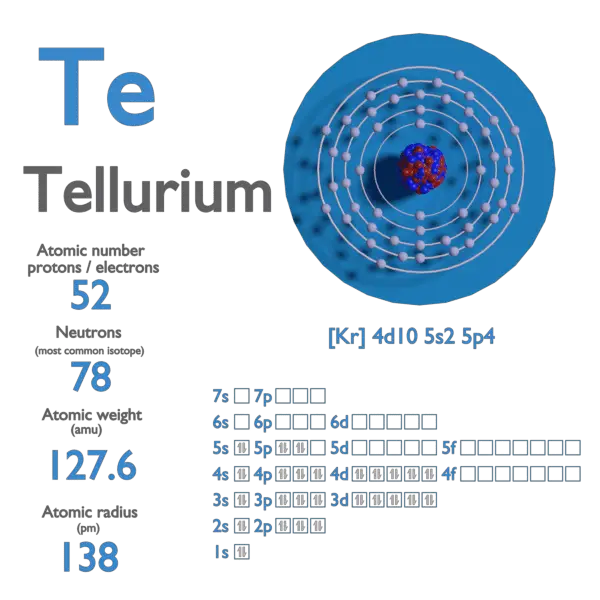
Tellurium is a chemical element with atomic number 52 which means there are 52 protons and 52 electrons in the atomic structure. The chemical symbol for Tellurium is Te.

Since the number of electrons is responsible for the chemical behavior of atoms, the atomic number identifies the various chemical elements.

How does the atomic number determine the chemical behavior of atoms?

Atomic Mass of Tellurium

Atomic mass of Tellurium is 127.6 u. 

Proton Number - Atomic Number - Density of Tellurium
Note that each element may contain more isotopes. Therefore this resulting atomic mass is calculated from naturally-occurring isotopes and their abundance.

The unit of measure for mass is the atomic mass unit (amu). One atomic mass unit is equal to 1.66 x 10⁻²⁴ grams. One unified atomic mass unit is approximately the mass of one nucleon (either a single proton or neutron) and is numerically equivalent to 1 g/mol.

For 12C, the atomic mass is exactly 12u, since the atomic mass unit is defined from it. For other isotopes, the isotopic mass usually differs and is usually within 0.1 u of the mass number. For example, 63Cu (29 protons and 34 neutrons) has a mass number of 63, and an isotopic mass in its nuclear ground state is 62.91367 u.

There are two reasons for the difference between mass number and isotopic mass, known as the mass defect:

  1. The neutron is slightly heavier than the proton. This increases the mass of nuclei with more neutrons than protons relative to the atomic mass unit scale based on 12C with equal numbers of protons and neutrons.
  2. The nuclear binding energy varies between nuclei. A nucleus with greater binding energy has lower total energy, and therefore a lower mass according to Einstein’s mass-energy equivalence relation E = mc2. For 63Cu, the atomic mass is less than 63, so this must be the dominant factor.

The atomic mass number determines especially the atomic mass of atoms. The mass number is different for each different isotope of a chemical element.

How does the atomic mass determine the density of materials?

Density of Tellurium

Density of Tellurium is 6.24g/cm3.
Density - Gas - Liquid - Solid

Typical densities of various substances at atmospheric pressure.

Density is defined as the mass per unit volume. It is an intensive property, which is mathematically defined as mass divided by volume:

ρ = m/V

In other words, the density (ρ) of a substance is the total mass (m) of that substance divided by the total volume (V) occupied by that substance. The standard SI unit is kilograms per cubic meter (kg/m3). The Standard English unit is pounds mass per cubic foot (lbm/ft3).

See also: What is Density

See also: Densest Materials of the Earth

density - chemical elements

Tellurium – Properties Summary

Element Tellurium
Atomic Number 52
Symbol Te
Element Category Metalloids
Phase at STP Solid
Atomic Mass [amu] 127.6
Density at STP [g/cm3] 6.24
Electron Configuration [Kr] 4d10 5s2 5p4
Possible Oxidation States +4,6/-2
Electron Affinity [kJ/mol] 190.2
Electronegativity [Pauling scale] 2.1
1st Ionization Energy [eV] 9.0096
Year of Discovery 1782
Discoverer Müller von Reichenstein, Franz Joseph
Thermal properties
Melting Point [Celsius scale] 449.5
Boiling Point [Celsius scale] 989.8
Thermal Conductivity [W/m K] 3
Specific Heat [J/g K] 0.2
Heat of Fusion [kJ/mol] 17.49
Heat of Vaporization [kJ/mol] 52.55


Tellurium in Periodic Table

Hydro­gen1H He­lium2He
Lith­ium3Li Beryl­lium4Be Boron5B Carbon6C Nitro­gen7N Oxy­gen8O Fluor­ine9F Neon10Ne
So­dium11Na Magne­sium12Mg Alumin­ium13Al Sili­con14Si Phos­phorus15P Sulfur16S Chlor­ine17Cl Argon18Ar
Potas­sium19K Cal­cium20Ca Scan­dium21Sc Tita­nium22Ti Vana­dium23V Chrom­ium24Cr Manga­nese25Mn Iron26Fe Cobalt27Co Nickel28Ni Copper29Cu Zinc30Zn Gallium31Ga Germa­nium32Ge Arsenic33As Sele­nium34Se Bromine35Br Kryp­ton36Kr
Rubid­ium37Rb Stront­ium38Sr Yttrium39Y Zirco­nium40Zr Nio­bium41Nb Molyb­denum42Mo Tech­netium43Tc Ruthe­nium44Ru Rho­dium45Rh Pallad­ium46Pd Silver47Ag Cad­mium48Cd Indium49In Tin50Sn Anti­mony51Sb Tellur­ium52Te Iodine53I Xenon54Xe
Cae­sium55Cs Ba­rium56Ba Lan­thanum57La 1 asterisk Haf­nium72Hf Tanta­lum73Ta Tung­sten74W Rhe­nium75Re Os­mium76Os Iridium77Ir Plat­inum78Pt Gold79Au Mer­cury80Hg Thallium81Tl Lead82Pb Bis­muth83Bi Polo­nium84Po Asta­tine85At Radon86Rn
Fran­cium87Fr Ra­dium88Ra Actin­ium89Ac 1 asterisk Ruther­fordium104Rf Dub­nium105Db Sea­borgium106Sg Bohr­ium107Bh Has­sium108Hs Meit­nerium109Mt Darm­stadtium110Ds Roent­genium111Rg Coper­nicium112Cn Nihon­ium113Nh Flerov­ium114Fl Moscov­ium115Mc Liver­morium116Lv Tenness­ine117Ts Oga­nesson118Og
1 asterisk Cerium58Ce Praseo­dymium59Pr Neo­dymium60Nd Prome­thium61Pm Sama­rium62Sm Europ­ium63Eu Gadolin­ium64Gd Ter­bium65Tb Dyspro­sium66Dy Hol­mium67Ho Erbium68Er Thulium69Tm Ytter­bium70Yb Lute­tium71Lu
1 asterisk Thor­ium90Th Protac­tinium91Pa Ura­nium92U Neptu­nium93Np Pluto­nium94Pu Ameri­cium95Am Curium96Cm Berkel­ium97Bk Califor­nium98Cf Einstei­nium99Es Fer­mium100Fm Mende­levium101Md Nobel­ium102No Lawren­cium103Lr

–
–
–

Indium – Atomic Number – Atomic Mass – Density of Indium

Atomic Number of Indium

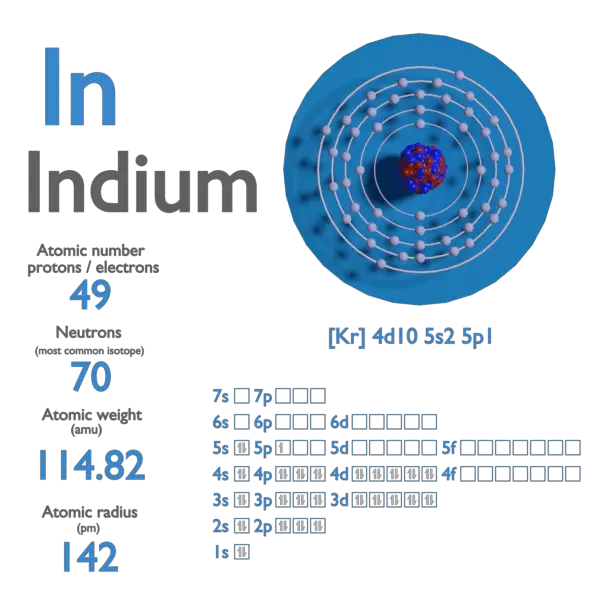
Indium is a chemical element with atomic number 49 which means there are 49 protons and 49 electrons in the atomic structure. The chemical symbol for Indium is In.

Since the number of electrons is responsible for the chemical behavior of atoms, the atomic number identifies the various chemical elements.

How does the atomic number determine the chemical behavior of atoms?

Atomic Mass of Indium

Atomic mass of Indium is 114.818 u. 

Proton Number - Atomic Number - Density of Indium
Note that each element may contain more isotopes. Therefore this resulting atomic mass is calculated from naturally-occurring isotopes and their abundance.

The unit of measure for mass is the atomic mass unit (amu). One atomic mass unit is equal to 1.66 x 10⁻²⁴ grams. One unified atomic mass unit is approximately the mass of one nucleon (either a single proton or neutron) and is numerically equivalent to 1 g/mol.

For 12C, the atomic mass is exactly 12u, since the atomic mass unit is defined from it. For other isotopes, the isotopic mass usually differs and is usually within 0.1 u of the mass number. For example, 63Cu (29 protons and 34 neutrons) has a mass number of 63, and an isotopic mass in its nuclear ground state is 62.91367 u.

There are two reasons for the difference between mass number and isotopic mass, known as the mass defect:

  1. The neutron is slightly heavier than the proton. This increases the mass of nuclei with more neutrons than protons relative to the atomic mass unit scale based on 12C with equal numbers of protons and neutrons.
  2. The nuclear binding energy varies between nuclei. A nucleus with greater binding energy has lower total energy, and therefore a lower mass according to Einstein’s mass-energy equivalence relation E = mc2. For 63Cu, the atomic mass is less than 63, so this must be the dominant factor.

The atomic mass number determines especially the atomic mass of atoms. The mass number is different for each different isotope of a chemical element.

How does the atomic mass determine the density of materials?

Density of Indium

Density of Indium is 7.31g/cm3.
Density - Gas - Liquid - Solid

Typical densities of various substances at atmospheric pressure.

Density is defined as the mass per unit volume. It is an intensive property, which is mathematically defined as mass divided by volume:

ρ = m/V

In other words, the density (ρ) of a substance is the total mass (m) of that substance divided by the total volume (V) occupied by that substance. The standard SI unit is kilograms per cubic meter (kg/m3). The Standard English unit is pounds mass per cubic foot (lbm/ft3).

See also: What is Density

See also: Densest Materials of the Earth

density - chemical elements

Indium – Properties Summary

Element Indium
Atomic Number 49
Symbol In
Element Category Poor Metal
Phase at STP Solid
Atomic Mass [amu] 114.818
Density at STP [g/cm3] 7.31
Electron Configuration [Kr] 4d10 5s2 5p1
Possible Oxidation States +3
Electron Affinity [kJ/mol] 28.9
Electronegativity [Pauling scale] 1.78
1st Ionization Energy [eV] 5.7864
Year of Discovery 1863
Discoverer Reich, Ferdinand & Richter, Hieronymus
Thermal properties
Melting Point [Celsius scale] 156.6
Boiling Point [Celsius scale] 2072
Thermal Conductivity [W/m K] 82
Specific Heat [J/g K] 0.23
Heat of Fusion [kJ/mol] 3.263
Heat of Vaporization [kJ/mol] 231.5


Indium in Periodic Table

Hydro­gen1H He­lium2He
Lith­ium3Li Beryl­lium4Be Boron5B Carbon6C Nitro­gen7N Oxy­gen8O Fluor­ine9F Neon10Ne
So­dium11Na Magne­sium12Mg Alumin­ium13Al Sili­con14Si Phos­phorus15P Sulfur16S Chlor­ine17Cl Argon18Ar
Potas­sium19K Cal­cium20Ca Scan­dium21Sc Tita­nium22Ti Vana­dium23V Chrom­ium24Cr Manga­nese25Mn Iron26Fe Cobalt27Co Nickel28Ni Copper29Cu Zinc30Zn Gallium31Ga Germa­nium32Ge Arsenic33As Sele­nium34Se Bromine35Br Kryp­ton36Kr
Rubid­ium37Rb Stront­ium38Sr Yttrium39Y Zirco­nium40Zr Nio­bium41Nb Molyb­denum42Mo Tech­netium43Tc Ruthe­nium44Ru Rho­dium45Rh Pallad­ium46Pd Silver47Ag Cad­mium48Cd Indium49In Tin50Sn Anti­mony51Sb Tellur­ium52Te Iodine53I Xenon54Xe
Cae­sium55Cs Ba­rium56Ba Lan­thanum57La 1 asterisk Haf­nium72Hf Tanta­lum73Ta Tung­sten74W Rhe­nium75Re Os­mium76Os Iridium77Ir Plat­inum78Pt Gold79Au Mer­cury80Hg Thallium81Tl Lead82Pb Bis­muth83Bi Polo­nium84Po Asta­tine85At Radon86Rn
Fran­cium87Fr Ra­dium88Ra Actin­ium89Ac 1 asterisk Ruther­fordium104Rf Dub­nium105Db Sea­borgium106Sg Bohr­ium107Bh Has­sium108Hs Meit­nerium109Mt Darm­stadtium110Ds Roent­genium111Rg Coper­nicium112Cn Nihon­ium113Nh Flerov­ium114Fl Moscov­ium115Mc Liver­morium116Lv Tenness­ine117Ts Oga­nesson118Og
1 asterisk Cerium58Ce Praseo­dymium59Pr Neo­dymium60Nd Prome­thium61Pm Sama­rium62Sm Europ­ium63Eu Gadolin­ium64Gd Ter­bium65Tb Dyspro­sium66Dy Hol­mium67Ho Erbium68Er Thulium69Tm Ytter­bium70Yb Lute­tium71Lu
1 asterisk Thor­ium90Th Protac­tinium91Pa Ura­nium92U Neptu­nium93Np Pluto­nium94Pu Ameri­cium95Am Curium96Cm Berkel­ium97Bk Califor­nium98Cf Einstei­nium99Es Fer­mium100Fm Mende­levium101Md Nobel­ium102No Lawren­cium103Lr

–
–
–

Tin – Atomic Number – Atomic Mass – Density of Tin

Atomic Number of Tin

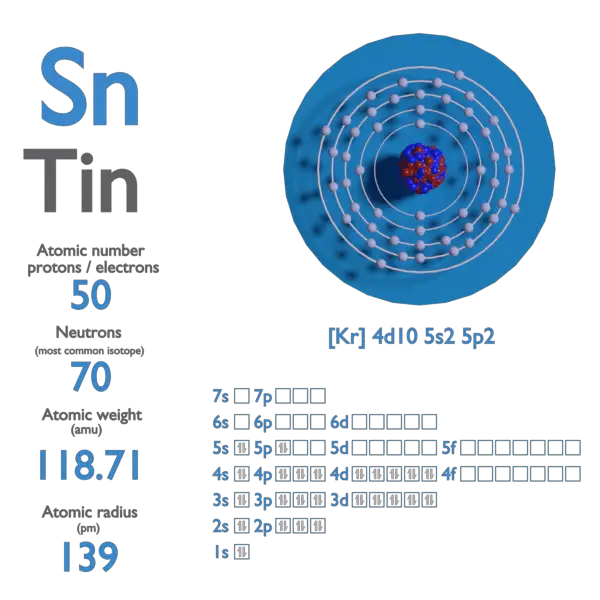
Tin is a chemical element with atomic number 50 which means there are 50 protons and 50 electrons in the atomic structure. The chemical symbol for Tin is Sn.

Since the number of electrons is responsible for the chemical behavior of atoms, the atomic number identifies the various chemical elements.

How does the atomic number determine the chemical behavior of atoms?

Atomic Mass of Tin

Atomic mass of Tin is 118.71 u. 

Proton Number - Atomic Number - Density of Tin
Note that each element may contain more isotopes. Therefore this resulting atomic mass is calculated from naturally-occurring isotopes and their abundance.

The unit of measure for mass is the atomic mass unit (amu). One atomic mass unit is equal to 1.66 x 10⁻²⁴ grams. One unified atomic mass unit is approximately the mass of one nucleon (either a single proton or neutron) and is numerically equivalent to 1 g/mol.

For 12C, the atomic mass is exactly 12u, since the atomic mass unit is defined from it. For other isotopes, the isotopic mass usually differs and is usually within 0.1 u of the mass number. For example, 63Cu (29 protons and 34 neutrons) has a mass number of 63, and an isotopic mass in its nuclear ground state is 62.91367 u.

There are two reasons for the difference between mass number and isotopic mass, known as the mass defect:

  1. The neutron is slightly heavier than the proton. This increases the mass of nuclei with more neutrons than protons relative to the atomic mass unit scale based on 12C with equal numbers of protons and neutrons.
  2. The nuclear binding energy varies between nuclei. A nucleus with greater binding energy has lower total energy, and therefore a lower mass according to Einstein’s mass-energy equivalence relation E = mc2. For 63Cu, the atomic mass is less than 63, so this must be the dominant factor.

The atomic mass number determines especially the atomic mass of atoms. The mass number is different for each different isotope of a chemical element.

How does the atomic mass determine the density of materials?

Density of Tin

Density of Tin is 7.31g/cm3.
Density - Gas - Liquid - Solid

Typical densities of various substances at atmospheric pressure.

Density is defined as the mass per unit volume. It is an intensive property, which is mathematically defined as mass divided by volume:

ρ = m/V

In other words, the density (ρ) of a substance is the total mass (m) of that substance divided by the total volume (V) occupied by that substance. The standard SI unit is kilograms per cubic meter (kg/m3). The Standard English unit is pounds mass per cubic foot (lbm/ft3).

See also: What is Density

See also: Densest Materials of the Earth

density - chemical elements

Tin – Properties Summary

Element Tin
Atomic Number 50
Symbol Sn
Element Category Poor Metal
Phase at STP Solid
Atomic Mass [amu] 118.71
Density at STP [g/cm3] 7.31
Electron Configuration [Kr] 4d10 5s2 5p2
Possible Oxidation States +2,4
Electron Affinity [kJ/mol] 107.3
Electronegativity [Pauling scale] 1.96
1st Ionization Energy [eV] 7.3438
Year of Discovery unknown
Discoverer unknown
Thermal properties
Melting Point [Celsius scale] 231.93
Boiling Point [Celsius scale] 2602
Thermal Conductivity [W/m K] 67
Specific Heat [J/g K] 0.227
Heat of Fusion [kJ/mol] 7.029
Heat of Vaporization [kJ/mol] 295.8


Tin in Periodic Table

Hydro­gen1H He­lium2He
Lith­ium3Li Beryl­lium4Be Boron5B Carbon6C Nitro­gen7N Oxy­gen8O Fluor­ine9F Neon10Ne
So­dium11Na Magne­sium12Mg Alumin­ium13Al Sili­con14Si Phos­phorus15P Sulfur16S Chlor­ine17Cl Argon18Ar
Potas­sium19K Cal­cium20Ca Scan­dium21Sc Tita­nium22Ti Vana­dium23V Chrom­ium24Cr Manga­nese25Mn Iron26Fe Cobalt27Co Nickel28Ni Copper29Cu Zinc30Zn Gallium31Ga Germa­nium32Ge Arsenic33As Sele­nium34Se Bromine35Br Kryp­ton36Kr
Rubid­ium37Rb Stront­ium38Sr Yttrium39Y Zirco­nium40Zr Nio­bium41Nb Molyb­denum42Mo Tech­netium43Tc Ruthe­nium44Ru Rho­dium45Rh Pallad­ium46Pd Silver47Ag Cad­mium48Cd Indium49In Tin50Sn Anti­mony51Sb Tellur­ium52Te Iodine53I Xenon54Xe
Cae­sium55Cs Ba­rium56Ba Lan­thanum57La 1 asterisk Haf­nium72Hf Tanta­lum73Ta Tung­sten74W Rhe­nium75Re Os­mium76Os Iridium77Ir Plat­inum78Pt Gold79Au Mer­cury80Hg Thallium81Tl Lead82Pb Bis­muth83Bi Polo­nium84Po Asta­tine85At Radon86Rn
Fran­cium87Fr Ra­dium88Ra Actin­ium89Ac 1 asterisk Ruther­fordium104Rf Dub­nium105Db Sea­borgium106Sg Bohr­ium107Bh Has­sium108Hs Meit­nerium109Mt Darm­stadtium110Ds Roent­genium111Rg Coper­nicium112Cn Nihon­ium113Nh Flerov­ium114Fl Moscov­ium115Mc Liver­morium116Lv Tenness­ine117Ts Oga­nesson118Og
1 asterisk Cerium58Ce Praseo­dymium59Pr Neo­dymium60Nd Prome­thium61Pm Sama­rium62Sm Europ­ium63Eu Gadolin­ium64Gd Ter­bium65Tb Dyspro­sium66Dy Hol­mium67Ho Erbium68Er Thulium69Tm Ytter­bium70Yb Lute­tium71Lu
1 asterisk Thor­ium90Th Protac­tinium91Pa Ura­nium92U Neptu­nium93Np Pluto­nium94Pu Ameri­cium95Am Curium96Cm Berkel­ium97Bk Califor­nium98Cf Einstei­nium99Es Fer­mium100Fm Mende­levium101Md Nobel­ium102No Lawren­cium103Lr

–
–
–